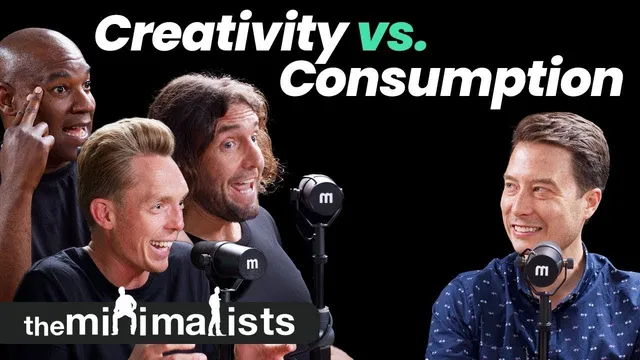
The Minimalists: Creating More with Less
Based on Tiago Forte's video on YouTube. If you like this content, support the original creators by watching, liking and subscribing to their content.
Digital clutter becomes clutter when it blocks attention from priorities, not when it’s inherently immoral or “bad.”
Briefing
The conversation ties physical minimalism to digital life by arguing that clutter—whether in a home, a calendar, or a phone—ultimately blocks attention from what matters. The core overlap between the Minimalists and Tiago Forte’s “second brain” approach is that both aim to clear space: not just for fewer possessions or fewer apps, but for clearer thinking, calmer relationships, and more intentional creation.
A striking throughline is the scale of digital consumption. One participant cites research that the average American spends about 12 hours per day on digital devices consuming media. That constant feed functions like “digital consumerism,” where information, entertainment, and even social connection become endless inputs. The danger isn’t that content exists—it’s that the environment is infinite, so there’s no natural stopping point like the walls of a house. Pleasure spikes from scrolling or bingeing get mistaken for lasting contentment, while algorithms and advertisers compete for attention using psychological triggers.
Against that backdrop, the group frames minimalism as a set of adjustable boundaries rather than deprivation. A key question—how life improves with less meaning, not less stuff—reappears across both worlds. Physical clutter is treated as an outward signal of internal chaos: clearing a room doesn’t “fix” a life, but it can create the conditions to notice mental, emotional, and informational clutter. Digital clutter follows the same logic. If time on a device crowds out priorities, it becomes clutter; if it supports a purpose, it becomes freedom.
Practical systems get treated as tools for protecting attention, not as solutions in themselves. One participant rejects to-do lists as “anxiety lists,” preferring a “today” list and a “someday” list that can be revisited later—often revealing that what felt urgent was never truly compelling. Another describes a morning routine built around Google Calendar and a blank Google Doc, then a short “oratory” meditation before checking tweets, texts, or messages to avoid reactive behavior. The “no” philosophy shows up as well: saying yes only to a “hell yes” commitment and using everything else as fuel only when it directly supports the work.
The discussion also emphasizes time-shifting and friction. Content is saved for specific moments rather than consumed impulsively, and social media boundaries are enforced through iPhone screen-time controls, app shutdowns, timers, and shared “watch together” sessions that end when the timer rings. Rules like “spontaneous combustion” (delete items/tabs that no longer feel worth replacing) and “just in case” (replace what’s truly needed for under $20 and under 20 minutes) translate minimalism into digital habits like closing tabs and clearing reading queues.
Finally, the group argues that large creative projects can be both purposeful and playful when direction is clear but outcomes remain flexible. Instead of rigid goal-setting, they describe “traveling in a direction”—creating quality work first, then letting distribution and mediums (books, podcasts, films, YouTube, even tweets) emerge as value pathways. The result is a unified message: structure makes freedom possible, and the right boundaries—physical or digital—protect the attention required to create a life that feels intentional.
Cornell Notes
The Minimalists and Tiago Forte connect physical and digital minimalism through one shared goal: clearing clutter so attention can serve real priorities. Digital life is treated as a new environment for consumerism and anxiety, amplified by infinite feeds and algorithmic persuasion. Instead of chasing perfect tools, participants emphasize boundaries—like “today vs. someday” lists, pre-work routines that delay message checking, and rules that delete tabs or content that no longer feels compelling. Social media is managed with friction (timers, screen-time limits, and intentional “together” sessions). For big creative endeavors, they recommend traveling in a direction—creating quality first while staying open to emergent outcomes across multiple mediums.
How do physical clutter and digital clutter relate in their framework?
What boundary systems are used to prevent reactive digital behavior?
Why does “saying no” show up as a core productivity principle?
How do they manage addictive or low-value social media consumption?
What do “spontaneous combustion” and “just in case” rules add to minimalism?
How do they reconcile long-term creative direction with flexibility and play?
Review Questions
- What functional definition of clutter do they use, and how does it apply to both a messy home and a crowded digital feed?
- Compare the “today/someday” system with the “no/hell yes” approach: what problem each one is designed to solve?
- Which rules (e.g., spontaneous combustion, just in case, timers/screen-time) create friction, and how does friction protect attention over time?
Key Points
- 1
Digital clutter becomes clutter when it blocks attention from priorities, not when it’s inherently immoral or “bad.”
- 2
Infinite feeds and algorithmic persuasion make stopping harder online than in physical spaces, so boundaries matter more than ever.
- 3
Minimalism is framed as adjustable boundaries that preserve freedom and play, not as strict deprivation or a fixed lifestyle template.
- 4
Attention protection is built into routines: delay message checking, plan the day before scrolling, and use meditation or “oratory” time to prevent reactive behavior.
- 5
Saying “no” is treated as a commitment strategy: reserve attention for a true “hell yes” and treat most other inputs as optional or supportive only when directly relevant.
- 6
Time-shifting reduces impulsive consumption: save content for selected moments and revisit saved items later to see whether they still feel compelling.
- 7
Large creative work benefits from “direction without rigid goals,” letting distribution and mediums emerge while keeping quality creation as the anchor.