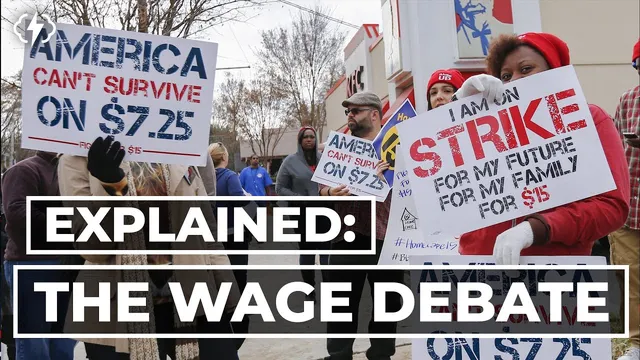
The Minimum Wage Debate Explained
Based on Second Thought's video on YouTube. If you like this content, support the original creators by watching, liking and subscribing to their content.
Inflation-adjusted comparisons show the minimum wage’s real value has fallen dramatically since the 1960s, with the 1966 $1.60 level equating to nearly $13 today.
Briefing
The minimum wage debate in the U.S. is less about whether wages should rise and more about whether workers are allowed to keep up with inflation and productivity—an issue that has quietly turned into a proxy fight over class power. Federal minimum wage rules began in 1938 with the Fair Labor Standards Act, and the 1966 amendment raised the federal floor to $1.60 an hour. But when today’s minimum wage is adjusted for inflation, the real value of that pay has fallen sharply; the 1966 peak would be nearly $13 an hour in today’s dollars, roughly double the current $7.25 level.
That gap matters because many arguments for keeping wages low rely on the idea that minimum-wage jobs are temporary “starter” work—held by students, retirees, or people living with family. The transcript challenges that framing, arguing it effectively normalizes poverty wages. It cites claims from multiple studies that no county in the U.S. allows a minimum-wage worker to afford even a one-bedroom apartment, and it argues that if the minimum wage had tracked inflation and productivity gains since 1968, it would be over $24 per hour. The core political tension, then, is that raising the wage would shift bargaining power away from employers who benefit from stagnant pay.
Common objections are addressed with a mix of historical evidence and comparisons. On housing costs, the transcript points out that the federal minimum wage hasn’t been raised since 2009, while average rents rose about 40% from 2010 to 2020—suggesting housing prices climbed without any wage-floor increase. It also contrasts the U.S. with Denmark, where fast-food workers reportedly start around $22 an hour and receive benefits like paid vacation, life insurance, paid maternity leave, and a pension; the claim is that a Big Mac costs only about 27 cents more than in America, undermining the idea that higher wages automatically translate into runaway prices.
On the fear that companies will shut down, the transcript leans on a study tied to the 1966 minimum wage increase, reporting that earnings rose across affected industries, the racial wealth gap narrowed, and there was no adverse employment effect—implying businesses could afford the change even if they didn’t want it. It then argues that today’s corporate landscape is even more capable of absorbing wage increases, pointing to highly profitable employers that employ minimum-wage workers.
The discussion also reframes the “small business can’t afford it” argument as a moral and economic problem: if a business can’t pay a living wage, it’s effectively built on exploitation. To reduce disruption, it proposes more frequent, incremental increases tied to inflation and economic indicators—citing countries like France and Australia as examples where minimum wages are recalculated more regularly.
Finally, the transcript broadens the debate into a critique of American individualism and class consciousness. It argues that wage fights divide workers—such as higher-paid workers blaming minimum-wage workers—while the real conflict is between workers and an owner class that profits from low wages. The minimum wage, in this framing, becomes a stand-in for whether the U.S. prioritizes survival-of-the-fittest labor politics or a society where working people can live with dignity.
Cornell Notes
The transcript argues that the federal minimum wage has lost most of its real value because inflation has erased gains since the 1960s, making today’s $7.25 far below what workers need to live. It claims that minimum-wage jobs are not a sufficient justification for poverty pay, citing studies that say minimum-wage earners can’t afford basic housing like a one-bedroom apartment. It counters common objections by pointing to rent increases occurring without minimum-wage hikes and to research from the 1966 increase showing earnings rose without harming employment. The broader message is that the minimum wage debate reflects class power: workers’ wages versus the profits of the owner class.
How does the transcript measure the minimum wage’s decline over time?
Why does the transcript reject the idea that minimum wage jobs are “just for students” or “not meant to be livable”?
What evidence is used to challenge the claim that raising the minimum wage will raise housing prices?
How does the transcript respond to the argument that higher minimum wages will destroy jobs or force businesses to close?
What alternative policy approach does the transcript propose to address business concerns?
What does the transcript say the minimum wage debate is really about beyond wages?
Review Questions
- What does the transcript claim is the inflation-adjusted value of the 1966 federal minimum wage, and how does that compare to today’s $7.25?
- Which two objections to raising the minimum wage does the transcript address with rent-timing evidence and with the 1966-related study findings?
- How does the transcript connect minimum wage policy to broader ideas about class struggle and worker solidarity?
Key Points
- 1
Inflation-adjusted comparisons show the minimum wage’s real value has fallen dramatically since the 1960s, with the 1966 $1.60 level equating to nearly $13 today.
- 2
The transcript argues that treating minimum wage work as “not meant to be livable” effectively normalizes poverty pay, including claims that minimum-wage earners can’t afford basic housing.
- 3
Rent increases are presented as occurring without minimum wage increases since 2009, undermining the claim that wage hikes are the main driver of housing costs.
- 4
A study tied to the 1966 Fair Labor Standards Act amendment is cited for reporting higher earnings and no adverse employment effects.
- 5
The “small business can’t afford it” argument is reframed as a question of whether a business model can ethically support a living wage.
- 6
To reduce disruption, the transcript proposes more frequent minimum wage adjustments tied to inflation and economic indicators rather than infrequent political jumps.
- 7
The minimum wage debate is portrayed as a proxy for class power, with worker-to-worker conflict benefiting employers who profit from low wages.