The Moon's Orbit is WEIRD
Based on minutephysics's video on YouTube. If you like this content, support the original creators by watching, liking and subscribing to their content.
The Moon’s Sun-centered trajectory doesn’t spiral outward toward Earth; it stays nearly circular with small perturbations because the Sun’s pull dominates the net inward acceleration.
Briefing
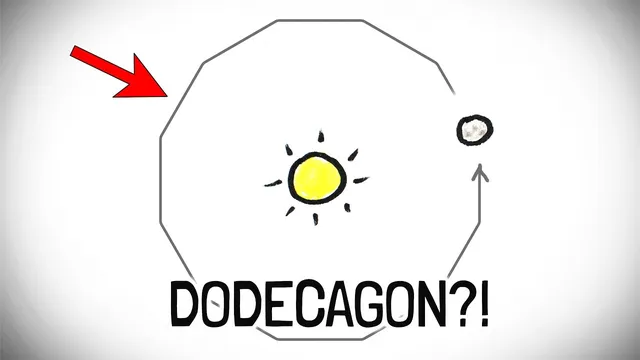
The Moon’s path isn’t the spiral people often picture. From Earth, it looks like the Moon orbits our planet, but the geometry of the combined Earth–Moon–Sun system makes the Moon’s trajectory around the Sun behave more like a nearly closed, 12-sided polygon with rounded corners—never curving outward toward Earth. In other words, the net “pull” direction stays inward toward the Sun, so the Moon’s overall track doesn’t develop the outward looping shape a simple spiral intuition would suggest.
A key reason is how gravity and distance compete. At the Moon’s location, the Sun’s gravitational pull on the Moon is almost twice the Earth’s. That means the Moon experiences a net force that always points toward the Sun, so there’s no sustained inward-then-outward force pattern that would bend the trajectory away from the Sun and toward Earth. In orbital mechanics language, the Moon sits outside Earth’s “Chebotarev radius,” where the Earth and Sun’s influences would be comparable; outside it, the Sun dominates the direction of the net acceleration. The result is a trajectory that stays close to circular, with only small perturbations from Earth.
However, the story changes slightly depending on which reference frame is used. Because the Earth and Moon both move around the Sun, centrifugal effects matter. When those are included, the Earth’s gravity becomes effectively stronger in the Earth-centered rotating frame. The Moon lies inside Earth’s “Hill radius,” the region where objects that move with the Earth can remain gravitationally bound despite the Sun’s pull. Under that criterion, the Moon behaves like an Earth-orbiting body.
This is why the Moon sits on a boundary between two descriptions: “satellite” versus “independently orbiting the Sun.” Strictly speaking, both Earth and Moon orbit their common center of mass, which lies inside Earth. That makes it reasonable to call the Moon a satellite, but only barely in a dynamical sense. If the Moon were about 40% farther away (or about 40% more massive), the center of mass would move outside Earth, making the system resemble a double planet rather than a planet–satellite pair. Even then, the overall shape of the Moon’s Sun-centered trajectory would barely change.
The broader takeaway is that orbit classification can be slippery. Trajectory shapes can mislead: a point on Earth’s surface doesn’t trace loops as Earth travels around the Sun, producing a wobbly path instead—yet it would be wrong to conclude that each point independently “orbits the Sun.” The Moon’s case is similar. From one viewpoint it’s an Earth satellite; from another it’s a Sun-dominated object with Earth-induced perturbations. Both descriptions can be true, but only when the reference frame and the governing criteria—Chebotarev radius versus Hill radius—are handled correctly.
Cornell Notes
The Moon’s motion looks like an Earth orbit from our viewpoint, but its Sun-centered trajectory doesn’t spiral outward toward Earth. Gravity at the Moon’s distance makes the Sun’s pull on the Moon almost twice the Earth’s, so the net acceleration points inward toward the Sun and prevents outward-curving loops. In a rotating Earth-centered frame, centrifugal effects shift the balance: the Moon lies inside Earth’s Hill radius, where Earth’s gravity dominates enough for the Moon to remain effectively bound to Earth. The Moon therefore sits near the boundary between “satellite” and “independent Sun orbit,” and small changes in distance or mass could turn the system into something closer to a double planet without dramatically altering the Sun-centered trajectory shape.
Why doesn’t the Moon’s Sun-centered trajectory spiral outward toward Earth?
How can the Moon still be considered an Earth-orbiting satellite if the Sun’s pull is stronger?
What does the “epitrochoid” analogy add to the explanation?
What changes would be required for the Moon’s trajectory to start wobbling or spiraling outward?
Why is the satellite-vs-independent-orbit distinction described as tricky?
How can trajectory shapes mislead people when thinking about orbits?
Review Questions
- What physical criterion separates the “Sun-dominated net force” regime from the “Earth-dominated bound motion” regime, and where does the Moon fall relative to each?
- How do centrifugal effects change the conclusion about whether the Moon is effectively bound to Earth?
- If the Moon’s distance from Earth increased by about 40%, what would happen to the Earth–Moon center of mass, and why wouldn’t the Sun-centered trajectory necessarily look dramatically different?
Key Points
- 1
The Moon’s Sun-centered trajectory doesn’t spiral outward toward Earth; it stays nearly circular with small perturbations because the Sun’s pull dominates the net inward acceleration.
- 2
At the Moon’s distance, the Sun’s gravitational force on the Moon is almost twice Earth’s, placing the Moon outside Earth’s Chebotarev radius.
- 3
In the Earth-centered rotating frame, centrifugal effects weaken the Sun’s relative influence, and the Moon lies inside Earth’s Hill radius.
- 4
Orbit classification depends on the chosen frame and criterion: “satellite” versus “independent Sun orbit” can both be defensible from different viewpoints.
- 5
The Earth–Moon system orbits their common center of mass, which lies inside Earth under current conditions, but could move outside with ~40% changes in distance or mass.
- 6
Trajectory shapes can mislead because they depend on reference-frame motion; apparent loops or lack of loops don’t automatically imply independent orbital behavior.