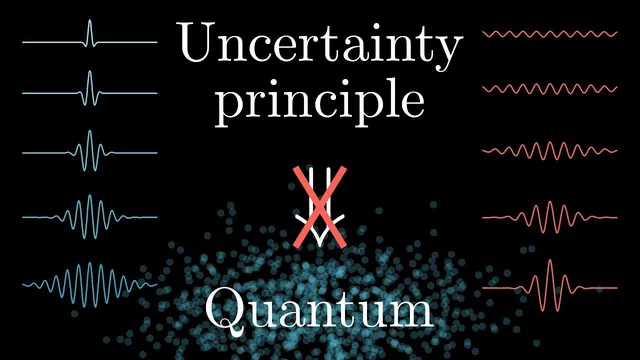
The more general uncertainty principle, regarding Fourier transforms
Based on 3Blue1Brown's video on YouTube. If you like this content, support the original creators by watching, liking and subscribing to their content.
Fourier transforms quantify how strongly a signal correlates with candidate pure frequencies, and the width of the transform peak reflects how quickly correlation fails as the candidate frequency shifts.
Briefing
Heisenberg’s uncertainty principle isn’t a one-off quantum oddity so much as a specific instance of a broader Fourier trade-off: signals that are tightly localized in one domain (time or space) must spread out in the conjugate domain (frequency or momentum). The key insight is that Fourier transforms quantify how strongly a signal correlates with different pure frequencies, and that “how long you observe” sets how sharply you can pin down “which frequency you have.” That same logic then reappears in radar and, with de Broglie’s matter-wave hypothesis, in quantum mechanics—where momentum becomes tied to spatial frequency.
The argument starts with an everyday intuition. If turn signals flash in sync for only a few seconds, there’s limited confidence about whether their frequencies truly match; a longer observation—say a full minute—lets the signals “balance out” only if the frequencies really are the same. Musical notes sharpen the same point: a short clap or shockwave can’t be assigned a single precise pitch, because a brief event correlates with a wide range of frequencies. In Fourier language, a short signal has a Fourier transform spread across many frequencies, while a narrow frequency correlation requires a longer duration.
To make that precise, the discussion revisits the Fourier transform as a kind of “winding” operation. A signal is wrapped around a circle by a rotating vector whose rotation rate is the candidate frequency. When the rotation rate matches the signal’s dominant frequency, the peaks and valleys line up and the “center of mass” of the wound-up graph shifts strongly away from the origin; the Fourier transform’s magnitude peaks there. Crucially, the width of that peak reflects how quickly the signal stops correlating as the candidate frequency drifts. A long-lasting signal keeps correlating only in a tight band, producing a sharp Fourier peak; a short-lived signal needs a larger frequency mismatch before it decorrelates, producing a broader peak. This is the uncertainty principle in Fourier form: time concentration forces frequency spread, and frequency concentration forces time spread.
That trade-off becomes tangible in Doppler radar. A transmitted pulse returns as an echo whose time structure reveals distance, while Doppler shifts in frequency reveal velocity. But separating multiple targets forces a dilemma. Long pulses improve time localization only up to the point where echoes overlap in time; shortening the pulse reduces time overlap but broadens its Fourier spectrum. With many objects moving at different speeds, those Doppler-shifted spectra then overlap in frequency space, making velocities harder to disentangle. Crisp separation in both time and frequency space can’t happen simultaneously.
Quantum mechanics enters by treating particles as waves. Louis de Broglie proposed that matter has wave-like properties and that a particle’s momentum is proportional to the wave’s spatial frequency. If a particle is represented as a localized wave packet in space, then its Fourier transform over space determines the distribution of spatial frequencies—and therefore momenta. A sharply localized particle wave packet implies a spread-out momentum distribution, not because measurements are clumsy, but because the particle’s wave nature enforces the same Fourier trade-off. The result reframes “uncertainty” as an unsharpness relation: concentration in position corresponds to higher probability near that location, while the associated Fourier spread limits how narrowly momentum can be predicted. The fascination, in the end, is structural: position and momentum mirror the sound-and-frequency relationship, as if momentum were the “sheet music” for how a particle moves through space.
Cornell Notes
The uncertainty principle emerges from a general Fourier trade-off: localization in one domain forces spread in the conjugate domain. A short signal in time correlates with a wide range of frequencies, while a narrow frequency correlation requires a longer duration. Fourier transforms quantify this by measuring how well a signal matches a candidate pure frequency via a “winding”/center-of-mass construction; the peak’s width reflects how quickly correlation drops as the candidate frequency shifts. Doppler radar shows the same tension between time resolution (distance) and frequency resolution (velocity). De Broglie’s matter-wave idea then maps momentum to spatial frequency, so a localized particle wave packet must have a spread of momenta—an unsharpness built into the wave description, not merely a measurement limitation.
Why does observing a flashing signal for a shorter time make frequency harder to pin down?
How does the Fourier transform’s “peak width” relate to uncertainty?
What dilemma does Doppler radar face when trying to measure distance and velocity for multiple objects?
How does de Broglie connect momentum to spatial frequency?
Why is the position–momentum spread treated as fundamental rather than a measurement artifact?
Review Questions
- In Fourier terms, what changes in the transform when a signal becomes shorter in time, and why does that happen?
- How does the radar example map “time resolution” to “distance” and “frequency resolution” to “velocity,” and where does the trade-off show up?
- What does it mean to treat momentum as spatial frequency, and how does that force a link between position localization and momentum spread?
Key Points
- 1
Fourier transforms quantify how strongly a signal correlates with candidate pure frequencies, and the width of the transform peak reflects how quickly correlation fails as the candidate frequency shifts.
- 2
Short time localization forces frequency spread: a brief event correlates with many nearby frequencies, producing a broad Fourier spectrum.
- 3
Long time localization forces frequency concentration: a sustained signal cancels out under small frequency mismatches, producing a sharp Fourier peak.
- 4
Doppler radar faces a practical version of the same trade-off: shortening pulses reduces time overlap but broadens spectra, making Doppler-shifted velocities harder to separate.
- 5
In de Broglie’s matter-wave picture, momentum is proportional to spatial frequency, so a localized particle wave packet implies a spread of momenta.
- 6
“Uncertainty” is reframed as unsharpness: probability of finding a particle near a location follows the wave amplitude, while the associated Fourier spread limits how narrowly momentum can be predicted.