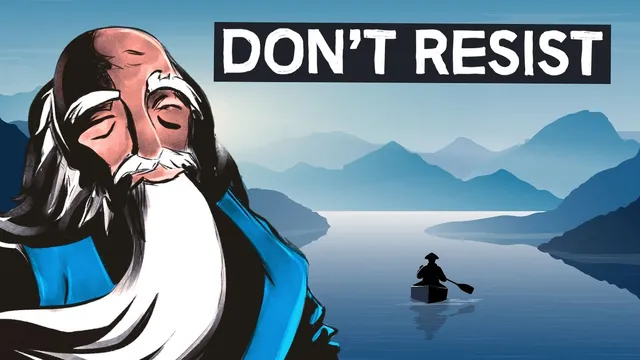
The More You Resist, The Worse It Gets | The Taoist Art of Non-Resistance
Based on Einzelgänger's video on YouTube. If you like this content, support the original creators by watching, liking and subscribing to their content.
Taoism treats resistance as rigidity that conflicts with life’s natural flux, often turning change into unnecessary suffering.
Briefing
Non-resistance in Taoism is presented as a practical way to reduce suffering: resisting the natural flow of life often wastes energy, intensifies stress, and can even damage physical and emotional health. The core claim is that life is in constant flux—events unfold through interdependence and cause-and-effect—and people suffer most when they try to control outcomes that cannot be controlled. Taoist sages link resistance with hardness and rigidity, while praising yielding and acceptance as more effective, even when injustice, danger, or hardship appear unavoidable.
The argument begins with a contrast that frames the whole worldview: water is soft and yielding yet overcomes the hard and rigid. In Western culture, a “hard stance” is treated as strength, but Taoism treats rigidity as a potential weakness. A brittle, dry plant illustrates the point—its inflexibility leads to collapse, while softness and flexibility endure. From there, the discussion ties non-resistance to wu wei, often described as “effortless action”: acting without striving against reality’s current. The message isn’t that people should do nothing; it’s that they should intervene skillfully where influence is possible, while dropping the attempt to force the world to match expectations.
That distinction matters because resistance is portrayed as both futile and counterproductive. The transcript emphasizes the energy spent trying to prevent the inevitable, the frustration when change arrives anyway, and the emotional toll of fighting what must happen. A quotation attributed to Liezi captures the pattern: people try too hard to make things happen or not happen, then discover their effort produces the opposite effect. Lao Tzu’s line reinforces the same principle—mastery comes from letting things take their natural course rather than trying to control the natural way.
Several everyday scenarios show how non-resistance works in practice. When adversity strikes—poverty, illness, death, or simply plans going wrong—the problem isn’t change itself but the attitude of clinging and resentment. A story about an old man encountered by Confucius depicts happiness rooted in acceptance: he doesn’t care whether he is rich or poor and treats birth and death as the natural order. The transcript adds that Taoism still allows goals and healthy habits; the key is pursuing improvement without forcing outcomes or resisting what lies beyond reach.
The second scenario targets conflict with other people. Instead of escalating hardness with hardness, the transcript points to a Tao Te Ching line: what offers no resistance overcomes the hardest substances. The suggested approach starts with accepting what can’t be controlled—other people’s opinions—and then using non-resistance as a channel for change through listening, empathy, and finding common ground.
The third scenario addresses global events and existential anxiety, including war and disaster. A Liezi story features a sage who initially agrees that catastrophe is possible but then redirects the anxious man: if the world won’t perish, worry is unnecessary; if it will, worry can’t change it. The transcript also recounts a personal anecdote—an exchange about nuclear risk—used to illustrate the relief that comes from recognizing limits on control.
Finally, the transcript brings in an academic paper by Cheryl L. Chrisman, framing resistance as a cause of “Qi stagnation” in Traditional Chinese Medicine. When Qi stagnates, balance is disrupted—especially in the heart and liver—leading to emotional and physical ailments such as fatigue and asthma attacks. The proposed remedy is to “be like water,” yielding to what passes through while returning unharmed—an approach applied to pain and emotions. By letting experiences flow without adding the extra layer of fighting, the transcript argues, calm and balance return, making clearer action possible. Non-resistance is therefore pitched as an adaptive, not passive, strategy: letting go, adjusting, and flowing with life rather than clenching against it.
Cornell Notes
Taoism’s non-resistance (linked to wu wei) is presented as a way to cut suffering by stopping the reflex to fight life’s natural flow. Because the world is in constant flux and outcomes are interdependent, resistance is often futile—and it can worsen stress, exhaustion, and disappointment. The transcript uses examples: accepting hardship instead of resenting change, de-escalating conflicts with other people by listening and showing empathy, and reducing anxiety about global events by recognizing what can’t be controlled. It also connects the idea to Traditional Chinese Medicine via Cheryl L. Chrisman’s work, claiming resistance can contribute to Qi stagnation and related emotional and physical problems. “Being like water” is offered as the practical method: yield to what arises, let it pass, and return to balance unharmed.
Why does Taoism treat resistance as a source of suffering rather than a path to improvement?
How does non-resistance apply to personal hardship like poverty, illness, or death?
What does non-resistance look like in conflicts with other people?
How does Taoism advise handling anxiety about global events like war or disaster?
What does “being like water” mean as a practical technique for pain and emotions?
How does Traditional Chinese Medicine connect resistance to health problems?
Review Questions
- Which kinds of suffering does the transcript attribute to resistance: the event itself, the attitude toward the event, or both? Explain with one example.
- In the transcript’s framework, when is intervention appropriate under non-resistance, and when does it become futile?
- How does the “water” metaphor change the way someone should respond to pain or anger?
Key Points
- 1
Taoism treats resistance as rigidity that conflicts with life’s natural flux, often turning change into unnecessary suffering.
- 2
Non-resistance is tied to wu wei: act skillfully without forcing outcomes or fighting reality’s current.
- 3
Resistance is described as both futile and costly, because it cannot stop what must happen and adds stress and exhaustion.
- 4
Non-resistance doesn’t require passivity; it supports goals and healthy habits while avoiding control attempts over what lies beyond influence.
- 5
Conflicts with other people can be approached by accepting what can’t be controlled and using listening, empathy, and common ground to enable change.
- 6
Anxiety about global events is addressed by separating what can be influenced from what cannot, using the logic that worry can’t alter outcomes.
- 7
Traditional Chinese Medicine is used to frame resistance as a contributor to Qi stagnation, linking mental struggle to physical symptoms.