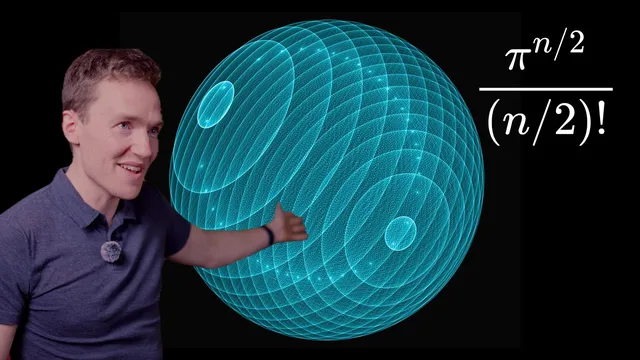
The most beautiful formula not enough people understand
Based on 3Blue1Brown's video on YouTube. If you like this content, support the original creators by watching, liking and subscribing to their content.
The probability that random coordinates satisfy X_1^2+…+X_n^2 ≤ 1 equals the fraction of an n-dimensional cube occupied by the unit n-ball.
Briefing
A single geometric idea—how the “surface area” of a higher-dimensional ball relates to the “volume” inside it—leads to a closed-form formula for the volume of an n-dimensional sphere, and it also explains why those volumes collapse in high dimensions. The result is the constant that mathematicians write as π^{n/2} divided by Γ(n/2+1), which for integer n can be expressed using factorials and half-factorials. Beyond the elegance, the numbers behave counterintuitively: the unit ball’s volume grows up to dimension five, then shrinks rapidly, becoming essentially zero by dimension 100.
The path to that formula starts with a probability puzzle: pick X, Y, … uniformly from −1 to 1, and ask for the probability that X^2+Y^2+… ≤ 1. That probability is exactly the fraction of a hypercube’s volume occupied by a unit ball in the corresponding dimension. In 2D this becomes the area of a unit circle over a 2×2 square (π/4). In 3D it becomes the volume of a unit sphere over a 2×2×2 cube (about 1/2). Extending the same logic forces the question into high-dimensional geometry: the “volume of a unit ball” is the key quantity.
A second warm-up warns against naive intuition. Place unit circles at the corners of a square, then find the largest circle tangent to all of them; the answer is √2−1. Repeat in 3D with unit spheres at the corners of a cube; the inner radius becomes √3−1. Generalizing to n dimensions gives √n−1, but when compared to a bounding hypercube, the inner sphere can actually poke outside the box in high dimensions. The culprit isn’t that spheres become spiky—they remain perfectly round by definition—but that cubes’ corners run away faster than their edges as dimension increases.
With that caution in mind, the lecture builds a “volume chart” across dimensions using calculus-like relationships: increasing a radius by a tiny amount changes volume in proportion to the boundary’s “surface measure,” while integrating boundary contributions reconstructs volume. The crucial step is a higher-dimensional version of an Archimedean trick for sphere surface area: project small surface patches onto a cylinder so stretching and squashing cancel, making area computation reduce to an easy product. The same “knight’s move” idea generalizes: the boundary of an n-dimensional ball can be treated (for volume calculations) as an (n−1)-dimensional interior measure times an appropriate angular factor, leading to a recurrence for the unit-ball volume.
From that recurrence, the constants emerge and the closed form follows. Plugging in values reveals the turning point: unit-ball volume increases from 0D through 5D, then decreases for 6D and beyond. The reason is structural: each two-dimensional step multiplies by 2π but also divides by the growing dimension through the integration factor. Eventually the denominator wins, and the volume becomes astronomically small. In 100 dimensions, the unit-ball volume is about 2.37×10^−40, matching the probability that 100 random coordinates land inside the “sum of squares ≤ 1” region.
The lecture closes by interpreting what “tiny” means geometrically and probabilistically: in high dimensions, almost all of a cube’s volume lies far from the center, so the unit ball occupies a negligible fraction. Related phenomena—like volume concentrating near the boundary and surface area concentrating near the equator—show up across machine learning, cryptography, and quantum mechanics, all tracing back to the same high-dimensional geometry.
Cornell Notes
The volume of an n-dimensional unit ball can be derived from a geometric recurrence built on how boundary “surface area” controls how volume grows with radius. A higher-dimensional adaptation of Archimedes’ projection idea yields a “knight’s move” rule: moving up two dimensions multiplies by 2π, while integrating to recover interior volume divides by the dimension. Solving the recurrence gives the closed form V_n = π^{n/2}/(n/2)! for even n, with half-factorials (equivalently Γ-functions) handling odd n. Numerically, V_n rises until dimension five, then collapses toward zero—so the probability that many random coordinates satisfy x_1^2+…+x_n^2 ≤ 1 becomes essentially zero in large n. This explains why high-dimensional balls are “puny” in applications.
Why does a probability about random squares turn into a hyper-sphere volume problem?
What does the “inner sphere tangent to corner spheres” puzzle teach about high dimensions?
How does the lecture connect boundary measure to volume using calculus intuition?
What is the Archimedean projection idea, and why does it matter for higher dimensions?
Why does the unit-ball volume peak at dimension five and then shrink?
What does “almost all volume is near the boundary” mean in practice?
Review Questions
- How does the recurrence relation for unit-ball volume encode the “multiply by 2π” and “divide by n” steps, and how do those steps correspond to geometry vs integration?
- Why does the corner-sphere tangency puzzle suggest that cubes become misleading in high dimensions even though spheres remain round?
- Using the closed form with Γ or half-factorials, what qualitative trend should you expect for V_n as n grows, and how does the dimension-five peak fit that trend?
Key Points
- 1
The probability that random coordinates satisfy X_1^2+…+X_n^2 ≤ 1 equals the fraction of an n-dimensional cube occupied by the unit n-ball.
- 2
A higher-dimensional version of Archimedes’ projection trick provides the surface-to-volume relationship needed to build a recurrence for n-ball volumes.
- 3
Increasing radius changes volume in proportion to boundary measure; integrating boundary contributions reconstructs volume and introduces “divide by dimension” factors.
- 4
The unit n-ball volume grows up to n=5, then decreases rapidly because the integration denominator eventually outweighs the 2π numerator growth.
- 5
In very high dimensions (e.g., n=100), the unit-ball volume becomes astronomically small (~2.37×10^−40), making “inside the ball” events extremely unlikely.
- 6
High-dimensional counterintuitions often come from comparing to cubes: corners move far away faster than edges, so the ball occupies a negligible fraction of the cube.
- 7
Most of a high-dimensional ball’s volume concentrates in a thin shell near its boundary, and most boundary measure concentrates near the equator-like region.