The Most Important Material Ever Made
Based on Veritasium's video on YouTube. If you like this content, support the original creators by watching, liking and subscribing to their content.
Glass fails through a predictable mechanism: cracks initiate at surface flaws and then propagate under stress because the amorphous structure can’t relieve stress.
Briefing
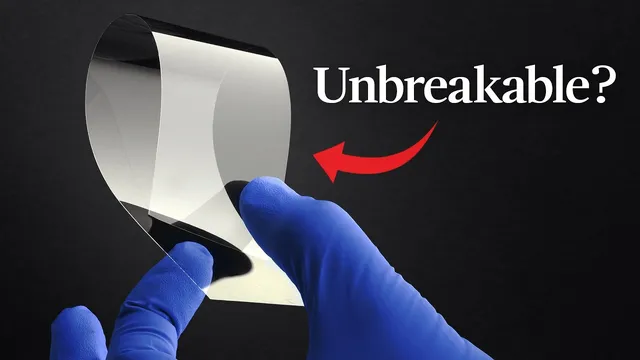
Unbreakable glass isn’t here—but modern “tough” glass has become durable enough to underpin everyday technology, from smartphones to scientific instruments. The breakthrough behind that shift is a combination of materials science and manufacturing tricks that turn brittle, flaw-driven fracture into something far harder to scratch and break. A key example is Gorilla Glass, developed for Apple’s first iPhone after Steve Jobs rejected plastic screens that scratched too easily and demanded thin glass that wouldn’t shatter.
The story begins with why ordinary glass fails. Glass is brittle because its atomic structure is amorphous—disordered rather than arranged in a repeating crystal lattice. That disordered network can’t rearrange to relieve stress the way more ductile materials can. When stress concentrates at a surface flaw, a crack forms and then grows as the stress is redistributed to atoms with fewer neighboring bonds, eventually fracturing the whole pane. That flaw-and-stress recipe is why glass can be made to break in controlled demos: sandblasting introduces a roughened flaw, and then a mechanical push supplies the stress.
From there, the transcript traces how humans learned to manipulate glass properties over thousands of years. Early glassmaking likely began accidentally when sand mixed into metalworking furnaces formed glass beads. Obsidian—volcanic glass—was used for cutting tools as far back as 1.2 million years ago because its brittleness allows chips to form sharp edges. Meanwhile, the modern glass base is built from abundant elements like silicon and oxygen, typically melted from quartz and then rapidly cooled so atoms “freeze” into a non-crystalline solid.
Different recipes tune glass behavior. Soda lime glass, made by adding sodium carbonate (“soda”) and calcium oxide (“lime”), dominates global production and melts at lower temperatures. Borosilicate glass adds boron trioxide, giving a low coefficient of thermal expansion—why lab glass can survive rapid temperature swings better than typical window glass. The transcript also explains why glass is often greenish: iron oxide impurities absorb more of the red and blue ends of visible light than green.
Transparent glass changed everything by enabling optics and information. Semi-transparent glass emerged around 100 AD in Alexandria with manganese dioxide, and truly clear glass was later developed in Venice on Murano. The mechanism is electronic: in transparent glass, visible photons don’t have enough energy to trigger electron transitions, so light passes through, while ultraviolet photons are absorbed.
That optical leap fed directly into lenses, microscopes, and telescopes. Lentil-shaped lenses helped correct farsightedness after the printing press boosted literacy. A compound microscope likely emerged from Hans and Zacharias Janssen’s lens arrangement, and Antony Van Leeuwenhoek later improved magnification by grinding lenses himself. Galileo Galilei used a telescope concept to observe Jupiter’s moons and Venus’s phases, undermining geocentrism.
Finally, the durability push returns to Gorilla Glass. The transcript describes an ion-exchange process: an aluminosilicate base is submerged in potassium salt at about 420°C, where smaller sodium ions are partially replaced by larger potassium ions. Because the glass is already rigid, the larger ions fit into the same space, creating compressive stress at the surface that resists crack growth. Corning then tests prototypes with bending, scratching, and drop trials, including replica phones and “selfie height” impacts. The result is not invincibility, but a steady march toward glass that can survive real life—while still cracking when pushed beyond its limits.
Cornell Notes
Glass is brittle because its amorphous atomic structure can’t rearrange to relieve stress; cracks start at surface flaws and then propagate as stress concentrates. Human glassmaking evolved from natural volcanic glass like obsidian to engineered compositions such as soda lime and borosilicate, which tune melting behavior and thermal expansion. Transparent glass—made possible by controlling impurities and electronic transitions—enabled lenses, microscopes, and telescopes, reshaping science and astronomy. Modern durability gains, including Gorilla Glass, come from strengthening methods like potassium–sodium ion exchange that leave compressive stress on the surface, making scratches and drops less likely to trigger catastrophic fracture. The practical takeaway: glass isn’t unbreakable, but it can be engineered to resist the specific failure modes that normally destroy it.
Why does glass crack so easily even when it looks solid?
What does “flaw and stress” mean in practice for breaking glass?
How do different glass recipes change performance?
What makes glass transparent to visible light but not to ultraviolet?
What manufacturing step makes Gorilla Glass harder to break and scratch?
How did transparent glass influence science and technology historically?
Review Questions
- What structural feature of glass makes it brittle, and how does that connect to crack growth at flaws?
- Explain how ion exchange produces compressive stress and why that helps resist fracture in Gorilla Glass.
- How do glass composition and impurities affect both thermal behavior and optical properties (color and UV absorption)?
Key Points
- 1
Glass fails through a predictable mechanism: cracks initiate at surface flaws and then propagate under stress because the amorphous structure can’t relieve stress.
- 2
Soda lime glass dominates production by lowering melting temperatures, while borosilicate glass improves thermal shock resistance through low thermal expansion.
- 3
Transparent glass depends on electronic energy levels: visible photons pass through when they can’t drive electron transitions, while UV photons are absorbed.
- 4
Human glassmaking progressed from natural volcanic glass and brittle cutting tools to engineered compositions and eventually clear optics that powered microscopy and astronomy.
- 5
Gorilla Glass durability comes largely from potassium–sodium ion exchange that creates compressive stress at the surface, resisting crack opening.
- 6
Corning’s development process relies on systematic testing—bending, scratching, and drop trials—using replica devices to validate improvements against real-world impacts.