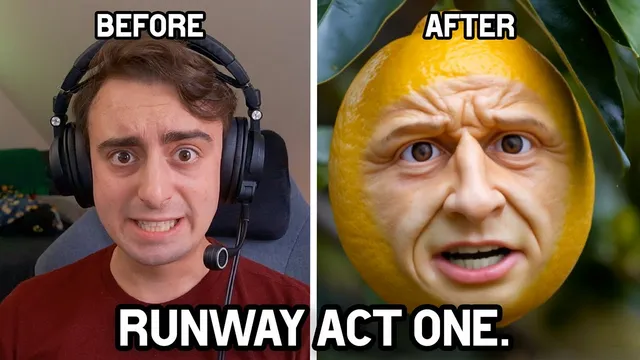
The Most POWERFUL AI Storytelling Tool of 2024 is Here.
Based on MattVidPro's video on YouTube. If you like this content, support the original creators by watching, liking and subscribing to their content.
Act One generates character acting by transplanting facial movements from an actor’s short input video (up to 30 seconds) onto a chosen character asset.
Briefing
Runway ML’s Act One is positioning itself as a fast, actor-driven way to generate expressive character performances from real facial acting—without the usual motion-capture and rigging pipeline. The core workflow takes up to 30 seconds of an actor’s video (recorded on a phone is enough), detects facial features, and then transplants those expressions onto a chosen character image—ranging from 3D animated models to photos and custom creations—producing outputs that can look surprisingly cinematic and, in some cases, close to non-AI animation.
The most important practical claim is that emotion and nuance can survive the transfer. Traditional facial animation often requires multi-step setups: motion capture hardware, multiple reference angles, and manual face rigging to preserve the subtleties of a performance. Act One aims to bypass that complexity by using an AI-driven approach where a single performance can drive a character’s acting. In demos and tests, characters can turn their heads and maintain convincing facial detail, while the background tends to be more limited—camera movement is generally constrained, and scenes often rely on steadier or stylized environments (burning buildings, swaying trees) rather than dynamic tracking shots.
Quality is a recurring theme. Many generated results are described as watchable and not “uncanny,” with some outputs resembling high-end renders or even footage-like realism. Still, the system shows clear failure modes. Blinking can be inconsistent, especially with cartoon or stylized characters, where the model may blink only parts of the eye rather than the full eyeball. Face detection is another friction point: some cartoony or stylized inputs trigger “unable to detect a face,” and the model may require a more human-like nose/face geometry to lock on. Longer clips also increase generation time, though the wait is framed as manageable—typically a few minutes.
The transcript also highlights how creators can extend the pipeline beyond Act One. Users can generate characters via idiogram, run performances through Act One, then use 11 Labs to translate the actor’s speech into a different voice—turning acting into dialogue with a new vocal identity. There’s also experimentation with post workflows, including combining Gen 3 video outputs with Act One to push toward more fluid, fuller-body animation.
Access and cost matter for adoption. Act One is described as available for everyone to try, but it runs on a credits system rather than being fully free. Copyright and ownership questions come up in community discussion, with claims that generated assets are owned by the user, though the transcript also notes practical limitations like head-and-shoulder focus and limited consistent character control across multiple angles.
Community reactions emphasize the workflow shift: animation that once took forever can happen in minutes, enabling lunch-break experimentation and new creative directions. The remaining bottlenecks—full-body tracking, consistent multi-angle character identity, and more reliable face detection—are framed as the next steps needed for Act One to become a truly dependable production tool for longer, story-driven projects.
Cornell Notes
Runway ML’s Act One turns a short actor performance into expressive character acting by detecting facial movements in an input video and transplanting them onto a selected character image. The approach is meant to replace traditional facial animation workflows that rely on motion capture, rigging, and multiple reference steps, aiming to preserve emotion and nuance from the original footage. Results can look professional and cinematic, especially for head turns and facial detail, but background motion is limited and camera movement is constrained. Common issues include inconsistent blinking (often partial eye blinks) and face-detection failures for highly stylized/cartoon inputs. Creators can further enhance outputs by generating characters with idiogram and swapping/transforming voices with 11 Labs, then adding ambience for a more film-like result.
How does Act One convert a real performance into character animation, and what inputs does it require?
What are the strongest visual capabilities Act One demonstrates in the transcript?
Where does Act One struggle, based on the tests described?
How do creators extend Act One results into more complete scenes or dialogue?
What production limitations still block Act One from being a full replacement for traditional pipelines?
How does community feedback characterize Act One’s impact on animation workflows?
Review Questions
- What specific facial features and input conditions does Act One appear to rely on for successful face detection?
- Which two generation artifacts are repeatedly mentioned as needing improvement, and why do they matter for character believability?
- How do idiogram and 11 Labs fit into the end-to-end pipeline described for producing more cinematic results?
Key Points
- 1
Act One generates character acting by transplanting facial movements from an actor’s short input video (up to 30 seconds) onto a chosen character asset.
- 2
The system is designed to reduce reliance on traditional facial animation workflows that require motion capture, manual rigging, and multi-step setups.
- 3
Head turns and facial nuance can look convincing, but background motion and camera movement are comparatively limited.
- 4
Blinking and eye behavior can be inconsistent for stylized/cartoon characters, sometimes producing partial-eye blinks.
- 5
Face detection can fail for highly stylized inputs; more human-like facial geometry improves results.
- 6
A practical creator pipeline pairs Act One with idiogram for character creation and 11 Labs for voice translation, then adds ambience for film-like immersion.
- 7
Adoption depends on access and cost: Act One is available broadly but uses a credits system rather than being fully free.