The Most Powerful Computers You've Never Heard Of
Based on Veritasium's video on YouTube. If you like this content, support the original creators by watching, liking and subscribing to their content.
The Antikythera mechanism forecasts eclipses by using gear-driven analog relationships between dial motion and celestial motion, not by symbol manipulation.
Briefing
A 2,000-year-old Greek gearwork device and a 20th-century tide-predicting machine share a common theme: when digital chips hit physical limits, analog computation is returning as a practical alternative. The Antikythera mechanism—discovered in a shipwreck off Antikythera in 1901—uses 37 interlocking bronze gears to model the sun and moon and forecast eclipses decades ahead. It doesn’t calculate with symbols; it computes by analogy, turning continuous physical motion into a representation of celestial motion. That same “continuous-to-physical” idea later reappeared in large-scale analog computers that, for centuries, outperformed early digital approaches.
The transcript draws a clear line between analog and digital machines. Analog computers accept continuous inputs and produce continuous outputs, with quantities represented directly by physical states—like how far a wheel turns. Digital computers, by contrast, operate on discrete symbols (zeros and ones). That difference matters because digital systems can repeat calculations exactly and tolerate noise: a one only needs to stay far enough from a zero. Analog systems are more vulnerable; small mechanical or electrical inaccuracies can accumulate and change results.
The most detailed case study is Lord Kelvin’s tidal prediction work in the 1800s. Pierre-Simon Laplace had shown that tides are driven by only a few astronomical frequencies—moon, sun, and the lunar orbit’s eccentricity—each contributing a sine wave with its own amplitude and phase. Kelvin’s challenge was turning those components into accurate future tide curves. He used Fourier’s method to decompose a tide record into sine and cosine coefficients, but the arithmetic was too heavy to do by hand. Kelvin therefore built analog machines to automate the process.
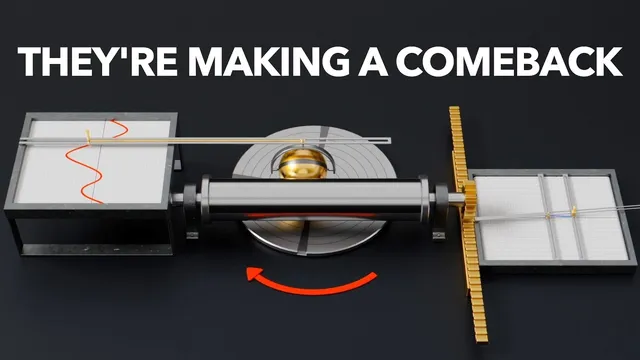
Kelvin’s approach combined mechanical building blocks for both harmonic analysis and synthesis. A scotch yoke mechanism produced sinusoidal motion, while a pulley-and-weight addition system combined multiple frequency contributions. For decomposition, Kelvin and his brother James Thompson developed a ball-and-disk mechanical integrator: a stylus traces the input function, and the ball’s position controls rotational speed so a roller can plot the integral on graph paper. By oscillating the disk at a target frequency while tracing the tide curve, the machine effectively computes the integral of the tide signal multiplied by a sine wave—yielding the needed coefficients. Parallel setups could analyze several frequencies at once.
Those machines weren’t just scientific curiosities. Kelvin’s harmonic analyzers influenced the differential analyzer, and tide-predicting systems were used operationally in World War II, including planning the D-Day invasion timing across multiple beaches. Analog computation also played a role in anti-aircraft fire control: Bell Labs’ David Parkinson scaled up a potentiometer-based charting idea into the M9 Gun Director, using radar and optical inputs to compute trajectories quickly. Yet analog precision proved brittle. The Norden bombsight—an elaborate mechanical analog system—required extreme manufacturing tolerances, and its performance fell short in practice.
As the war ended, digital systems surged. Claude Shannon’s 1936 thesis showed that any numerical operation can be built from Boolean logic using true/false values and operations like AND, OR, and NOT. Digital machines became universal, repeatable, and more noise-resistant, helping drive the shift toward the transistor-based world. Today, the transcript argues that the digital era may be approaching a ceiling as transistors near atomic-scale limits and machine learning strains existing architectures—prompting renewed interest in analog computing startups and a promised Part Two on what comes next.
Cornell Notes
The Antikythera mechanism and Lord Kelvin’s tide computers illustrate how analog computation works: continuous physical motion can represent continuous quantities, letting gears or mechanical linkages “compute” by analogy rather than by manipulating discrete symbols. Kelvin’s breakthrough was building machines that automate Fourier-based harmonic analysis—turning a measured tide curve into sine-wave amplitudes and phases, then recombining them to predict future tides. These analog systems were operationally important, from D-Day planning to anti-aircraft gun directors, but they also suffered from precision limits: small mechanical or electrical errors can accumulate and change outputs. Digital computing ultimately dominated because Boolean logic (Shannon) enables universal, repeatable computation using ones and zeros, which are more robust to noise. With modern transistor scaling nearing physical limits, analog computing is again being reconsidered.
What makes the Antikythera mechanism an “analog computer,” and what does it predict?
How do analog and digital computers differ in how they represent numbers and handle noise?
Why did Laplace’s insight make tidal prediction possible in principle?
What problem made Kelvin’s tidal work computationally difficult, and how did his machines address it?
How were Kelvin’s ideas used during World War II?
What ultimately pushed computing toward digital dominance?
Review Questions
- Why does representing quantities with continuous physical states make analog computation sensitive to small component errors?
- Describe the two-stage workflow Kelvin needed for tidal prediction and how his machines supported each stage.
- What role did Shannon’s Boolean logic framework play in making digital computers universal?
Key Points
- 1
The Antikythera mechanism forecasts eclipses by using gear-driven analog relationships between dial motion and celestial motion, not by symbol manipulation.
- 2
Analog computers represent quantities continuously (e.g., wheel rotation), while digital computers represent them discretely using zeros and ones.
- 3
Laplace’s frequency-based view of tides made prediction feasible by reducing tides to a small set of sine-wave components with specific amplitudes and phases.
- 4
Lord Kelvin’s analog machines automated Fourier-style harmonic analysis using mechanical integration and frequency-specific oscillation, then recombined components to predict future tides.
- 5
Analog systems proved valuable in real wartime planning and targeting, including D-Day tide scheduling and the M9 Gun Director.
- 6
Digital computing surged because Boolean logic (Shannon) enables universal computation with repeatable, noise-resistant symbol operations.
- 7
Modern interest in analog computing is tied to physical limits of transistor scaling and growing computational demands from machine learning.