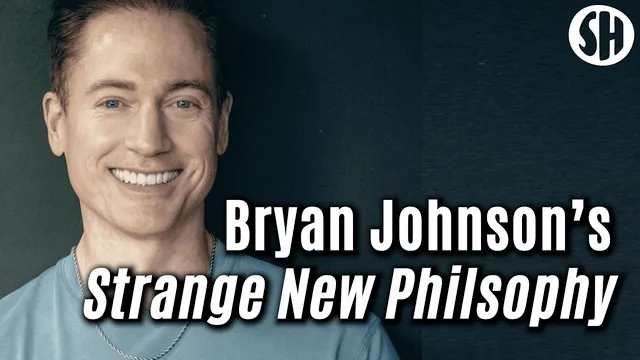
The Movement That Could End Capitalism
Based on Sabine Hossenfelder's video on YouTube. If you like this content, support the original creators by watching, liking and subscribing to their content.
Johnson’s “Don’t Die” movement treats aging as an entropy-like process and aims to slow deterioration long enough to benefit from faster AI-driven medicine.
Briefing
Bryan Johnson’s “Don’t Die” movement reframes aging and success around a single, measurable mission: slow or reverse the entropy-like deterioration of the body long enough to outpace human aging—especially as AI accelerates medical progress. Johnson’s pitch is both personal and philosophical: he runs an extreme, tightly tracked health regimen (supplements, procedures, and prescriptions under medical supervision), claims biomarker targets such as “telomeres” that he says read like he’s about 10 years old, and sets a far-future horizon—surviving to witness the last Bitcoin halving in 2140. The practical point is that physical decline is treated as an engineering problem, not an inevitable life stage.
The deeper argument ties longevity to the coming AI era. Once machines surpass average human intelligence, Johnson expects rapid breakthroughs that could make wealth less central to survival—at least in the long run—because medicine could improve faster than bodies degrade. In that scenario, the only rational societal goal becomes “don’t die,” replacing profit-driven metrics with survival-driven ones. Johnson’s framing also asks whether existing moral and political systems—capitalism, democracy, major religions, socialism—will still provide stable ethical guidance when humanity faces “super intelligence” and when AI goals must be aligned with human values.
Yet the movement’s reception is sharply divided. Critics call Johnson a narcissist or snake-oil salesman, and much of the backlash is described as social rather than scientific: his public biomarker bragging and daily Twitter-style admonitions about sleep, diet, and exercise can feel condescending. More pointedly, his program is expensive and difficult to replicate. Many interventions he cites—such as prescription drugs (including metformin and “Reprim”), plasma replacement, stem-cell-related approaches, and hyperbaric oxygen therapy—are not realistically accessible to most people. That gap fuels a suspicion that “forever” will be reserved for the wealthy while others accept earlier death.
Skepticism also targets the biomarkers themselves. Telomere length, inflammation markers, and regeneration-related signals may correlate with health risks, but their ability to predict actual lifespan remains uncertain. A cited example of a 117-year-old woman with very short telomeres but remarkable health underscores how misleading single metrics can be. Even Johnson’s youthful appearance—he has pursued treatments to reduce sun damage and boost collagen, plus a fat transfer that triggered an allergic reaction—doesn’t settle the question of biological age.
Still, the transcript argues that the “guinea pig” approach may be valuable even if the ultimate “live forever” claim is overstated. The most evidence-backed longevity basics remain familiar: eat well, sleep well, exercise, and avoid unnecessary drugs. The non-boring part is using Johnson’s regimen as a high-profile testbed for biomarker-driven optimization while waiting for AI-enabled medicine—potentially including organ regrowth and replacement—to shift the odds. The segment closes by noting cryopreservation as another speculative bet: cooling the body to pause biological activity with the hope that future technology can revive and treat the original condition. The central takeaway is not that Johnson’s plan is guaranteed, but that treating aging as a solvable problem—and timing it against accelerating medical progress—could plausibly extend healthy life, even if 200-year lifespans remain unlikely.
Cornell Notes
Bryan Johnson’s “Don’t Die” movement treats aging as an entropy-like accumulation of errors that can be slowed or repaired, using biomarker tracking and an aggressive health protocol. The mission is framed as survival through the AI revolution: if AI accelerates medicine faster than bodies age, then longevity becomes an achievable species-level goal. The transcript highlights both the appeal and the controversy—Johnson’s public biomarker claims and strict lifestyle demands, plus the reality that many interventions are expensive and hard to access. Skepticism also centers on whether biomarkers like telomere length reliably predict lifespan, citing evidence that short telomeres can coexist with extreme longevity. Even so, the argument holds that optimizing nutrition, sleep, and exercise while monitoring biomarkers could extend healthy years and potentially bridge the gap to future AI-driven therapies.
What is the core “Don’t Die” idea, and how does it connect to AI?
Why does Johnson’s approach trigger backlash beyond normal disagreement about health?
What role do biomarkers play, and why are they contested?
How does the transcript assess whether Johnson’s regimen is likely to work?
What is cryopreservation, and what does it represent in the longevity strategy?
Review Questions
- Which parts of Johnson’s “Don’t Die” framework are presented as evidence-based versus speculative, and what evidence is cited for each?
- How do the transcript’s examples (like the 117-year-old with short telomeres) challenge the reliability of specific biomarkers?
- What ethical or political concerns arise when survival becomes the primary goal in a world shaped by AI and concentrated wealth?
Key Points
- 1
Johnson’s “Don’t Die” movement treats aging as an entropy-like process and aims to slow deterioration long enough to benefit from faster AI-driven medicine.
- 2
The longevity strategy is explicitly tied to the expectation that AI will accelerate medical progress, potentially outpacing human aging.
- 3
Public biomarker comparisons and strict lifestyle rules contribute to backlash, especially when they appear to ignore how constrained most people’s lives are.
- 4
Many interventions in Johnson’s regimen are expensive and access-limited, raising concerns that longevity will be unevenly distributed.
- 5
Biomarkers such as telomere length may correlate with health risks, but their ability to predict lifespan is not settled; extreme longevity can occur with short telomeres.
- 6
Conventional longevity fundamentals—nutrition, sleep, exercise, and avoiding unnecessary drugs—remain the most scientifically supported pieces.
- 7
Cryopreservation is presented as a high-uncertainty, future-dependent bet: pause biology now, hope revival and cures become possible later.