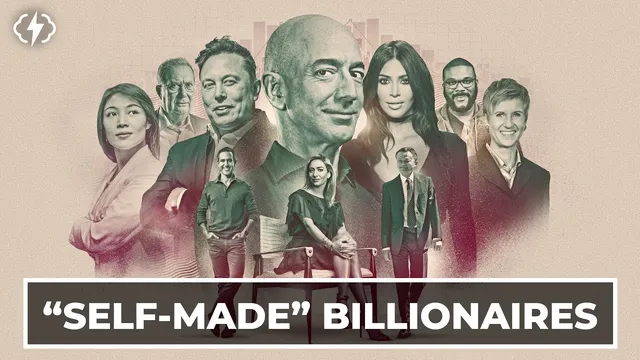
The Myth Of The "Self-Made" Billionaire
Based on Second Thought's video on YouTube. If you like this content, support the original creators by watching, liking and subscribing to their content.
Only about 600 people in the U.S. are billionaires (around 0.0002% of the population), making “anyone can do it” a misleading takeaway.
Briefing
Billionaires rarely rise through “self-made” grit alone; their fortunes typically reflect a mix of inherited privilege, labor exploitation, and government-backed risk-taking that gets privatized as private profit. That matters because the “self-made” story is used to justify policies that benefit the ultra-rich—especially lower taxes—while starving public services that affect everyday life.
The myth persists even though the odds are vanishingly small: only about 600 people in the U.S. are billionaires, roughly 0.0002% of the population. Yet the narrative is marketed as proof that “anyone” can do it, encouraging viewers to accept the idea that billionaires earned their wealth and that others should want the same tax treatment and political deference. From there, the story becomes politically useful. It helps normalize the claim that everyone would be better off if billionaires paid less in taxes, even though the ultra-rich already have ways to avoid taxes and further reductions mean less money for roads, public services, healthcare, and education.
In some cases, the “from nothing” origin story is presented as a near-fairytale. Jeff Bezos is described as a hardworking kid who worked a McDonald’s job, reached Princeton, then took a leap selling books online—eventually building Amazon. Elon Musk is framed similarly as a bullied science-minded outsider who overcame student debt and skepticism. But the core image is portrayed as misleading: Amazon’s rise wasn’t driven only by novelty and work ethic; it also came with a roughly $300,000 initial investment from Bezos’s parents. Musk’s “everyman” framing also clashes with details about his family’s wealth, including his father’s ownership of a lucrative emerald mine and his role as a property developer in apartheid South Africa. The transcript’s bottom line: billionaires don’t start from nothing.
Instead, three pathways are highlighted. First is family wealth and privilege, which helps explain why white men dominate billionaire rankings while women and racial minorities remain a smaller share. Second is exploitation, defined in Marxist terms as the extraction of surplus value—workers are paid less than the value they produce, enabling owners to profit. A concrete example is offered: an Ohio pizza shop where the owner stopped siphoning surplus value for a day, resulting in employees making $78 an hour. The same logic is said to apply broadly, including in sweatshop-like conditions tied to high-profile brands such as Fenty Beauty and Ivy Park, where the public face may change but the underlying labor arrangements remain comparable.
Third is government help. The transcript points to Elon Musk’s companies—SpaceX, Tesla, and SolarCity—as examples of how subsidies and tax breaks can underpin ventures while the same figures criticize regulation and seek to reduce taxation. It also extends the argument to pharmaceutical research, where public funding supports innovation but private firms later capture profits through high prices and restricted access.
The conclusion is a call to drop reverence for “self-made” billionaires and imagine a world where workers receive the full value of their labor—reducing stress and making society fairer, since the economy produces enough for everyone while wealth concentrates at the top.
Cornell Notes
The “self-made billionaire” narrative is presented as a political myth: only a tiny fraction of people become billionaires, and the stories that make it seem attainable often omit key advantages. The transcript argues that billionaire success typically comes from inherited privilege, labor exploitation (workers paid less than the value they produce), and government support that reduces risk while profits are privatized. Examples include Bezos’s early $300,000 family investment and Musk’s family ties to wealth in apartheid-era South Africa. The practical consequence is that the myth helps justify lower taxes for the ultra-rich, reducing funding for public goods like healthcare and education.
Why does the transcript treat the “self-made” label as misleading even when individual effort is real?
What are the three main mechanisms offered for how billionaires actually get rich?
How does the transcript use Bezos and Musk to illustrate the “self-made” story’s omissions?
What does “exploitation” mean in the transcript, and what example is used to make it concrete?
How does the transcript connect the myth of self-made billionaires to tax policy and public services?
What role does government support play, according to the transcript?
Review Questions
- Which of the three mechanisms (privilege, exploitation, government help) do you think is most persuasive, and why?
- How does the transcript’s definition of exploitation (surplus value) change the way you interpret wage differences?
- What policy outcome does the transcript link to belief in “self-made” billionaires, and what evidence is offered for that link?
Key Points
- 1
Only about 600 people in the U.S. are billionaires (around 0.0002% of the population), making “anyone can do it” a misleading takeaway.
- 2
The “self-made” narrative is portrayed as a tool to justify lower taxes for the ultra-rich, even though they already have ways to avoid taxes.
- 3
Origin stories about Bezos and Musk are described as incomplete because early capital and family wealth are treated as decisive factors.
- 4
Family wealth and privilege are presented as a major driver of who reaches the billionaire class, reflected in the dominance of white men in rankings.
- 5
Exploitation is defined as surplus value extraction: workers are paid less than the value they produce, enabling owners to profit.
- 6
High-profile brands are used as examples of exploitative labor arrangements, with the claim that public-facing celebrity status doesn’t change underlying labor practices.
- 7
Government subsidies and public funding are described as risk-reduction mechanisms that enable private profit while critics of regulation seek to limit public support for everyone else.