The Napkin Ring Problem
Based on Vsauce's video on YouTube. If you like this content, support the original creators by watching, liking and subscribing to their content.
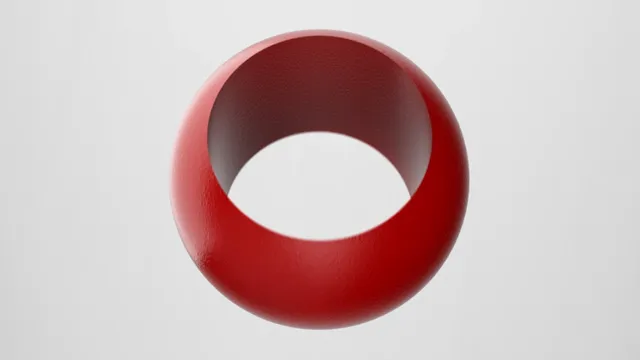
A napkin ring is created by removing a cylinder from a sphere, leaving a curved band of material.
Briefing
Coring a sphere to make a “napkin ring” produces a surprising result: if two napkin rings have the same height, they always have the same volume—even if one comes from a tiny tomato and the other from Earth. That means a hand-sized napkin ring cut from an orange can match the volume of a napkin ring whose circumference would wrap around the planet, despite the wildly different sizes of the original spheres. The counterintuitive punchline is that the geometry conspires so that a thinner ring from a smaller sphere is exactly compensated by a thicker ring, leaving equal space occupied.
The explanation leans on Cavalieri’s principle, a volume rule for solids sliced by parallel planes. If two solids sit between the same pair of parallel planes and every cross-section taken at the same height has equal area, then the solids must have equal volume. The transcript first illustrates this with stacked “VSauce stickers,” where skewing the arrangement changes shape but not the total number of stickers, so volume stays fixed. The same logic then gets applied to napkin rings: compare a sphere with a cylinder removed, and look at what happens when a horizontal plane cuts through.
At any slice height, the napkin ring’s cross-sectional area equals the area of the sphere’s circular cross-section minus the area of the cylinder’s circular cross-section. The key is that, for a given napkin-ring height h, those two circular areas combine in a way that eliminates dependence on the sphere’s radius R. To do this, the cylinder radius is expressed using the geometry of a right triangle: the cylinder radius squared becomes R² minus (h/2)². Meanwhile, the sphere’s cross-section radius at height y above the equator is √(R² − y²), so its area is π(R² − y²). The cylinder cross-section area uses the cylinder radius, giving π(R² − (h/2)²).
When the sphere area and cylinder area are subtracted, the πR² terms cancel cleanly. What remains depends only on the slice position within the napkin ring—bounded by the napkin-ring height—and not on how big the original sphere was. Since every parallel-plane cut through one napkin ring matches the corresponding cut through the other in area, Cavalieri’s principle guarantees equal volumes.
The closing message turns the math into a practical intuition: if material is limited and the goal is a fixed amount of substance, a napkin ring can be a geometry-based “portioning” tool rather than a size-dependent one. The transcript then pivots to unrelated live-event and merchandise plugs, plus an August 21, 2017 total solar eclipse reminder with eye-safety guidance and Curiosity Box details.
Cornell Notes
A napkin ring is formed by removing a cylinder from a sphere. If two such rings have the same height, their volumes are equal even when the original spheres are vastly different in size. The reasoning uses Cavalieri’s principle: equal cross-sectional areas at every height between parallel planes imply equal volume. For a slice at height y, the napkin ring’s area equals the sphere’s circular cross-section area minus the cylinder’s circular cross-section area. After expressing the cylinder radius in terms of the sphere radius R and ring height h, the πR² terms cancel, leaving cross-section areas that depend only on the ring height, not on R. That cancellation is why a ring cut from a small fruit can match the volume of a ring cut from Earth.
What exactly is a “napkin ring,” and why does its volume seem like it should depend on the sphere’s size?
How does Cavalieri’s principle connect cross-sectional areas to volume?
Why is the napkin ring’s cross-sectional area computed as “sphere area minus cylinder area”?
How do the cylinder and sphere radii get related to the ring height h and sphere radius R?
What algebraic cancellation makes the volume independent of the sphere radius R?
What does this imply for real objects like fruit versus Earth?
Review Questions
- In the napkin ring setup, what must be true about cross-sectional areas at every height for Cavalieri’s principle to guarantee equal volumes?
- Where does the (h/2) term enter the geometry, and how does it affect the cylinder radius squared?
- During the sphere-minus-cylinder area subtraction, which terms cancel and why does that remove dependence on the sphere radius R?
Key Points
- 1
A napkin ring is created by removing a cylinder from a sphere, leaving a curved band of material.
- 2
Cavalieri’s principle links equal cross-sectional areas at matching heights to equal volumes.
- 3
For any slice, the napkin ring’s cross-sectional area equals the sphere’s circular cross-section area minus the cylinder’s circular cross-section area.
- 4
The cylinder radius satisfies r² = R² − (h/2)², derived from right-triangle geometry.
- 5
The sphere’s cross-section at height y has radius √(R² − y²), giving area π(R² − y²).
- 6
Subtracting the two areas cancels the πR² terms, making slice areas independent of the sphere’s size.
- 7
Equal slice areas across the ring height imply that two napkin rings with the same height have identical volumes.