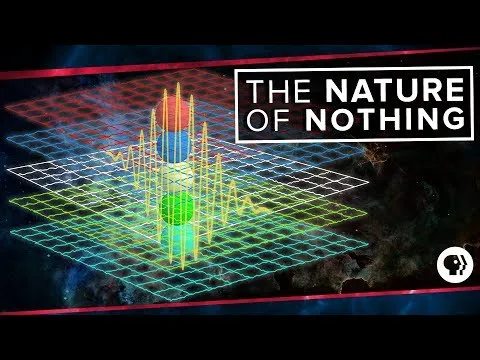
The Nature of Nothing | Space Time
Based on PBS Space Time's video on YouTube. If you like this content, support the original creators by watching, liking and subscribing to their content.
Quantum field theory treats empty space as a vacuum state of quantum fields, not a complete absence of physical effects.
Briefing
“Nothing” in physics isn’t an absence of everything—it’s a seething baseline state of quantum fields. Even when air is removed, radiation is blocked, and temperatures are pushed toward absolute zero, quantum mechanics still prevents truly motionless particles and truly zero-energy fields. The result is a universe where empty space carries a measurable “vacuum energy,” and where fleeting “virtual particles” can influence real-world outcomes.
The episode starts by revisiting why absolute zero is unattainable: Heisenberg’s uncertainty principle forbids perfect stillness. Trying to pin down a particle’s position forces its momentum—and thus its motion—to become uncertain, producing a nonzero minimum average kinetic energy called zero-point energy. That same logic extends to empty space. In quantum field theory (QFT), space is filled with fundamental quantum fields—one per elementary particle type—whose oscillations can’t be fully switched off. The lowest-energy configuration of a field is the vacuum state, but “zero energy at all times” is blocked by uncertainty in time and energy: on very short timescales, a field can exist in a blur of energy states.
From that blur comes the idea of virtual particles: temporary excitations that appear “out of nothing” between measurements. QFT treats interactions through exchanges of these virtual excitations, often represented in Feynman diagrams. The rules are strict even for something so ephemeral. Conservation laws still apply, so virtual particles typically arise as particle–antiparticle pairs. Their existence is also limited by the uncertainty principle: higher-energy virtual particles can only persist for shorter times. This time-energy constraint helps explain the range of forces. Massless photons can have arbitrarily tiny energies, allowing virtual photons to mediate electromagnetism over long distances. By contrast, gluons carry mass, so creating them requires a baseline energy, limiting how long they can exist and making the strong nuclear force short-ranged.
The episode then turns from theory to evidence. The Lamb shift—an observed tiny energy difference between hydrogen’s electron orbitals—was first noticed in 1947 by Willis Lamb and Robert Rutherford and later explained in 1947 by Hans Bethe using fluctuating vacuum energy. Another major test is the Casimir effect. In 1948, Hendrick Casimir proposed that two closely spaced conducting plates would alter which virtual photons can fit between them, lowering vacuum energy inside relative to outside. That difference should create a measurable pressure pushing the plates together. The effect was confirmed in 1996 by Steven Lamoreaux at the University of Washington, with results matching quantum field theory predictions.
Still, the vacuum energy problem refuses to settle. Lamb shift and Casimir measurements constrain only relative differences, not the absolute vacuum energy. Estimating the absolute value leads to a dramatic mismatch: if vacuum energy corresponds to dark energy driving the universe’s accelerating expansion, the required energy density is tiny. QFT’s theoretical calculation lands about 120 orders of magnitude higher. That discrepancy—often framed as one of physics’ greatest unsolved mysteries—suggests quantum field theory is missing something essential about the true nature of “nothing,” and by extension, about space-time itself.
Cornell Notes
Quantum field theory treats empty space as a lowest-energy vacuum state of underlying quantum fields, not a true absence of activity. Heisenberg uncertainty prevents fields (and particles) from having perfectly zero energy, producing zero-point energy and allowing brief “virtual particle” excitations. Virtual particles mediate forces in QFT, but their lifetimes are constrained by the uncertainty principle, which helps set the ranges of forces (long-range electromagnetism via massless photons; short-range strong force via massive gluons). Two key experiments—Lamb shift and the Casimir effect—support vacuum fluctuations by measuring their consequences. The biggest open issue is that QFT’s predicted absolute vacuum energy overshoots the value implied by cosmic acceleration by roughly 120 orders of magnitude.
Why can’t “nothing” be truly empty in quantum field theory?
How do virtual particles fit into the explanation of forces?
What experimental evidence supports vacuum fluctuations like virtual particles?
Why do the Lamb shift and Casimir effect not determine the absolute vacuum energy?
What is the vacuum energy “120 orders of magnitude” problem?
Review Questions
- How does the uncertainty principle connect zero-point energy to the impossibility of perfectly empty, perfectly still space?
- In what way do the mass properties of exchanged particles (photons vs. gluons) determine the range of the forces they mediate?
- What do the Lamb shift and Casimir effect each measure, and why does neither directly fix the absolute vacuum energy?
Key Points
- 1
Quantum field theory treats empty space as a vacuum state of quantum fields, not a complete absence of physical effects.
- 2
Heisenberg uncertainty prevents both perfect particle stillness at absolute zero and perfect zero-energy fields, leading to zero-point energy.
- 3
Virtual particles are short-lived quantum fluctuations constrained by conservation laws and the time–energy uncertainty relation.
- 4
The range of forces follows from the allowed energies of exchanged virtual excitations: massless photons enable long-range effects, while massive gluons limit the strong force’s reach.
- 5
Experimental signatures of vacuum fluctuations include the Lamb shift in hydrogen and the Casimir effect between conducting plates.
- 6
Lamb shift and Casimir measurements test relative vacuum-energy changes, not the absolute vacuum energy of space.
- 7
A major unresolved puzzle remains: QFT’s predicted absolute vacuum energy is vastly larger than the value suggested by the universe’s accelerating expansion.