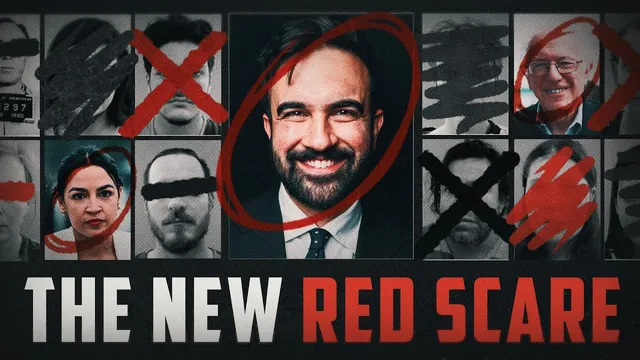
The New Red Scare is Here
Based on Second Thought's video on YouTube. If you like this content, support the original creators by watching, liking and subscribing to their content.
NSPM7 is presented as a targeted national security memorandum directing agencies to “disrupt” people and organizations labeled with broad “indicators of violence.”
Briefing
A new “red scare” is taking shape in the United States, and it’s being driven less by open communist activity than by government and institutional tactics that treat broad swaths of left-wing politics as security threats. The central warning is that civil liberties and political organizing are getting squeezed through labels—“communist,” “Antifa,” and increasingly “woke”—while enforcement mechanisms expand beyond what Congress would normally authorize.
The flashpoint cited is a Trump-era national security directive: National Security Presidential Memorandum Number 7 (NSPM7). Unlike routine executive orders, NSPMs are framed as targeted guidance for defense, foreign policy, intelligence, and law enforcement. NSPM7 directs those agencies to “disrupt” groups, organizations, and even individuals deemed to show “indicators of violence,” including anti-Americanism, anti-capitalism, “extremism on gender,” and hostility toward “traditional American” family views. The transcript argues that these categories are vague enough to ensnare many people left of the MAGA movement, effectively lowering the threshold for investigation and allowing the Department of Justice to act without the usual legislative gatekeeping.
That concern is paired with a claim that the crackdown pattern already exists in practice. A comparison is drawn to anti-ICE protest enforcement in Los Angeles, where National Guard deployment and a government notice to organizations were followed by demands to preserve communications and other operational data—or face criminal investigation. The transcript describes this as intimidation-by-compliance: even if no wrongdoing is found, fear can reduce membership, drain resources from organizing, and create “guilt by association” risks for people outside the targeted groups.
To show how red scares work, the transcript revisits the second Red Scare of the 1950s, especially the Hollywood blacklist. The House Committee on Un-American Activities subpoenaed the “Hollywood 10,” who were convicted, appealed, and ultimately served prison time. Blacklists and studio employment bans followed, but the account emphasizes that the damage went far beyond Hollywood: academics were fired, thousands were imprisoned or deported, the FBI spied on civil rights activists, and courts upheld convictions tied to refusing to name names. The broader point is that “communism” functioned as a flexible catch-all label for almost any progressive demand.
The transcript then links past tactics to present-day labor and cultural politics. It describes efforts to weaken worker protections and collective bargaining—citing disruptions around SNAP during a government shutdown, changes affecting the National Labor Relations Board, and broader pressure on labor law—as part of a wider strategy to push progressive movements toward the political center. In recent years, “woke” is portrayed as the new wedge word that makes a wide range of social and cultural issues feel like threats to “Americanism,” enabling private institutions—law firms, universities, brands, hospitals—to preemptively distance themselves from left-leaning causes.
Still, the closing argument is not purely fatalistic. The transcript claims that intimidation tactics are failing to fully suppress organizing: left-wing membership is rising, protests draw large crowds, and major cities elect socialist candidates. The implied logic is that governments and institutions only escalate when they believe the targeted movements are gaining traction—so the fear campaign itself becomes evidence of momentum for resistance.
Cornell Notes
The transcript argues that the U.S. is entering a new “red scare” in which broad left-wing views are treated as security threats. It points to NSPM7, a national security memorandum directing agencies to “disrupt” people and organizations labeled with “indicators of violence,” including anti-Americanism, anti-capitalism, and certain gender-related views. The account claims this lowers the threshold for investigation and can chill civil liberties and organizing even without formal trials. It then compares today’s tactics to the 1950s Red Scare—especially Hollywood blacklists and wider purges of academics, workers, and civil rights activists—showing how “communism” functioned as a flexible label. The transcript ends by arguing that intimidation is meeting resistance and that progressive organizing is still growing.
What is NSPM7, and why is it treated as a turning point?
How does the transcript connect protest enforcement to a broader strategy?
What lessons from the 1950s Red Scare are used to interpret today’s labels?
How does the transcript argue labor and institutional power are being targeted now?
What does the transcript say about the long-term effects of red scares on progressive movements?
Why does the transcript end on a note of resistance rather than defeat?
Review Questions
- How does NSPM7’s definition of “indicators of violence” broaden the range of people who can be investigated?
- What parallels does the transcript draw between the Hollywood blacklist era and modern institutional self-censorship?
- Why does the transcript argue that red scares harm progressive movements beyond the people directly accused?
Key Points
- 1
NSPM7 is presented as a targeted national security memorandum directing agencies to “disrupt” people and organizations labeled with broad “indicators of violence.”
- 2
The cited “indicators” include anti-Americanism, anti-capitalism, “extremism on gender,” and hostility toward “traditional American” family views, which the transcript says can capture many mainstream left positions.
- 3
Protest enforcement is framed as intimidation-by-compliance, using threats of criminal investigation and demands for operational data to chill organizing.
- 4
The 1950s Red Scare is used as a template: blacklists and purges extended beyond communists to civil rights activists, academics, and workers, with “communism” functioning as a flexible label.
- 5
The transcript argues that “woke” has become a modern wedge term that enables similar tactics against a wide range of social and cultural issues.
- 6
Red scares are described as damaging left-wing solidarity for years, narrowing movements and delaying intersectional organizing.
- 7
Despite intimidation, the transcript claims organizing and protest participation are rising, suggesting the fear campaign is not fully suppressing resistance.