The NEW SCIENCE of Moon Formation
Based on PBS Space Time's video on YouTube. If you like this content, support the original creators by watching, liking and subscribing to their content.
Seismology from Apollo landings indicates the Moon has a small iron core—about 20% of the Moon’s diameter—embedded in a frozen mantle.
Briefing
Earth’s Moon is unusually large relative to Earth, has a surprisingly small iron core, and—most strikingly—shares oxygen isotope ratios with Earth’s crust. Those mismatches between “same building blocks” and “different internal structure” have pushed lunar-formation theories toward a single dominant explanation: a giant impact that both mixed Earth-like material and reshaped the newborn bodies.
Apollo-era measurements provide the clues. Seismometers deployed during Apollo landings recorded moonquakes, letting scientists infer the Moon’s interior. The results point to a small iron inner core—about 20% of the Moon’s diameter—surrounded by a frozen mantle. Meanwhile, Apollo samples brought back roughly half a ton of lunar material, including silicate rocks whose oxygen isotopes match Earth’s to within a few parts per million. In other words, the Moon’s chemistry looks Earthlike in isotopic fingerprints, yet its bulk structure—especially its low iron fraction—doesn’t.
Surface geology adds a timeline. Dark basaltic “mare” fill lowland craters, formed when magma erupted and froze. Lighter anorthosite rocks, rich in calcium, silicon, and oxygen, formed differently: they crystallized inside a long-lived magma ocean and floated upward as they solidified. Together, these layers imply the Moon spent tens to hundreds of millions of years covered by liquid magma, later punctuated by basalt eruptions and then billions of years of impacts.
Several formation routes struggle with the full set of constraints. Building the Moon in a circumplanetary disk alongside Earth would naturally produce shared isotopic ratios, but it would also tend to yield more similar overall elemental proportions and align Earth’s spin axis with the Moon’s orbital plane—yet those axes are misaligned. Capturing a pre-formed moon during close flybys is also difficult because slowing down an incoming body without it escaping requires conditions Earth simply doesn’t have, and capture via binary “exchange” is more plausible for other moons than for one as massive and distinctive as ours.
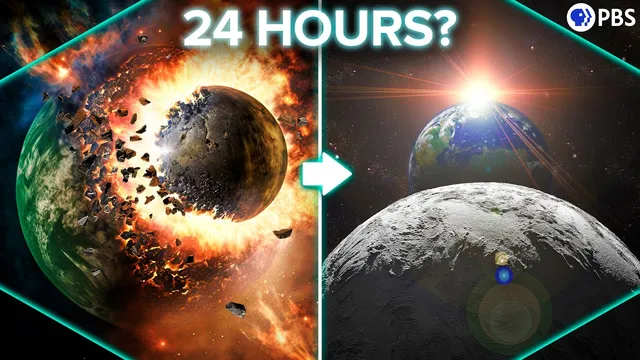
The giant impact hypothesis fits best. Two proto-planets—proto-Earth and a Mars-sized body called Theia—likely formed near the L4 or L5 Lagrange points. Around 100 million years into solar system history, Theia’s orbit destabilized and it drifted into Earth. The collision would have liquefied rock, sprayed lighter material into space, and left Earth with much of the iron—accounting for the Moon’s tiny core. Mixing during the impact explains why the Moon and Earth share the same oxygen isotope signature.
Recent high-resolution simulations sharpen the picture. A new set of hydrodynamic calculations by Jacob Kegerreis and collaborators at NASA Ames and Durham University used up to 100 million particles—about a thousand times more detailed than typical models. In a scenario with a near-escape-velocity collision at roughly a 45° angle, Theia is largely obliterated and debris strips Earth’s mantle. Crucially, the simulation briefly produces two moons for a few hours; one falls back while the other is pushed into a wider, stable orbit. Within under two days, the surviving satellite resembles the real Moon, with about 1% of Earth’s mass and an outer layer heated to roughly 4000 K—enough to sustain a magma ocean.
Uncertainty remains: the true masses, impact speed, and geometry are unknown, and even improved simulations rely on approximations. But as resolution rises and models add physics such as magnetic fields, researchers can narrow the range of viable impacts and test predictions—potentially even about the Moon’s interior—until the “cosmic cataclysm” story becomes more than a best fit.
Cornell Notes
The Moon’s formation is constrained by three main observations: its small iron core (inferred from Apollo seismology), its oxygen isotope ratios matching Earth’s crust (from Apollo samples), and its surface record of a long magma-ocean phase (from mare basalt and anorthosite geology). Several origin scenarios fail to match all constraints at once, especially the combination of Earthlike isotopes with a very different iron fraction and a misalignment between Earth’s spin and the Moon’s orbital plane. The giant impact hypothesis—proto-Earth colliding with a Mars-sized Theia—naturally explains both the mixing of Earthlike material and the Moon’s iron-poor structure, while also producing a magma ocean. New, much higher-resolution simulations suggest the collision can temporarily create two moons before one is lost, leaving a stable Moon-like remnant within days.
What specific measurements from Apollo data pin down the Moon’s interior and composition?
How do mare basalts and anorthosites constrain the Moon’s early thermal history?
Why does forming the Moon in a circumplanetary disk alongside Earth run into trouble?
What makes capture scenarios difficult for a Moon like ours?
What is new about the latest giant-impact simulations at much higher resolution?
How does the giant impact hypothesis explain both the Moon’s isotopic similarity and its small iron core?
Review Questions
- Which three lines of evidence most strongly constrain lunar-formation models, and what does each one specifically measure?
- How do the expectations from circumplanetary-disk formation conflict with the Moon’s iron fraction and the Earth–Moon axis alignment?
- In the high-resolution giant-impact simulations, what sequence leads from a collision to a stable single Moon rather than a long-lived debris disk?
Key Points
- 1
Seismology from Apollo landings indicates the Moon has a small iron core—about 20% of the Moon’s diameter—embedded in a frozen mantle.
- 2
Apollo samples show lunar oxygen isotope ratios match Earth’s crust to within a few parts per million, pointing to shared source material.
- 3
Mare basalts and anorthosite crust imply the Moon experienced a long magma-ocean phase lasting tens to hundreds of millions of years, followed by basalt resurfacing and later heavy cratering.
- 4
Circumplanetary-disk formation struggles because it would tend to align Earth’s spin with the Moon’s orbital plane and would likely produce more similar elemental proportions than the Moon’s tiny iron core allows.
- 5
Capture scenarios are hard to make work for Earth’s Moon because slowing an incoming body without it escaping requires conditions Earth’s atmosphere can’t provide.
- 6
The giant impact hypothesis—proto-Earth colliding with a Mars-sized Theia—best reconciles isotopic similarity, iron depletion in the Moon, and the existence of a lunar magma ocean.
- 7
Higher-resolution hydrodynamic simulations suggest the collision can temporarily create two moons; one is lost while the other becomes stable quickly, within about two days.