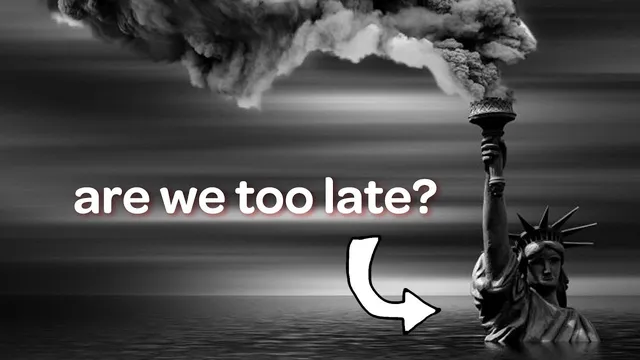
The New UN Climate Report: We're Screwed
Based on Second Thought's video on YouTube. If you like this content, support the original creators by watching, liking and subscribing to their content.
The report frames climate change as a global failure with human-rights consequences, not just a technical emissions problem.
Briefing
A new UN climate report warns that limiting warming to 1.5°C is no longer realistic and that the world is on track for severe, unequal harm—especially for people who contributed least to emissions. The report, drafted by Philip Alston, the UN Special Rapporteur on extreme poverty and human rights, frames climate change as a global failure to address root causes, with hard numbers for hunger, water stress, displacement, and premature death. It also argues that human rights institutions and UN bodies have not pushed hard enough to prevent the catastrophe.
The report’s central moral and economic claim is that climate damage will fall hardest on the poorest populations. Those with the least capacity to cope—despite low emissions—are expected to bear the brunt of droughts, storms, food system shocks, and health impacts. By contrast, the highest emitters have both contributed the most and retained the resources to shield themselves. The transcript highlights stark responsibility gaps: the poorest half of the world accounts for about 10% of carbon emissions, while the richest 10% accounts for roughly half. It also notes that individual emissions at the very top are dramatically higher—an individual in the top 1% uses about 175 times the carbon of someone in the bottom 10%.
On the temperature question, the report treats 1.5°C as effectively out of reach. Even if society achieved “historically unprecedented” transformation, the consequences would still be extreme. The transcript contrasts the earlier IPCC goal—where even a 0.5°C difference could reduce vulnerability by hundreds of millions—with the new reality: extreme droughts and famine, lost livelihoods, worse health, and reduced life expectancy. It cites projections tied to warming levels around 2°C, including up to 400 million more people at risk of hunger and starvation, as many as 2 billion facing inadequate access to water, and crop yield reductions of about 30% by 2080.
The human toll is projected to be massive. Between 2030 and 2050, the report expects an additional 250,000 deaths per year from malnutrition, malaria, diarrhea, and heat stress. By mid-century, displacement could reach around 140 million people across sub-Saharan Africa, South Asia, and Latin America, with additional impacts likely in island nations and coastal regions. Developing countries are forecast to shoulder 75–80% of climate-change costs—costs they can’t afford—making them more vulnerable to disasters, disease, and food-price spikes. The transcript adds that climate change could push about 120 million more people into poverty by 2030, with the report warning this figure may be an underestimate.
A major thrust of the report is accountability: governments and the private sector failed to act despite decades of scientific warnings. The transcript points to fossil fuel industry knowledge and disinformation, including a period when the American Petroleum Institute ran a “CO2 and Climate Task Force” (1979–1983) after reviewing evidence that CO2 from fossil fuels was driving warming. It claims that industry forecasts of severe warming were known, yet production continued and misinformation campaigns persisted. The result, in the transcript’s framing, is a preventable catastrophe that will likely be met with insufficient consequences—leaving the poorest to suffer while the biggest contributors remain comparatively insulated.
Cornell Notes
The UN climate report described here argues that the world has failed to stop the drivers of climate change and that limiting warming to 1.5°C is now a “pipe dream.” The forecast emphasizes extreme inequality: the poorest populations, who contributed least to emissions, face the worst outcomes—hunger, water stress, displacement, and premature deaths—while high emitters have more ability to avoid harm. Projections tied to roughly 2°C include up to 400 million more people at risk of hunger, as many as 2 billion facing inadequate water access, and large crop-yield losses by 2080. The report also assigns blame beyond governments, citing persistent fossil-fuel profiteering and decades of disinformation despite scientific warnings. The stakes are framed as a human-rights crisis, not just an environmental one.
Why does the report treat climate change as a human-rights and poverty crisis rather than only an environmental problem?
What responsibility gap does the transcript highlight, and how does that shape who suffers most?
What does the transcript say about the feasibility of the 1.5°C target?
If warming is assumed around 2°C, what key impacts are projected?
How does the transcript connect fossil-fuel industry knowledge to today’s outcomes?
Review Questions
- Which groups does the report identify as most responsible for emissions, and which groups are projected to suffer the most from climate impacts?
- What specific consequences does the transcript attach to warming around 2°C (hunger, water, crop yields, deaths, displacement)?
- What evidence from the transcript is used to argue that fossil-fuel companies knew about climate risks decades ago?
Key Points
- 1
The report frames climate change as a global failure with human-rights consequences, not just a technical emissions problem.
- 2
The projected harms are expected to be most severe for the poorest populations, who contributed least to emissions and have the fewest resources to adapt.
- 3
Limiting warming to 1.5°C is described as no longer achievable, even though earlier IPCC assessments showed large benefits from staying below 2°C.
- 4
Assuming roughly 2°C, the transcript cites major risks: hunger and starvation, water scarcity, large crop-yield declines, and substantial mortality from heat and disease.
- 5
Displacement could reach around 140 million people by mid-century, with developing regions and vulnerable communities hit hardest.
- 6
Developing countries are expected to bear 75–80% of climate-change costs, deepening poverty and making disasters and food-price shocks more likely.
- 7
The report assigns blame to governments and the private sector, including claims of long-running fossil-fuel disinformation despite decades of scientific warnings.