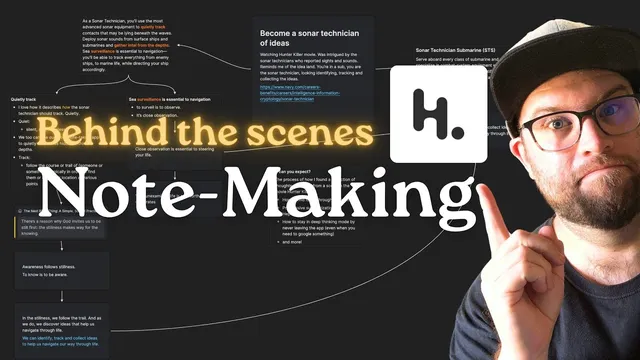
The note-making tool I use to discover ideas from anywhere (Heptabase Tutorial)
Based on Greg Wheeler's video on YouTube. If you like this content, support the original creators by watching, liking and subscribing to their content.
Start with a single strong curiosity, then capture it immediately in Heptabase’s Journal so the idea has a clear origin date.
Briefing
A movie about submarine rescue sparks a practical “idea sonar” workflow: capture a single curiosity, mine it with synonyms and definitions, and turn the results into connected building blocks inside Heptabase—without breaking deep-thinking momentum to switch apps. The payoff is not just more notes, but a traceable origin for each idea, plus a network of links that clarifies how one insight can guide future thinking.
The process begins with a specific trigger. While watching *Hunter Killer*, the viewer fixates on a sonar technician’s ability to distinguish torpedo and ship sounds. That curiosity becomes a journal entry in Heptabase’s Journal meta app, along with a Navy article URL describing sonar technician duties. The key detail is traceability: once the idea is fleshed out, the system lets the user return to the exact date the card was created and see the related ideas written that day—along with where the card sits in the workflow (weekly review and a “workbench” whiteboard where connections are built).
From there, the workflow shifts into a “stay in the app” research mode. In the Heptabase workbench whiteboard, a dedicated section—“become a sonar technician of ideas”—holds a card that already contains the pasted Navy URL. Instead of leaving Heptabase, the user opens a sidebar, copies the URL, and triggers an in-app Google lookup. Passages from the article are highlighted and pasted into the section, then key words are emphasized with orange highlights and bolding.
Those highlighted terms become the engine for progressive summarization through language. Words like “quietly track,” “still,” “surveillance,” “identify,” “track,” “collect,” and “navigation” are treated as prompts. The user looks up synonyms and definitions directly inside Heptabase using embedded Google searches, keeping multiple lookups open as needed. “Quietly track” leads to the idea of “be still,” tying the concept of stillness to the ability to follow a trail of meaning. The user then converts that into a building-block phrase—“awareness follows Stillness”—and extends it into a navigation metaphor: in stillness, people follow the trail; following the trail reveals ideas that help steer life.
A second path comes from “surveillance.” In context, surveillance is reframed as close observation, which the user links to steering one’s life through careful attention. That connection is reinforced with a Socrates quote about the value of an examined life, positioning observation as a prerequisite for wise direction.
Finally, the Navy job description supplies a structural template. The sonar technician’s tasks—identify, track, and collect scientific undersea data for defense and navigation—become a direct analogy for knowledge work: identify, track, and collect ideas so they can navigate life. The result is a clearer “sonar technician of ideas” identity built from cross-industry cues, plus visible connections between concepts that might otherwise remain buried.
The central message is that deep thinking can be engineered: start with one strong curiosity, mine it through synonyms and definitions, and convert the findings into linked, reusable knowledge blocks—while keeping research and synthesis inside the same app to preserve focus.
Cornell Notes
A single curiosity from a film—how sonar technicians detect meaningful sounds—turns into a repeatable Heptabase workflow. The method captures the initial idea in the Journal, attaches a relevant source (a Navy job description), then moves to a workbench whiteboard where highlighted phrases become prompts for synonym and definition lookups. Those lookups happen inside Heptabase via embedded Google searches, so research and synthesis stay in one place. Key terms like “quietly track,” “still,” “surveillance,” and “identify/track/collect” are translated into building blocks such as “awareness follows Stillness,” linking stillness to knowing and observation to steering life. The approach matters because it produces traceable, connected ideas that can guide future thinking rather than isolated notes.
How does the workflow turn one movie moment into a structured knowledge system?
Why are synonyms and definitions treated as part of the “idea sonar” process rather than separate research?
What does “quietly track” become after the synonym/definition mining?
How does “surveillance” get reframed into a life-steering principle?
How does the Navy job description structure the final analogy for knowledge work?
What role does staying inside Heptabase play in the workflow’s effectiveness?
Review Questions
- If you had to replicate this workflow, what would you record first in the Journal, and what would you attach to it to enable later expansion?
- Which highlighted term in the process most directly leads to a building-block phrase (e.g., “awareness follows Stillness”), and what intermediate synonym/definition step bridges them?
- How do “identify, track, collect” map onto knowledge work in this system, and what “purpose” does the analogy assign to the process?
Key Points
- 1
Start with a single strong curiosity, then capture it immediately in Heptabase’s Journal so the idea has a clear origin date.
- 2
Attach a relevant source (like a job-description article) to the idea early, so later expansion has grounded material to mine.
- 3
Move from Journal to a dedicated workbench whiteboard section where ideas can be expanded into connected cards and text elements.
- 4
Highlight key words in pasted passages and treat those terms as prompts for synonym and definition lookups.
- 5
Use Heptabase’s in-app Google search capability to keep research and synthesis in the same environment, reducing context switching.
- 6
Convert mined language into reusable building blocks (e.g., “awareness follows Stillness”) that connect concept to action.
- 7
Translate domain-specific tasks (identify/track/collect for navigation) into a personal knowledge workflow that guides future thinking.