The Oldest Unsolved Problem in Math
Based on Veritasium's video on YouTube. If you like this content, support the original creators by watching, liking and subscribing to their content.
Perfect numbers are defined by the equality between a number and the sum of its proper divisors (6 works; 10 does not).
Briefing
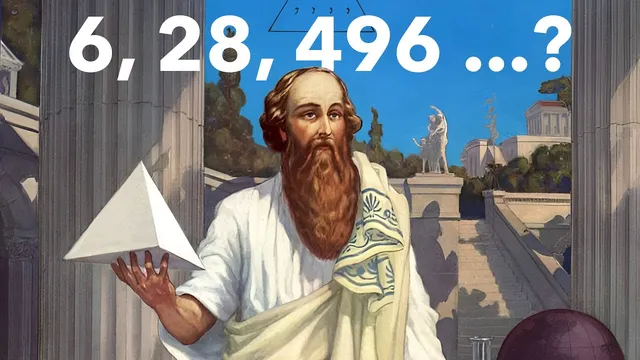
The oldest unsolved problem in math asks a deceptively simple question: does any odd perfect number exist? Perfect numbers are integers whose proper divisors add up exactly to the number itself—6 works (1+2+3=6), while 10 does not (1+2+5=8). For centuries, mathematicians found only even perfect numbers, and the search for odd ones has turned into a long-running chase through number theory, computer verification, and increasingly strict “must-be-true” conditions—yet no example has ever surfaced.
Even perfect numbers follow a celebrated construction traced to Euclid. If 2^P − 1 is prime (a Mersenne prime), then
2^(P−1)·(2^P − 1)
is perfect. This explains the known early perfect numbers: 6, 28, 496, and 8,128. It also connects perfect numbers to deep properties of primes of the form 2^P − 1. Over time, mathematicians tried to determine whether Euclid’s recipe was the only route to perfection. Nicomachus—writing around 2000 years ago—listed several conjectures, including that all perfect numbers are even and that Euclid’s form generates every even perfect number. Some of those claims were later disproved: Ibn Fallus produced a list where certain entries turned out not to be perfect, and later discoveries showed the “digits” and “ending-digit alternation” patterns Nicomachus believed in were wrong.
The breakthrough that settled the “only even perfect numbers of Euclid’s form” question came from Leonhard Euler. Using the sigma function (which sums all divisors of a number), Euler proved the Euclid–Euler theorem: every even perfect number must be generated by Euclid’s construction. That left the odd case as the real mystery, and Euler also derived a strong structural constraint: if an odd perfect number exists, it must have a very specific prime factorization pattern—one prime raised to an odd power and all others to even powers.
From there, progress has been mostly about narrowing the possibilities. Computers have pushed lower bounds dramatically: in 1991, an algorithmic “factor chain” approach showed any odd perfect number would have to exceed 10^300; later work raised that threshold to around 10^2200. Researchers also developed “spoofs”—numbers that satisfy many of the same divisibility and sigma-function properties as odd perfect numbers but fail at least one requirement. Finding properties that all spoofs share, and then proving that no number can satisfy the remaining conditions, is one promising strategy.
Meanwhile, the even side has flourished through Mersenne prime searches. In 1952, Raphael Robinson’s program on the SWAC computer accelerated discovery, and later efforts like GIMPS (launched in 1996 by George Woltman) distributed the search across volunteers. By 2017, John Pace found the 50th Mersenne prime, and the largest known primes today are almost always Mersenne primes—though that success hasn’t translated into an odd perfect number.
The current state of the problem is evidence without a proof. Heuristic reasoning by Carl Pomerance suggests odd perfect numbers should not exist, but heuristics can’t settle the question. As a result, the problem remains the same: after thousands of years, mathematicians still don’t know whether an odd perfect number exists—and the answer would complete a fundamental picture of how perfection can arise from divisors and primes.
Cornell Notes
Perfect numbers are integers whose proper divisors sum to the number itself (6 is perfect; 10 is not). Euclid showed a construction for even perfect numbers: if 2^P − 1 is prime (a Mersenne prime), then 2^(P−1)·(2^P − 1) is perfect. Euler proved the Euclid–Euler theorem, meaning every even perfect number must come from this form, leaving odd perfect numbers as the only open case. Euler also proved that any odd perfect number would have a highly restricted prime factorization: exactly one prime appears to an odd power, with all other primes to even powers. Despite extensive searches and stronger lower bounds (now around 10^2200), no odd perfect number has been found, and a proof of nonexistence remains out of reach.
What makes a number “perfect,” and how do early examples illustrate the definition?
How does Euclid’s construction generate even perfect numbers from primes of the form 2^P − 1?
What did Euler prove about even perfect numbers, and why was that decisive?
What structural constraint does Euler derive for odd perfect numbers?
How have modern computations narrowed the search for odd perfect numbers?
What are “spoofs,” and how do they relate to the odd perfect number hunt?
Review Questions
- Why does Euclid’s construction require that 2^P − 1 be prime, and how does that lead to a perfect number?
- What parity argument about σ(p^k) forces exactly one prime to an odd exponent in any hypothetical odd perfect number?
- What does it mean for a number to be a “spoof,” and how could proving a property shared by all spoofs help rule out odd perfect numbers?
Key Points
- 1
Perfect numbers are defined by the equality between a number and the sum of its proper divisors (6 works; 10 does not).
- 2
Euclid’s construction produces even perfect numbers whenever 2^P − 1 is prime, yielding 2^(P−1)·(2^P − 1).
- 3
Euler proved the Euclid–Euler theorem: every even perfect number must come from Euclid’s construction, eliminating any other source for even perfect numbers.
- 4
Euler’s sigma-function method shows that any odd perfect number would have exactly one prime factor raised to an odd power, with all other primes raised to even powers.
- 5
Computational progress on odd perfect numbers has focused on constraint propagation, pushing the smallest possible odd perfect number beyond about 10^2200.
- 6
The search uses “spoofs” to approximate odd perfect numbers; proving that all spoofs fail a final necessary condition could establish nonexistence.
- 7
Heuristic predictions (not proofs) suggest odd perfect numbers should not exist, but the problem remains unsolved because heuristics can’t replace a rigorous argument.