The Only* Car-Free Neighbourhood in Canada (and why you can't live there)
Based on Not Just Bikes's video on YouTube. If you like this content, support the original creators by watching, liking and subscribing to their content.
Toronto’s Ward’s Island and Algonquin Island host Canada’s only meaningful car-free residential neighborhood, with ferry access and near-zero private car presence.
Briefing
Toronto’s Toronto Islands function as Canada’s only meaningful car-free residential neighborhood—an island community where daily life runs on walking, cycling, and ferry access, not private vehicles. The result is strikingly quiet streets, well-preserved roads, and a cottage-like setting that still sits minutes from downtown Toronto. But the same rules that keep the islands car-free also make the place effectively impossible to replicate elsewhere in Canada, turning a livable experiment into a rare, tightly rationed exception.
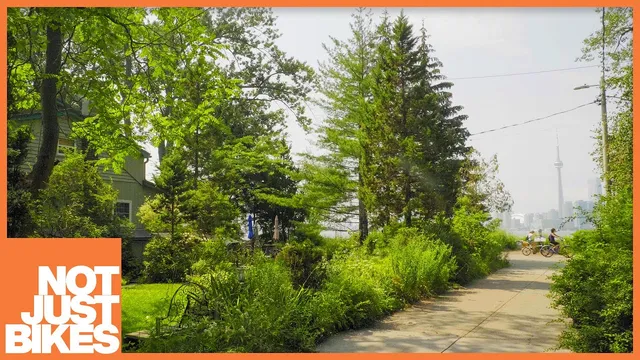
Access begins with a ferry: the ride costs $8.50 and departs from the downtown terminal named after socialist politician Jack Layton, while a water taxi option runs $10. Bikes can be brought aboard for no extra charge, and once on the islands, cycling becomes the practical default. The environment feels different from the mainland—less noise, more nature, and even the asphalt appears to hold up better than Toronto’s downtown streets. The transcript attributes that durability to the fact that bicycles dominate local traffic, avoiding the heavy wear that cars and trucks cause.
The islands are split between Ward’s Island and Algonquin Island, with residents—often described as “islanders”—moving around on foot or by bike, including elderly residents carrying heavy items without cars. Services are limited: there are no shops and only a few restaurants aimed at tourists and day-trippers, so most supplies come from the mainland. Still, the islands include a school with a cargo bike for transporting children, plus a fire station with an ambulance and fire truck. The community’s small-scale logistics also include marinas, a nude beach, and an amusement park called Centerville.
The car-free reality is inseparable from the islands’ history. Indigenous presence in the area includes the Mississaugas of the Credit First Nations, and a dispute over whether the islands were included in the Toronto Purchase wasn’t resolved until 2010. The islands were once connected to the mainland until a storm separated them in 1858, and they previously hosted a hotel, a children’s hospital, a baseball stadium, and a yacht club.
After World War II, Toronto’s car push accelerated in the 1960s, including plans for a waterfront freeway that threatened neighborhoods such as South Parkdale. When freeway plans were stopped in the 1970s, the city converted the waterfront parkland into a public park—at the cost of evicting residents between 1955 and 1970. Homes fell from more than 600 to about 250, triggering decades of legal battles that reached the Supreme Court of Canada. An agreement in 1993 left the parks department owning the land while residents received 99-year leases, with restrictions on transfers and fixed-price sales.
Today, demand far outstrips supply. The waiting list is capped at 500 people and has been full since it began, with only one or two homes selling per year. The transcript highlights how the rules can produce unusual workarounds, such as a 91-year-old man adopting a 60-year-old friend to inherit a home.
The bigger frustration is policy: building another car-free residential neighborhood like this is described as effectively illegal in Canada, and developers would face massive costs to meet car-oriented regulations. A proposed car-free neighborhood by Sidewalk Labs on Toronto’s waterfront—featuring surveillance-style cameras and sensors—was canceled in 2020 after backlash over data privacy. The transcript contrasts this with the Netherlands’ “autoloo” concept, where areas are mostly car-free but allow vehicle access when needed, arguing that such models are cheaper, safer, and more feasible to scale. The discussion then pivots to future car-free travel and learning, including a series on Nebula featuring places like Greathorn in the Netherlands and car-free tram streets across Europe.
Cornell Notes
Toronto’s Ward’s and Algonquin Islands host Canada’s only practical car-free residential neighborhood, where residents rely on ferries, walking, and cycling instead of private cars. The islands’ quiet streets and durable asphalt are linked to bicycle-dominant travel, while limited on-island services mean most shopping comes from the mainland. The community persists because of a long, contentious history: residents were evicted when the city shifted waterfront land toward park use after freeway plans, leading to Supreme Court litigation and a 1993 settlement with 99-year leases and strict transfer rules. Today, a capped waiting list and slow home turnover make the islands hard to access, and the transcript argues Canada’s regulations make it nearly impossible to build similar car-free neighborhoods elsewhere.
How does the islands’ car-free design shape everyday mobility and infrastructure?
What amenities and services exist on the islands, and what’s missing?
Why did the islands become car-free residential space in the first place?
What legal and ownership rules govern living on the islands today?
Why can’t similar car-free neighborhoods be built elsewhere in Canada, according to the transcript?
What happened to a proposed car-free neighborhood on Toronto’s waterfront?
Review Questions
- What specific historical events and policy decisions led to residents being displaced and later allowed back under 99-year leases?
- How do the islands’ transportation rules (ferry access, bike-first movement) influence both the physical environment (road wear) and daily routines (shopping and services)?
- What constraints—legal, financial, and political—does the transcript identify as barriers to building new car-free residential neighborhoods in Canada?
Key Points
- 1
Toronto’s Ward’s Island and Algonquin Island host Canada’s only meaningful car-free residential neighborhood, with ferry access and near-zero private car presence.
- 2
Bicycles dominate local travel, and the transcript links that to better long-term asphalt quality compared with downtown Toronto’s car-heavy streets.
- 3
On-island services are limited—no shops and only a few restaurants—so residents rely on the mainland for most purchases.
- 4
The islands’ current residential model traces back to mid-century freeway politics, resident evictions for parkland, and a 1993 settlement that granted 99-year leases with strict transfer and sale rules.
- 5
A capped waiting list (500 people) has been full since it started, with only one or two homes selling per year, creating unusual inheritance workarounds.
- 6
The transcript argues Canada’s car-accommodating regulations make it effectively illegal to build similar car-free residential neighborhoods today, and it cites Sidewalk Labs’ canceled waterfront proposal as an example of additional political and privacy hurdles.
- 7
The Netherlands’ “autoloo” model is presented as a more scalable alternative: mostly car-free areas that still allow vehicle access when necessary.