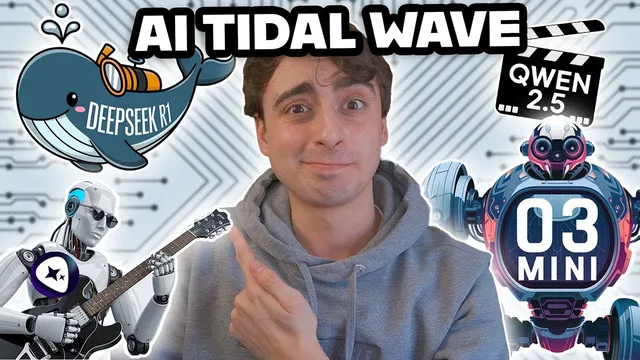
The Open Source AI Revolution continues! HUGE News & Updates
Based on MattVidPro's video on YouTube. If you like this content, support the original creators by watching, liking and subscribing to their content.
DeepSeek R1’s open-source release is linked to a short-term tech selloff, but critics argue the market misread how “thinking” inference affects compute demand.
Briefing
A sharp U.S. tech selloff tied to DeepSeek’s open-source R1 model is being framed as shortsighted—because the “thinking” model that triggered the reaction is also likely to expand AI adoption and increase competitive pressure, not permanently erase U.S. leadership. The crash was described as dramatic (with the tech sector down roughly 19% over five days), and the market reaction was linked to the release of DeepSeek R1, an open-source Chinese large language model positioned as a close competitor to OpenAI’s o1. Supporters of R1 argue the market misread the economics: R1 is trained already, but as a “thinking” chain-of-thought style model, it can require more inference-time compute per query, which doesn’t naturally translate into “fewer GPUs needed” for the broader AI wave. Instead, open availability is expected to let more developers study, iterate, and build—accelerating the compounding pace of innovation.
That view is reinforced by commentary from AI insiders, including a senior NVIDIA researcher, Jim Fan, who is cited as pushing back on the “it’s so over” narrative. The argument centers on open-source benefits: American companies can benefit from DeepSeek R1’s research and tooling, and the model’s open release is portrayed as a net gain for the ecosystem. DeepSeek’s continued shipping also undercuts the idea that the moment is purely negative. Alongside R1, DeepSeek reportedly published additional open releases, including Janice 7B (MIT licensed), a lightweight multimodal model that can generate and ingest images and is designed to run locally on many machines.
The competitive pressure theme then shifts to OpenAI. OpenAI CEO Sam Altman is quoted responding to DeepSeek’s momentum by praising R1’s price-performance and emphasizing that more compute remains central to progress. Altman’s message also frames competition as healthy: better models at better prices for consumers. OpenAI’s own roadmap is discussed through upcoming releases such as o3 mini, described as a faster, more capable step in the o-series. Rumors place a possible release window “today” or within the next week, and the transcript also notes an upgrade to GPT-4o with improved image recognition.
Beyond the core LLM race, the roundup broadens into adjacent AI markets. In AI music, a new beta music generation site called Refusion is promoted as offering unlimited free generations while in beta, plus controls like personalization and “multisound prompts.” The transcript also surveys the competitive landscape: 11 Labs, closed competitors like Udio, and open-source music models such as Yu, with the claim that 2025 could bring heavier competition and more locally runnable options.
Several policy and research updates follow. The U.S. Copyright Office is reported to have clarified that using AI tools in the creative process does not automatically undermine copyright, while reiterating that human authorship is essential and that simply entering prompts isn’t enough. Research highlights include Netflix’s “Go with the Flow,” a method for controlling motion in video diffusion models via cut-and-drag style interaction, and Alibaba’s reported addition of video generation to its Qwen 2.5 release. The overall throughline: open-source releases, faster iteration, and clearer rules are accelerating AI adoption—even when markets react emotionally in the short term.
Cornell Notes
DeepSeek R1’s open-source release triggered a steep U.S. tech selloff, but the dominant counterpoint is that the market misread what open models change. R1’s “thinking” approach may increase inference-time compute per request, and open availability can help developers build faster, expanding adoption rather than shrinking demand. DeepSeek’s continued releases (including MIT-licensed Janice 7B for local multimodal use) reinforce the idea that momentum is ongoing. OpenAI’s response—praising R1’s price-performance and emphasizing more compute—signals that competition is pushing better models and potentially lower costs. The roundup also highlights AI music, copyright guidance on AI-assisted creation, and research advances in interactive video generation.
Why did DeepSeek R1’s release spark a market drop, and why do critics call that reaction shortsighted?
What does “open source” change in the AI ecosystem according to the transcript’s examples?
How does the transcript connect DeepSeek’s momentum to OpenAI’s messaging?
What other AI areas are highlighted beyond LLMs, and what’s the common theme?
What policy update affects creators using AI tools?
What does Netflix’s “Go with the Flow” contribute to interactive video generation?
Review Questions
- How do the transcript’s arguments reconcile “thinking models” with claims about GPU demand?
- What role does open licensing (e.g., MIT licensing) play in enabling local multimodal AI use?
- Why does the U.S. Copyright Office’s clarification matter for small creators using AI in post-production?
Key Points
- 1
DeepSeek R1’s open-source release is linked to a short-term tech selloff, but critics argue the market misread how “thinking” inference affects compute demand.
- 2
Open-source availability is portrayed as increasing developer experimentation, which can expand AI adoption and accelerate innovation.
- 3
DeepSeek’s continued releases, including MIT-licensed Janice 7B, are presented as evidence of sustained momentum and broader local multimodal capability.
- 4
OpenAI’s response—praising R1’s price-performance and emphasizing more compute—frames competition as beneficial for consumers.
- 5
Refusion is promoted as a beta AI music generation platform offering unlimited free generations and user-controllable features like personalization and multisound prompts.
- 6
The U.S. Copyright Office clarified that AI-assisted creative tools don’t automatically undermine copyright, while requiring meaningful human authorship.
- 7
Research updates include Netflix’s cut-and-drag style motion control for video diffusion models and Alibaba’s reported addition of video generation to Qwen 2.5.