The Origin of Quantum Mechanics (feat. Neil Turok)
Based on minutephysics's video on YouTube. If you like this content, support the original creators by watching, liking and subscribing to their content.
Planck’s quantization rule was driven by a mismatch between classical electromagnetic predictions and measured radiation spectra from hot filaments.
Briefing
Quantum mechanics traces back to a practical engineering problem: making light bulbs more efficient by predicting how a hot filament distributes its emitted light across wavelengths. In the early 1890s, the German Bureau of Standards asked Max Planck for a way to calculate the spectrum of radiation from a heated object—specifically, how to maximize visible light while minimizing energy lost to ultraviolet and infrared. Classical electromagnetic theory kept producing predictions that disagreed with experimental measurements, leaving Planck to abandon the old approach and work backward from the data.
The experimental results forced a startling rule: energy in light is not emitted continuously but in discrete packets, or “quanta.” Higher-frequency light comes in larger energy packets; lower-frequency light comes in smaller ones. Planck’s “act of despair” wasn’t a philosophical leap so much as a mathematical necessity to match what instruments measured. Yet the idea quickly connected to a deeper pattern: energy sharing among many recipients. Neil Turok’s analogy frames the issue as a cookie-sharing problem—if energy were spread continuously across infinitely many tiny waves (like infinitely many kids sharing limited cookies), each would receive an infinitesimal amount and the total system would absorb energy without bound, effectively freezing anything placed in the room. The universe avoids this runaway behavior because the smallest, high-frequency waves can’t take just any amount; they demand specific packet sizes.
That “fussy” requirement prevents the infinite absorption catastrophe. Instead, energy exchange becomes quantized: only certain packet energies are allowed, so high-frequency contributions are suppressed unless the source is hot enough to supply the larger quanta. In this framework, temperature becomes the average energy carried by these packets. As temperature rises, the typical packet energy increases, shifting the emitted radiation toward higher frequencies—explaining why objects glow first in infrared, then red, yellow, white, and eventually toward blue, violet, and ultraviolet as they get hotter.
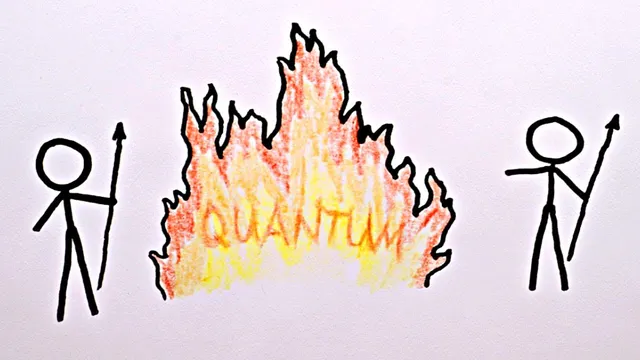
Planck’s model also yields a concrete design target for light bulbs. To concentrate most emission in the visible range, filaments should be heated to roughly 3200 Kelvin. The transcript closes by emphasizing that quantum physics isn’t confined to lab instruments or modern electronics: everyday combustion already hints at quantized behavior, with flame colors reflecting the same underlying relationship between temperature and the spectrum of emitted radiation.
Cornell Notes
Quantum theory emerged from an efficiency challenge in early light-bulb design: predicting the radiation spectrum of a hot filament. Max Planck found that classical electromagnetic theory couldn’t match measurements, so he derived a rule that light energy is emitted in discrete packets (“quanta”). The quantization prevents an otherwise catastrophic “infinite sharing” scenario where infinitely many tiny waves would absorb unlimited energy. In Planck’s framework, temperature corresponds to the average energy per packet, so hotter objects emit higher-frequency light. This explains the observed color shift from infrared to visible and then toward ultraviolet, and it even implies a practical filament temperature near 3200 Kelvin for visible-dominant light.
What practical problem pushed Max Planck toward quantization?
Why did classical electromagnetic theory fail for the filament spectrum?
What is the “quanta” rule, and how does it avoid an infinite-energy disaster?
How does temperature connect to the spectrum in this picture?
What filament temperature does the model suggest for visible light bulbs?
How does the cookie-sharing analogy relate to the physics?
Review Questions
- How does quantization change the way energy is distributed among light waves compared with a continuous-wave model?
- Explain how the concept of temperature as average packet energy leads to the observed color shift of glowing objects.
- What role does the “fussy” acceptance of specific packet sizes play in preventing infinite absorption?
Key Points
- 1
Planck’s quantization rule was driven by a mismatch between classical electromagnetic predictions and measured radiation spectra from hot filaments.
- 2
Light energy is emitted in discrete packets (“quanta”), with higher-frequency light associated with larger packet energies.
- 3
Quantization prevents an infinite-energy absorption scenario that would arise if arbitrarily small waves could share energy continuously.
- 4
Temperature corresponds to the average energy carried by these packets, so hotter objects emit higher-frequency light.
- 5
The spectrum shift explains why objects glow from infrared to visible and then toward ultraviolet as temperature rises.
- 6
Planck’s model implies a practical filament target of about 3200 Kelvin to concentrate most emission in the visible range.