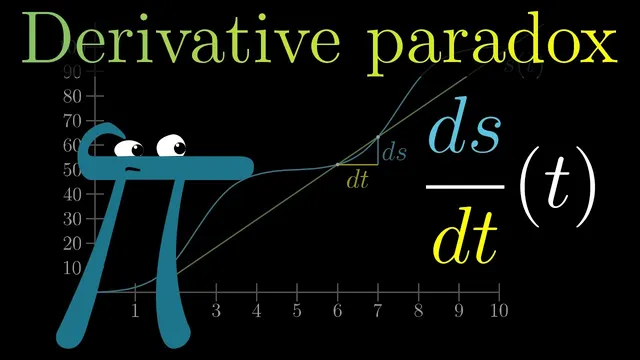
The paradox of the derivative | Chapter 2, Essence of calculus
Based on 3Blue1Brown's video on YouTube. If you like this content, support the original creators by watching, liking and subscribing to their content.
Velocity can’t be determined from a single time snapshot; it requires comparing distances across a time interval.
Briefing
Calculus’s derivative isn’t a literal “instantaneous rate of change”—that phrase collapses under scrutiny because real change requires comparing two different moments. The derivative instead captures the best single-number rate that can approximate change *around* a particular time, obtained by looking at how the average rate behaves as the time interval shrinks toward zero. That shift—from a fixed tiny interval to a limiting process—turns a conceptual paradox into a precise mathematical tool.
The explanation starts with a concrete motion problem: a car travels from point A to point B over 10 seconds, first speeding up and then slowing to a stop. Distance traveled as a function of time, s(t), rises slowly at first (small slope), steepens as the car accelerates, then flattens again as it decelerates. Velocity, plotted against time, forms a “bump” shape: near the start it’s near zero, it peaks mid-journey, and it returns to zero at the end. The key question becomes how velocity depends on the distance curve.
At first glance, velocity seems to demand two time points: velocity is distance change divided by time change. A snapshot at one instant can’t reveal speed; you need a comparison across time. That mismatch—wanting a function v(t) that assigns a value at a single t, while the definition of velocity uses two times—creates the “paradox of the derivative.” The resolution is physical and operational: a speedometer measures over a small but nonzero time window (for example, from t to t+0.01), effectively computing a ratio like ds/dt using tiny increments.
Mathematics then sharpens the idea. For a chosen small dt, the ratio (s(t+dt)−s(t))/dt equals the slope of a secant line through two nearby points on the s(t) graph. The derivative is not tied to any particular dt; it is the limit of that slope as dt approaches 0. In geometric terms, the limiting secant slope becomes the slope of the tangent line at the single point t. Crucially, calculus does not require plugging in dt=0 or imagining an actual “infinitely small” interval. The derivative is the value the secant-slope expression approaches as the interval gets smaller and smaller.
A worked example makes the mechanism feel less mysterious. If s(t)=t^3, then the velocity at time t is found by forming ( (2+dt)^3 − 2^3 )/dt and expanding. After cancellation, the expression reduces to 3·2^2 plus terms still containing dt; letting dt→0 removes those extra terms, leaving 12. More generally, the derivative of t^3 is 3t^2.
That result sets up the central paradox about “instantaneous motion.” At t=0, the derivative gives velocity 0 because the tangent line is flat. But the car does move immediately after the start: between 0 and 0.1 seconds it travels a small distance (0.001 m), corresponding to an average speed of 0.01 m/s. The derivative being 0 means the *best constant approximation* to the car’s velocity near t=0 is 0, not that the car is literally motionless. The derivative’s power—and why calculus becomes useful—lies in replacing the impossible notion of change at a single instant with a rigorous limiting approximation around that instant.
Cornell Notes
The derivative resolves a conceptual conflict: velocity seems to require comparing two different times, yet v(t) assigns a value to a single instant. The fix is to compute average rates over a small interval dt, then take the limit as dt→0. Geometrically, the secant-line slope between (t, s(t)) and (t+dt, s(t+dt)) approaches the tangent-line slope at t. For s(t)=t^3, the limiting process yields v(t)=3t^2, including v(0)=0. That “0” does not mean the car never moves; it means the best constant approximation to its velocity near t=0 is 0 m/s.
Why does the phrase “instantaneous rate of change” create a paradox?
How does the derivative connect velocity to the distance function s(t)?
What does “dt approaches 0” mean, and what does it not mean?
How does the example s(t)=t^3 produce v(t)=3t^2?
If v(0)=0 for s(t)=t^3, how can the car still be moving at t=0?
Review Questions
- In what sense is the derivative a “single-number” rate even though velocity is defined using differences across time?
- Explain the geometric meaning of (s(t+dt)−s(t))/dt and how it turns into the derivative.
- For s(t)=t^3, compute the velocity at t=2 using the limiting idea (without fully expanding every term). What result should you get?
Key Points
- 1
Velocity can’t be determined from a single time snapshot; it requires comparing distances across a time interval.
- 2
For a small dt, (s(t+dt)−s(t))/dt represents the average velocity over that interval and equals the secant slope on the distance-time graph.
- 3
The derivative v(t) is defined as the limit of that secant slope as dt→0, yielding the tangent-line slope at t.
- 4
Calculus avoids the impossible notion of “change in an instant” by using a limiting approximation around the instant.
- 5
For s(t)=t^3, the derivative is v(t)=3t^2, obtained by expanding (t+dt)^3 and letting dt→0.
- 6
A derivative value of 0 at a time does not mean the object is motionless; it means the best constant approximation to the velocity near that time is 0.