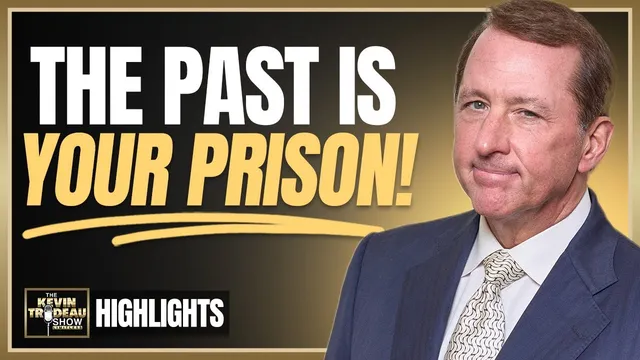
The Past is a Cancelled Check You've Got to Let it Go!
Based on The Kevin Trudeau Show: Limitless's video on YouTube. If you like this content, support the original creators by watching, liking and subscribing to their content.
Unresolved emotions from past events are described as “energetic imprints” that keep emitting a frequency and shaping future experiences.
Briefing
Holding on to past hurts—especially anger, guilt, regret, and grief—creates “energetic imprints” that keep people stuck and can damage health, according to a wellness-and-mindset argument built around the idea that the past is “a cancelled check” that should be released. The core claim is that unresolved emotional trauma doesn’t stay contained in memory; it remains active in the body and mind as contracted energy (described using terms like “samscara” and “engram”), continually emitting a frequency that attracts more of the same emotional patterns through a law-of-attraction cycle.
The argument starts with a practical question: what people are refusing to let go of. It then links that refusal to both personal outcomes—reduced joy, happiness, and “enlightenment success”—and physical consequences. The transcript frames the mechanism as follows: when an event happens and triggers trauma, the analytical mind can’t process it, so the experience is stored in a reactive/subconscious layer. That stored imprint supposedly vibrates and pulls additional circumstances that mirror the original emotion, trapping someone in a loop of regret or hate.
From there, the health claim becomes more specific and more alarming. Unreleased negative emotions are said to contribute to serious illness, with heart attack and cancer singled out as outcomes. The transcript ties this to an alkalinity/oxygenation theory of cancer: cancer is described as unable to survive in an alkaline or oxygen-rich environment. A personal anecdote is used to support the connection. At the “Hyprocrates Health Center” in West Palm Beach, the narrator expected a fitness-and-spa style retreat but found many patients there because conventional medicine hadn’t solved their conditions. Despite diets and alternative practices—raw/alkalizing foods, pure water, cleanses, fasting, yoga, exercise, and supplements—many patients still had cancer, and saliva/urine tests were described as showing high acidity.
The transcript argues that diet alone wasn’t shifting the internal environment enough because the “number one” driver of acidity was negative thinking—again traced back to unresolved engrams. A doctor referenced as Dr. Paulus (credited with two Nobel prizes) is cited for the claim that cancer can’t live in alkaline or oxygen-rich conditions. The transcript also adds a sensory detail: people with cancer are said to smell of ammonia because the body supposedly produces ammonia while trying to balance acidity.
To address the emotional root, the transcript describes a release process aimed at identifying the specific trauma imprint and dissolving it. Participants are asked to name a major trauma immediately—examples include a son dying in a car crash, divorce, job loss, bankruptcy, and betrayal by a business partner. A “reversal” is described as a common obstacle: some people say they want to release, but their internal response is treated as “no,” requiring correction before the release can happen. The transcript then lists multiple modalities—Thought Field Therapy (TFT), the Callahan technique, Dr. Hawkins’ “Letting Go” approach, and the Sedona Method—along with a virtual/energy-based procedure that “contracts” the emotion into a ball in the stomach and then releases it on exhale. Emotional catharsis (crying, breathing changes, color returning) is presented as evidence that something was lifted.
The closing message returns to the central metaphor: the past is history, the future is a mystery, and the present is a gift. Letting go is framed not as a slogan but as a health and life-improvement requirement—because holding on is portrayed as a direct path to misery and, in the transcript’s view, potentially to fatal disease.
Cornell Notes
The transcript argues that unresolved past trauma—anger, guilt, regret, grief, and bitterness—creates “energetic imprints” (engram/samscara) that keep people emotionally and physically stuck. These imprints are described as vibrating at a frequency that attracts more of the same negative experiences, creating a repeating cycle. A health claim links negative thinking to bodily acidity, which is then tied to cancer risk through an alkalinity/oxygenation theory: cancer is said to struggle in alkaline or oxygen-rich environments. An anecdote from a health center describes cancer patients who followed strict alternative diets yet remained ill, leading to the conclusion that emotional release is the missing lever. A release process is presented as identifying the specific trauma and dissolving it, sometimes after correcting an internal “reversal.”
What does “energetic imprint” mean in this framework, and why does it matter?
How does the transcript connect emotional holding-on to cancer risk?
What role does the “law of attraction” play in the argument?
Why does the transcript say some people need to correct a “reversal” before releasing trauma?
What techniques are named for letting go, and how are they positioned?
What kinds of past events are used as examples of the trauma imprint?
Review Questions
- According to the transcript, what happens to trauma when the analytical mind can’t process it, and where is it stored?
- How does the transcript connect acidity/alkalinity to cancer, and what evidence from the health center is used to support that link?
- What does the transcript mean by a “reversal,” and how does correcting it change the release outcome?
Key Points
- 1
Unresolved emotions from past events are described as “energetic imprints” that keep emitting a frequency and shaping future experiences.
- 2
Trauma is framed as being stored in a reactive/subconscious layer when it can’t be processed, which then sustains emotional cycles.
- 3
The transcript links negative thinking to bodily acidity and uses an alkalinity/oxygenation theory to connect emotional release to cancer risk.
- 4
Dietary and alternative health practices are portrayed as insufficient if emotional trauma remains unaddressed.
- 5
A release process is presented as identifying the specific trauma imprint and dissolving it, sometimes after correcting an internal “reversal.”
- 6
Multiple letting-go modalities are named (TFT, Callahan technique, Dr. Hawkins’ Letting Go, Sedona Method), alongside an energy-based approach.