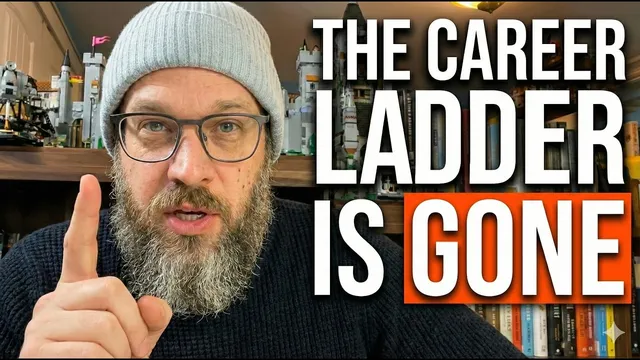
The People Getting Promoted All Have This One Thing in Common (AI Is Supercharging this Mindset)
Based on AI News & Strategy Daily | Nate B Jones's video on YouTube. If you like this content, support the original creators by watching, liking and subscribing to their content.
Entry-level hiring and postings have fallen sharply, and AI is automating many of the tasks that used to train newcomers for the next career rung.
Briefing
Entry-level career ladders are collapsing as generative AI takes over the “training tasks” that used to teach newcomers how to operate inside complex organizations—summarizing meetings, cleaning data, drafting memos, and processing information. With fewer entry roles and fewer rungs to climb, promotions increasingly demand experience that junior jobs no longer provide. The result is a steeper path to advancement, and for many people, a path that traditional, time-served progression can’t deliver.
The proposed replacement for the disappearing ladder is “high agency,” defined not as confidence or motivation, but as an internal locus of control: the belief that the major elements shaping outcomes are within one’s influence. A simple exercise frames it as a circle on paper—everything inside is treated as controllable, everything outside as beyond reach. People with low agency tend to place key career levers (learning, promotion timing, skill acquisition) outside the circle, while people with high agency place them inside. When setbacks occur, the high-agency response is not denial; it’s a “skill issue” framing—“I don’t know how to do it yet, but I can learn,” then identifying what’s blocking progress and adjusting the approach.
Critics are addressed directly: the mindset isn’t meant to ignore layoffs, structural barriers, or economic forces. Instead, the claim is that while individuals can’t control whether a company cuts jobs, they can control how they respond, what they learn next, and where they direct effort—factors correlated with better career trajectories. Research cited in the transcript links internal locus of control to persistence, higher academic achievement, stronger professional outcomes, and more effective leadership; students with internal attributions outperform others by roughly 20–30% on average.
AI is positioned as the “jet engine” that makes high agency more actionable and more scalable. The argument is that AI equalizes agency by compressing timelines: obstacles that once required years of education, rare access, or specialized networks can be attacked with a laptop and iterative learning. The gap between high- and low-agency behavior, described as slow over decades, now widens quickly—months instead of years—because AI accelerates both capability building and stagnation.
That acceleration reshapes what organizations reward. Senior leadership roles increasingly go to people with existing leadership experience plus “AI-native” ways of working. Titles also lose meaning: low-agency people cling to credentials as status markers, while high-agency people treat titles as temporary labels and focus on producing outcomes over time.
The practical prescription is high agency plus AI fluency, reinforced by two behavioral rules: keep expanding the locus of control by turning “outside my control” goals into “what would it take to own this?” projects, and raise the “say-do ratio” by acting immediately—starting uncomfortable work, shipping partial progress, and using AI to prototype and learn faster. Examples of solo founders and lean AI startups illustrate the pattern: fewer employees, faster iteration, and value creation driven by rapid learning loops. The closing message is that the old ladder is gone, but a new link has emerged between agency, intelligent tools, and the ability to create value at scale—rewarding people who build, ship, and iterate now rather than waiting for permission later.
Cornell Notes
The transcript argues that AI is dismantling the traditional entry-to-promotion ladder by automating the low-risk tasks that used to train newcomers. As entry roles shrink and requirements rise, advancement depends less on time-served credentials and more on “high agency”—an internal locus of control where key outcomes (learning, skill-building, next steps) are treated as influenceable. High agency isn’t confidence; it’s a skill-focused response to obstacles (“It’s a skill issue—I can learn”) paired with persistence. AI then acts as a force multiplier: it compresses learning and prototyping timelines, enabling individuals to create value at scale even without prior networks or pedigree. The practical takeaway is to pair internal locus of control with AI fluency and a high say-do ratio—start, ship, iterate, and expand what you treat as controllable.
How does the transcript define “high agency,” and how is it different from motivation or confidence?
What does “It’s a skill issue” mean in practice when facing setbacks like layoffs or missed promotions?
Why does the transcript claim AI changes the speed of career divergence between high- and low-agency people?
What are the two behavioral components the transcript highlights for turning agency into results?
How does the transcript connect high agency to AI fluency and solo-founder success?
What does the transcript say about job titles and credentials in an AI-driven, reorganizing workplace?
Review Questions
- What is the circle-and-control exercise meant to reveal about how someone interprets career levers like learning and promotion timing?
- How does the transcript distinguish “high agency” from emotional confidence, and what response does it recommend when an obstacle feels outside control?
- According to the transcript, what specific behaviors raise the say-do ratio, and how does AI change the feasibility of shipping early progress?
Key Points
- 1
Entry-level hiring and postings have fallen sharply, and AI is automating many of the tasks that used to train newcomers for the next career rung.
- 2
High agency is defined as an internal locus of control—placing key career levers inside what you can influence, not as a feeling of empowerment.
- 3
When blocked, high-agency people use a “skill issue” frame to identify what to learn next and adjust tactics rather than treating obstacles as fate.
- 4
AI acts as a force multiplier for agency by compressing learning and prototyping timelines, widening the gap between active and passive career behaviors.
- 5
Organizations increasingly reward AI-native execution and scaled outcomes, making traditional credentials and titles less predictive of advancement.
- 6
A practical strategy combines expanding locus of control with a high say-do ratio: act immediately, ship imperfect progress, and use AI to generate next actions.
- 7
The transcript argues that the old ladder is gone, but a new link has emerged between agency, intelligent tools, and value creation at scale.