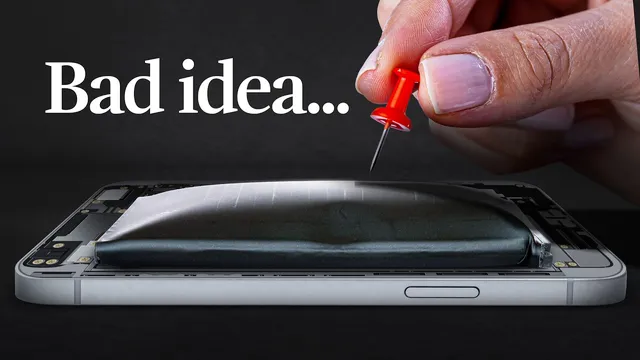
The Perfect Battery Material Is Dangerous
Based on Veritasium's video on YouTube. If you like this content, support the original creators by watching, liking and subscribing to their content.
Water-based electrolytes cap cell voltage at about 1.23 volts because electrolysis begins at that threshold.
Briefing
Lithium-ion batteries became the backbone of modern electronics and electric vehicles, but their core chemistry still carries a built-in failure mode: when internal conditions go wrong, heat and short circuits can trigger runaway combustion. The breakthrough that made lithium-ion batteries practical—replacing unstable, water-based electrolytes and using safer electrode materials—also created a system that can fail violently if damaged, overheated, or manufactured poorly. That tension helps explain both the batteries’ dominance and why incidents on planes and in cities keep happening.
The story begins with a constraint that shaped battery design for decades: water-based electrolytes cap cell voltage at about 1.23 volts. Early rechargeable batteries therefore struggled with low energy density, forcing bulky packs for phones, laptops, and medical devices. In the early 1970s, Stanley Whittingham at Exxon pushed past that ceiling by pairing a lithium-based chemistry with a layered cathode material—titanium disulfide (TiS₂). The structure mattered. TiS₂ forms stacks held together by weak van der Waals forces, creating gaps that lithium ions can intercalate into and out of repeatedly. Lithium’s electrochemistry offered high energy per electron, but the practical problem was safety: lithium metal anodes can form dendrites—needle-like growths that pierce separators, short the cell internally, and can ignite a chain reaction.
Whittingham’s prototype delivered nearly double the voltage of earlier designs (about 2.4 volts per cell) and showed impressive cycle consistency, but it was too dangerous for broad adoption. Firefighters were repeatedly called to Exxon labs, and the program was shut down when the oil crisis eased. Whittingham published the work in 1976, yet the first lithium battery revolution stalled—partly because the chemistry was promising but the institutional momentum wasn’t.
John B. Goodenough later improved the cathode. By switching from sulfides to more stable transition-metal oxides, he pushed cell voltage from roughly 2.4 volts to about four volts using lithium cobalt oxide (LiCoO₂). That cathode already contains lithium, reducing reliance on lithium metal and pointing toward safer designs. Still, the invention struggled to find traction due to patent and funding delays.
Akira Yoshino then solved the missing piece for a commercial, safer battery anode. He explored polyacetylene, a conductive plastic that could host lithium ions, but it lacked the energy density needed for real products. His breakthrough came when vapor grown carbon fiber worked as an anode in safety tests, and then Sony helped translate the concept into mass-market cells by replacing it with graphite—an anode that better intercalates lithium ions. The first commercial lithium-ion battery appeared in the Sony Handycam in 1991, and the technology scaled rapidly as prices collapsed and performance improved.
Even with the protective solid electrolyte interface (SEI) layer that forms during the first charge, lithium-ion batteries remain vulnerable to degradation. As cells age, lithium can plate in the wrong places, raising the risk of internal shorts. Catastrophic failure typically begins when heat breaks down the SEI around ~80°C, followed by separator melting near ~130°C, direct electrode contact, cathode decomposition that supplies oxygen, and a self-feeding fire. The lesson is not that lithium-ion is obsolete—it’s that energy storage is a trade: the same chemistry that enables portable power also demands careful engineering, materials sourcing, and continued work on safer, cheaper, longer-lasting alternatives.
Cornell Notes
Lithium-ion batteries took over because they overcame a hard voltage limit imposed by water-based electrolytes (about 1.23 V) and delivered high energy density in compact devices. Stanley Whittingham’s layered titanium disulfide cathode enabled lithium-ion intercalation, but lithium-metal anodes could form dendrites that short the cell and trigger fires. John B. Goodenough boosted voltage by switching to lithium cobalt oxide, and Akira Yoshino helped make the system practical and safer by using a lithium-free anode (eventually graphite) while relying on lithium already stored in the cathode. The resulting SEI layer forms a protective shield that stabilizes the battery over many cycles, but degradation can still lead to internal shorts and thermal runaway. This matters because billions of batteries in daily life make rare failures unavoidable, even as demand for energy storage grows.
Why did early rechargeable batteries struggle with energy density, and what fixed that bottleneck?
What made titanium disulfide (TiS₂) such a good cathode candidate?
What exactly goes wrong in lithium-metal anodes that makes them dangerous?
How did Goodenough’s cathode change both voltage and safety prospects?
Why does a lithium-ion battery survive repeated cycling even though side reactions should keep consuming lithium?
What sequence turns overheating or damage into thermal runaway?
Review Questions
- How do voltage limits from water-based electrolytes shape battery design choices, and what changes allow higher voltages?
- Compare the roles of dendrites and the SEI layer in lithium-ion battery safety and long-term performance.
- Why does using lithium stored in the cathode (e.g., LiCoO₂) reduce reliance on lithium metal, and how does that affect failure risk?
Key Points
- 1
Water-based electrolytes cap cell voltage at about 1.23 volts because electrolysis begins at that threshold.
- 2
Whittingham’s high-voltage lithium-ion concept relied on layered TiS₂ cathodes that let lithium ions intercalate reversibly.
- 3
Lithium-metal anodes can fail when dendrites form, piercing separators and causing internal short circuits that can ignite runaway reactions.
- 4
Goodenough’s switch to lithium cobalt oxide raised voltage to about four volts and stored lithium in the cathode lattice, enabling safer architectures.
- 5
Yoshino’s work led to practical anodes (eventually graphite) that avoid lithium metal while still supporting reversible lithium-ion movement.
- 6
The SEI layer forms during the first charge and sacrifices a small fraction of lithium (~5%) to prevent ongoing side reactions, enabling long cycle life.
- 7
Even rare battery failures become inevitable at scale, and degradation can shift lithium plating into “wrong places,” increasing the odds of internal shorts and thermal runaway.