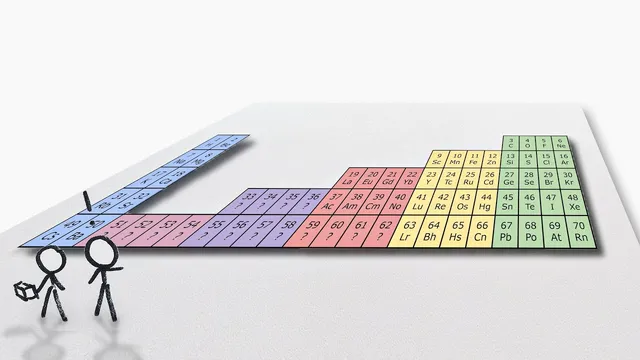
The Periodic Table in a 2D World
Based on minutephysics's video on YouTube. If you like this content, support the original creators by watching, liking and subscribing to their content.
A 2D periodic table still exists because chemistry depends on which outermost orbital is filled last as electrons are added.
Briefing
A two-dimensional universe would still produce a periodic table, but the ordering of elements would shift because electron energy levels and orbital options change when space has one fewer dimension. In ordinary chemistry, an element’s behavior is largely set by its outermost electrons—the ones least tightly bound to the nucleus—so the periodic table is essentially a map of which “outermost orbital” ends up being filled last as electrons are added. Recreating that filling process in 2D yields a different pattern, even though the underlying idea—outer electrons controlling chemistry—remains intact.
The differences come from two physics changes. First, the nucleus–electron attraction follows a different distance law. In 3D, the electromagnetic force scales like 1/r² because it spreads over the surface area of a sphere. In 2D, that geometry becomes a circle, so the effective “surface area” grows with circumference, and the attraction scales like 1/r. That alters the spacing between energy levels, changing which orbitals become energetically favorable as electrons fill them.
Second, fewer spatial dimensions means fewer ways for electrons to orbit. With only two dimensions, an electron’s angular momentum can correspond to only two rotational senses—clockwise or counterclockwise—rather than the many distinct orientations available in 3D. The result is a reduced set of orbitals per energy level, which compresses the “horizontal” structure of the energy-level diagram and reshapes how the electron-filling sequence progresses.
When electrons are added to these 2D orbitals—filling available states while respecting the rule that no more than two electrons occupy the same orbital—the outermost occupied orbital for each element lands in a new place in the ordering. After a rearrangement, the resulting 2D periodic table resembles the familiar 3D layout in broad strokes, but the details differ enough to produce a genuinely distinct structure.
Naming becomes a choice rather than a necessity. One approach keeps the same names tied to proton and electron counts, which would swap which 2D elements correspond to familiar categories like noble gases and halogens. Another approach names elements by chemical properties instead, preserving labels like Neon, Argon, Krypton for the noble-gas-like set and keeping fluorine and chlorine for the halogen-like set. That second method drops many 2D-specific names but also introduces new “blocks” that don’t exist in the 3D table.
Whether such a 2D periodic table is practically useful is uncertain. Still, the exercise has value: it shows how much of the periodic table’s structure depends on dimensionality, and it offers a test case for predicting behaviors of electrons or related quasiparticles on real 2D materials such as graphene. Even without ever experiencing a 2D universe, the ability to calculate and reasonably trust the 2D ordering—by analogy with successful 3D calculations—makes the comparison a powerful curiosity-driven probe into what is unique about our three-dimensional chemistry.
Cornell Notes
In a hypothetical 2D universe, electron chemistry would still be governed by outermost electrons, so a periodic table would still exist—but its structure would change. Two key physics shifts drive the difference: the nucleus–electron attraction scales as 1/r instead of 1/r², changing energy-level spacing, and electrons have fewer orbital orientations, limiting orbitals per energy level to clockwise/counterclockwise options. Filling these 2D orbitals with electrons produces a new ordering of which orbital ends up outermost for each element. The resulting table can be rearranged to look broadly familiar, yet it differs in important details. Naming can follow either proton/electron counts (relabeling familiar groups) or chemical properties (keeping classic noble-gas/halogen labels while introducing new 2D blocks).
Why does the periodic table depend on outermost electrons?
How does changing from 3D to 2D alter the electron–nucleus force?
Why are there fewer orbitals in 2D for a given energy level?
What does “filling the tank” mean for constructing the periodic table?
How do the two naming proposals for 2D elements differ?
Is a 2D periodic table expected to be useful in practice?
Review Questions
- What two physical changes in 2D most directly reshape the ordering of orbitals compared with 3D?
- How does the 1/r vs 1/r² force law influence the “vertical” structure of electron energy levels?
- Under the two naming proposals, how would the same 2D element be labeled differently depending on whether names follow proton count or chemical properties?
Key Points
- 1
A 2D periodic table still exists because chemistry depends on which outermost orbital is filled last as electrons are added.
- 2
In 2D, the electron–nucleus attraction scales as 1/r rather than 1/r², changing energy-level spacing.
- 3
In 2D, each nonzero angular momentum value corresponds to only two orbital senses (clockwise and counterclockwise), reducing the number of orbitals per energy level.
- 4
Electron filling in 2D follows the same basic rule of populating available orbitals while limiting occupancy to two electrons per orbital, producing a different outermost-orbital sequence.
- 5
The 2D table can be rearranged to resemble the 3D layout, but the ordering details differ because both energy spacing and orbital availability change.
- 6
Element naming in 2D can follow either proton/electron counts (reassigning familiar group names) or chemical properties (preserving classic noble-gas and halogen labels while introducing new 2D blocks).
- 7
Even if a 2D universe can’t be realized, the exercise may inform predictions for quasiparticles on real 2D materials like graphene.