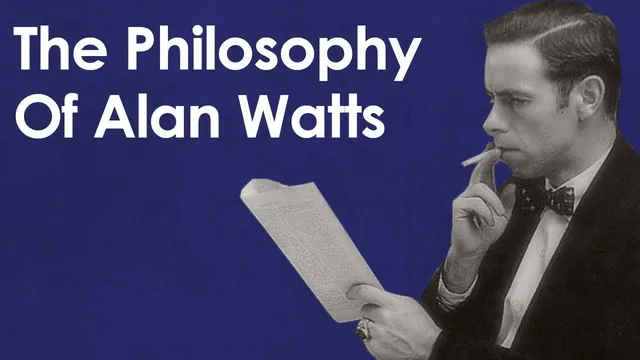
The Philosophy Of Alan Watts - Making Sense Of Senselessness
Based on Pursuit of Wonder's video on YouTube. If you like this content, support the original creators by watching, liking and subscribing to their content.
Watts ties much suffering to ego-based separation—the felt “I” that stands apart from what it perceives.
Briefing
Alan Watts’ central message is that much of human suffering comes from treating the world as something separate from the self—then trying to force meaning, control, and morality onto a reality that doesn’t work that way. His Zen-flavored alternative frames life as an interconnected process: people and nature are not opposites but parts of one ongoing “organism environment” system, where thoughts and actions remain subject to the same cause-and-effect laws as everything else. That shift matters because it undercuts the Western habits of status-chasing, anxiety-driven self-improvement, and the belief that an external authority can solve inner disconnection.
Watts, a 20th-century British American philosopher (born 1915, died 1973), became influential in the West by translating Buddhist and Zen ideas into language that felt practical rather than mystical. He drew on an early fascination with Chinese and Japanese storybooks and Eastern aesthetics—especially the way art renders light, color, and nature with clarity and emotional force. As his views developed, he grew dissatisfied with Christianity’s focus on history and an authoritative, controlling God, which he felt did not genuinely answer questions about the universe, the self, or how to live. Buddhism offered a different structure: no tyrannical controller, but a universal consciousness in which everything is interconnected and interdependent, expressing a single essence “following the nature of itself.”
In Watts’ account, the mind’s core error is ego-identification. Humans notice what they perceive and then identify with that noticing—creating the sense of an “I” that stands apart from the observed world. Zen, as Watts presented it, treats that separation as the root of alienation, anxiety, and suffering. When death and change are inevitable, chaining identity to body, personal story, possessions, or status becomes a recipe for fear. Zen’s counterpoint is radical: the self is not a separate thing among things; it is everything, and everything is the self. The internal and external are mutually necessary—like noise and silence, or light and darkness—so experience cannot be separated from non-experience (including death).
Watts also challenges a common Western assumption: that thoughts are exempt from natural law and that willpower can impose itself on reality. Instead, brain and consciousness are part of the same universe-wide causality. “Success” therefore isn’t winning over the world through wealth, power, or being right; it’s synchronizing with nature—acting as nature acts through you. The result is a kind of flowing acceptance: not choosing to be human, not choosing the conditions of mind and body, but expressing the universe’s nature without the constant need to manage it.
Even with criticism—Watts’ ideas can be confusing, and Eastern teachings don’t solve every human problem—Watts’ lasting value is practical. His framing reduces the urge to overanalyze and to treat life as a contest with winners and losers. Life becomes an “endless game of back-and-forth,” a dance of universal consciousness that mystifies and entertains. The most useful takeaway, in his view, isn’t perfect certainty about metaphysics, but learning to enjoy the senselessness rather than taking it as a threat.
Cornell Notes
Alan Watts popularized Zen and Buddhist principles in the West by arguing that suffering often comes from ego-based separation—treating the self as detached from nature and then trying to force control, meaning, and morality onto reality. Zen, as Watts framed it, says the self is not separate from what it experiences; everything is interconnected and interdependent, captured by the idea of “organism environment.” Thoughts and actions are not exempt from natural law; consciousness is part of the same cause-and-effect universe. “Success” becomes synchronizing with nature and flowing without the constant need to choose or manage life. Even if the metaphysics remain debatable, Watts’ approach aims to reduce alienation and anxiety by changing how people relate to experience.
Why does Watts link ego-identification to alienation and anxiety?
What does “organism environment” mean in Watts’ framework?
How does Watts challenge the belief that thoughts can override natural law?
What counts as “success” in Watts’ Zen-influenced view?
Why does Watts think taking life “seriously” can be counterproductive?
Review Questions
- Which specific mental distinction does Watts say creates the ego “in a bag of skin,” and how does that distinction feed fear?
- How does the “organism environment” idea change the way you interpret cause and effect between people and nature?
- What does Watts treat as a more realistic definition of success than status, wealth, or being right?
Key Points
- 1
Watts ties much suffering to ego-based separation—the felt “I” that stands apart from what it perceives.
- 2
Zen, as Watts presents it, treats identity as inseparable from experience: the self is not separate from nature but an expression of it.
- 3
The “organism environment” framing rejects the idea that a person is an isolated entity inside a separate world.
- 4
Watts argues thoughts and consciousness are not exempt from natural law; they remain part of universal cause and effect.
- 5
He reframes success as synchronization with nature rather than winning through wealth, power, or status.
- 6
Watts emphasizes that meaning doesn’t come from clinging to changing things (body, identity, possessions) in the face of death.
- 7
Even if metaphysical claims are debatable, the practical payoff is reduced alienation and less compulsive overanalysis.