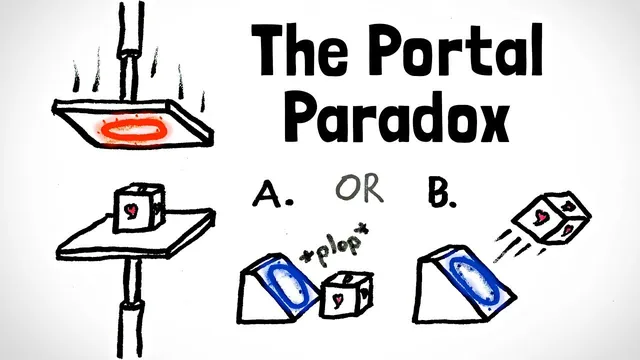
The Portal Paradox
Based on minutephysics's video on YouTube. If you like this content, support the original creators by watching, liking and subscribing to their content.
Portal “same speed” rules become ambiguous when a portal mouth moves because velocity must be defined relative to a reference frame.
Briefing
Portal’s “portal paradox” boils down to a simple question with a physics-sized headache: if an object enters one portal end and exits the other with the same speed, what reference frame is that speed measured against—especially when one portal end is moving? In the game, portals usually sit still relative to the environment, so the rule looks unambiguous. Once a portal end moves, two intuitive outcomes compete: a stationary cube might “plop out” with zero speed, or it might shoot out with a speed set by the moving portal’s motion.
The core issue is that physics doesn’t provide an absolute backdrop for velocity. Speeds and velocities are always relative to something else. That forces the puzzle into a set of candidate rules for what “same speed” means during the portal transition. One option (A) keeps the object’s speed relative to the surrounding environment while redirecting its direction. Another option (B) keeps the object’s speed relative to the specific portal end it enters—so the exit speed is determined locally by the portal’s motion at the entry and exit mouths. A third idea tries to preserve speed relative to the “average” portal position, which effectively collapses back into option A when portals aren’t accelerating. A weird but logically possible alternative keeps the speed constant relative to the portal end the object is not using at the moment.
Option B is presented as the most physically natural. If portals behave like wormholes that bend spacetime, then local conservation laws apply in curved geometry, making “locally measured” velocities the natural quantity to preserve. The same intuition fits a teleportation-like mechanism: the device could scan incoming matter and reconstruct it at the other mouth in a way that respects local kinematics tied to each portal end.
Option A, however, runs into a seemingly fatal problem when a portal end moves toward a stationary cube. If the cube enters with zero speed relative to the environment, it would have to exit with zero speed too. That would imply the cube’s material would have to “arrive” and “leave” in a way that doesn’t allow the cube to maintain its shape during the transition. The transcript resolves this by noting that the cube doesn’t enter the portal all at once—it passes through in slices. If each slice exits the other portal already at rest relative to the environment, the slices would emerge in the portal plane and pile up, effectively squishing the cube into a flat square. If the cube is rigid and can’t be deformed, then a moving portal end could simply fail to accept the cube in the first place, bouncing it away.
The upshot: the “paradox” isn’t a single contradiction but a diagnostic. The outcome depends on how the fictional portal rule is implemented—whether it preserves global motion (option A) or local motion relative to each portal mouth (option B). The transcript even suggests the game’s behavior leans toward option A programming, citing glitches where solid objects don’t pass through portals moving toward them. The closing challenge flips the setup: if the orange portal moves sideways and a cube drops through it, the cube’s trajectory could go straight up, bounce, or exit at an angle—another test of which reference-frame rule the portals obey.
Cornell Notes
Portal’s rule—objects exit with the same speed they had when entering—becomes ambiguous when one portal mouth moves. The ambiguity comes from the lack of an absolute reference frame: velocity is always measured relative to something. Option A preserves speed relative to the surrounding environment, which can force deformation or even prevent entry if the cube must remain rigid. Option B preserves speed relative to the portal end itself, making the exit speed depend on the local motion of the portal mouth; this aligns naturally with wormhole-like spacetime bending or teleportation-style reconstruction. The “paradox” resolves only after choosing which reference-frame rule the portals follow.
Why does a moving portal make “same speed” ambiguous?
What is option A, and what problem does it create for a stationary cube?
What is option B, and why is it considered more physically natural?
How does the “average portal position” idea relate to option A?
What does the game’s behavior suggest about which option is implemented?
What is the final “sideways portal” puzzle meant to test?
Review Questions
- If velocity has no absolute reference frame, what specific reference frame must be chosen to define “same speed” during a portal transition?
- Under option A, why does a moving portal potentially require the cube to deform, and what happens if the cube is rigid?
- How would you predict the cube’s exit direction in the sideways-portal scenario if the portals preserve speed locally (option B) versus globally (option A)?
Key Points
- 1
Portal “same speed” rules become ambiguous when a portal mouth moves because velocity must be defined relative to a reference frame.
- 2
Option A preserves speed relative to the environment, but can force cube deformation (slicing and piling up) or prevent entry for rigid objects.
- 3
Option B preserves speed relative to the portal end, making exit speed depend on local portal motion.
- 4
Wormhole-like spacetime bending and teleportation-style reconstruction both naturally support locally defined velocity preservation (option B).
- 5
Speed relative to an “average portal position” collapses to option A when portals aren’t accelerating.
- 6
The game’s observed glitches—solid objects failing to pass through portals moving toward them—are cited as evidence that its implementation may resemble option A.