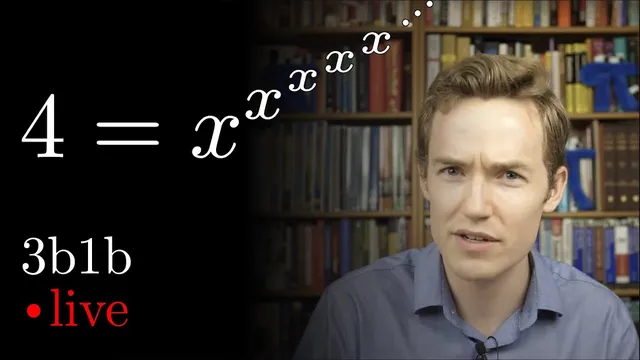
The power tower puzzle | Ep. 8 Lockdown live math
Based on 3Blue1Brown's video on YouTube. If you like this content, support the original creators by watching, liking and subscribing to their content.
Tetration is repeated exponentiation evaluated from the top down, best defined via a recursion .
Briefing
A single “power tower” question—how far repeated exponentiation goes before it either settles or explodes—turns into a full lesson on tetration, fixed points, and the sharp boundary between convergence and divergence. The central finding is that for towers of the form (height ), growth is not monotone in the way intuition suggests: once the base passes a critical threshold, the iteration stops converging and instead blows up to infinity. For real bases, that upper threshold is exactly , about 1.4447—right around where the graphs of and become tangent.
The episode begins by defining tetration as “repeated exponentiation from the top down,” avoiding ambiguity caused by exponentiation’s non-associativity. Using a recursive sequence with , the tower grows extremely fast: height 4 gives 65,536, and height 5 already reaches a number with roughly 19,000 digits. Height 6 is so large that storing it physically would be impossible—an intentionally dramatic way to motivate why mathematicians care about the *behavior* of the iteration rather than the raw size of its outputs.
To probe the “switch,” the lesson compares two growth regimes. Repeated multiplication by 1.1 (ordinary exponential growth) quickly reaches moderate sizes. But repeated exponentiation with base 1.1 behaves differently: the sequence rises at first and then locks into a fixed value satisfying . That fixed-point equation becomes the key lens for everything that follows.
The next step is to find where convergence fails. For , a tempting self-similarity argument suggests the infinite tower might converge to 4, but numerical iteration and a deeper graphical analysis show the tower actually approaches 2. The discrepancy comes from assuming convergence before verifying it. The cobweb diagram method—iterating while bouncing between and —reveals which fixed points are stable. Intersections alone are not enough: stability requires the intersection to have slope magnitude less than 1.
Using the tangency condition (the curve tangent to ), the critical base is derived by solving the system and at the tangency point. The result is and . Past this value, the iteration “kisses and then separates,” never settling to a finite number—so the tower cannot converge to any value between and infinity. The episode closes by extending the idea to complex bases, where convergence/divergence patterns form fractal-like regions reminiscent of the Mandelbrot set, and by noting how even seemingly simple questions like whether is an integer remain unresolved.
Cornell Notes
Tetration is defined as repeated exponentiation evaluated from the top down, producing power towers like . For real bases , the infinite tower converges only when the iteration approaches a stable fixed point satisfying . Graphical cobweb diagrams show that intersections of with are not sufficient; stability depends on the slope at the intersection having magnitude less than 1. The convergence-to-divergence boundary occurs when the curve is tangent to , yielding the exact critical base . Above that threshold, the tower diverges to infinity rather than settling to some larger finite value.
Why does tetration require a specific evaluation order, and how is that order formalized?
What does it mean for the infinite power tower to converge, and what equation captures that?
How can a self-similarity trick fail when analyzing -based towers?
What does the cobweb diagram reveal that intersections alone do not?
How is the critical base for convergence derived, and what is its exact value?
Why can’t the tower converge to any value between and infinity once exceeds the threshold?
Review Questions
- For a given base , what fixed-point equation must the limit satisfy if the infinite power tower converges?
- In cobweb diagrams, what slope condition determines whether an intersection is stable or unstable?
- What exact value of marks the real-number threshold between convergence and divergence, and how does tangency to relate to that threshold?
Key Points
- 1
Tetration is repeated exponentiation evaluated from the top down, best defined via a recursion .
- 2
The infinite power tower converges exactly when the iteration approaches a stable fixed point satisfying .
- 3
Intersections of and are not enough; stability requires the slope magnitude at the intersection to be less than 1.
- 4
For real bases, the convergence-to-divergence boundary occurs when is tangent to , giving the critical base .
- 5
Once exceeds , the tower does not settle to any finite value larger than the attracting fixed point; it diverges to infinity.
- 6
A self-similarity algebra trick can produce the wrong target if it assumes convergence without checking stability.
- 7
Extending to complex numbers produces intricate convergence/divergence fractal patterns, echoing Mandelbrot-like behavior.