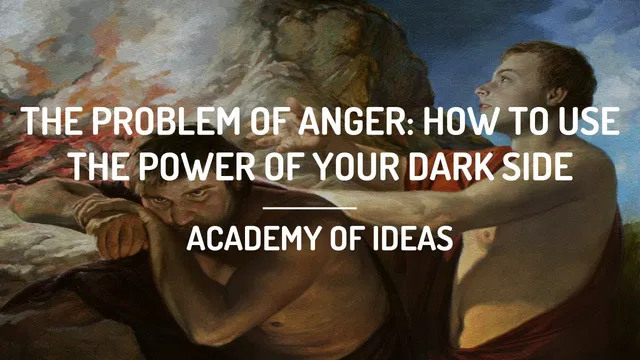
The Problem of Anger - How to Use the Power of Your Dark Side
Based on Academy of Ideas's video on YouTube. If you like this content, support the original creators by watching, liking and subscribing to their content.
Strong emotions can erase key distinctions—rational vs. irrational, right vs. wrong, and real vs. imagined.
Briefing
Anger’s core danger isn’t just that it feels intense—it blurs judgment. When a person gets caught in a strong emotion, the mind can lose the ability to separate rational from irrational, right from wrong, and even the real from the imagined. That breakdown matters because it turns feelings into decision-makers, steering behavior in ways that may not match reality or values.
The framing centers on a broader claim: people are “lived by” powerful forces they often only partially understand. Life is shaped by hidden powers—especially emotions—that influence well-being in both dramatic and mysterious ways. Anger is treated as one of those powers: a “dark side” energy that can either be managed or allowed to take control. The key issue is not whether anger exists, but what happens when it dominates attention and judgment.
From there, the emphasis shifts toward using anger’s power rather than being ruled by it. The idea is that emotions can be powerful tools, but only when they’re recognized clearly enough to avoid confusing them with truth. When anger is experienced as a totalizing force, it can collapse moral reasoning and reality-testing—making it easier to justify harmful actions or believe things that aren’t grounded. In contrast, treating anger as a force to work with implies a different relationship: one that acknowledges its intensity while maintaining the capacity to evaluate what is rational, ethical, and real.
Overall, the central insight is practical and psychological: strong emotions can hijack perception and judgment, so the task is to regain discernment. Anger becomes a test of self-knowledge—whether a person can notice the emotion, understand its influence, and prevent it from erasing the boundary between inner experience and external reality. That boundary is what protects well-being and keeps decisions aligned with what’s actually true and right, even when the “dark side” is activated.
Cornell Notes
Strong emotions like anger can overwhelm judgment, making it hard to distinguish rational from irrational, right from wrong, and even real from imagined. The transcript frames emotions as powerful forces that shape well-being in dramatic yet hard-to-fully-understand ways. When anger takes control, it can distort moral reasoning and reality-testing, increasing the risk of acting on false or irrational beliefs. The implied goal is not to deny anger but to use its energy without letting it erase discernment. Regaining that ability to evaluate what’s true and ethical is presented as the key to protecting well-being.
Why does anger pose a threat beyond discomfort or stress?
What does it mean to say people are “lived by” powers they pretend to understand?
How does the transcript connect emotions to well-being?
What’s the practical challenge when someone is “caught in the grip” of anger?
What does “use the power of your dark side” imply about anger management?
Review Questions
- How can strong emotion change the way a person distinguishes reality from imagination?
- What boundaries between judgment categories (rational/irrational, right/wrong, real/imagined) does anger threaten?
- What does it mean to treat anger as a power to use rather than a force to obey?
Key Points
- 1
Strong emotions can erase key distinctions—rational vs. irrational, right vs. wrong, and real vs. imagined.
- 2
Anger’s risk lies in its ability to hijack judgment, not just its intensity.
- 3
Emotions are portrayed as powerful forces that shape well-being in dramatic and hard-to-fully-understand ways.
- 4
People often underestimate how much emotional forces influence their lives even when they think they understand them.
- 5
Regaining discernment is presented as the protective mechanism against anger-driven confusion.
- 6
Using anger’s power requires maintaining the ability to evaluate truth and ethics while the emotion is present.