The Problem With A Balanced Life - The Four Burners Theory
Based on Better Than Yesterday's video on YouTube. If you like this content, support the original creators by watching, liking and subscribing to their content.
The Four Burners Theory frames life as four competing priorities—family, friends, health, and work—limited by finite time and energy.
Briefing
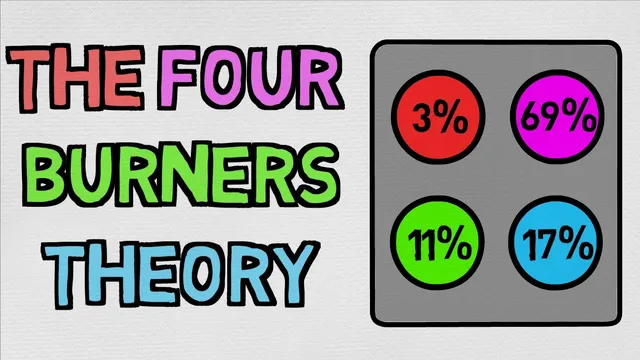
A “balanced life” is mostly a myth because time and energy are limited—so meaningful success in one area requires sacrificing others. The Four Burners Theory frames this tradeoff with a simple image: a stove with four burners representing family, friends, health, and work. If all four burn at the same level, none gets enough heat to really drive results; each sits around 25% capacity. Turning up one burner necessarily reduces power to the other three, meaning major focus comes with a cost.
The theory’s core claim is blunt: to be successful, someone must effectively “cut off” one burner, and to be truly exceptional, they likely must “cut off two.” Success is treated as relative, but the pattern shows up repeatedly—people seen as successful tend to have one dominant quadrant while other parts of life lag. Elon Musk is offered as an example of extreme work focus, citing his reported schedule of at least 100 hours per week. That level of investment in work leaves less time and energy for health, family, or friends, illustrating how one priority can crowd out the rest.
Still, the argument doesn’t demand permanent shutdowns. Instead of extinguishing a quadrant completely, it suggests keeping it burning at a lower setting. People can divide attention evenly and pursue “balance,” but the tradeoff is that major achievement in any single area becomes unlikely. The real constraint is practical: spending five hours with friends means five hours not spent exercising or working on a business. Every choice reallocates limited resources, so excelling anywhere requires becoming temporarily imbalanced.
The Four Burners Theory also emphasizes that priorities change over time. Childhood tends to elevate family and friends; school years often shift attention toward friends and studying; in the 20s and 30s, health and work may dominate, especially for those without children. Later, family needs can rise while work demand drops, and eventually people may reconnect with old friends or pursue long-delayed goals. Because these shifts are inevitable, chasing a fixed, perfect balance is portrayed as pointless.
The practical takeaway is to aim for life satisfaction rather than an idealized equilibrium. If more time with friends and family increases joy, lean into it. If career matters most, allocate energy accordingly. The theory ultimately reframes “balance” as a series of evolving tradeoffs: each burner can burn stronger only when others burn less, and the goal is to choose the tradeoffs that match one’s values and current stage of life.
Cornell Notes
The Four Burners Theory argues that “balanced life” is an illusion because time and energy are limited. With four life areas—family, friends, health, and work—turning up one burner reduces power for the others, so major success usually requires sacrificing at least one quadrant (and sometimes two). The theory also rejects the idea of permanently turning burners off; instead, it recommends letting less-prioritized areas burn at a lower level. Priorities shift across life stages, so the “right” imbalance changes over time. Rather than chasing perfect balance, the framework encourages choosing the tradeoffs that produce satisfaction and align with personal values.
Why does the Four Burners Theory claim that “balanced life” is hard to achieve?
What does the theory mean by “cut off one burner” or “cut off two” to succeed?
How does the example of Elon Musk illustrate the theory’s tradeoff logic?
Does the theory recommend abandoning all tradeoffs permanently?
How does the theory handle changing priorities across different life stages?
What does the theory propose as the better goal than perfect balance?
Review Questions
- Which life area(s) would likely become the “dominant burner” in your current stage of life, and what would you have to reduce to turn it up?
- How would you distinguish between “equal division” across burners and “life satisfaction” under the Four Burners Theory?
- What are two examples of tradeoffs you make weekly, and which burner(s) do they strengthen or weaken?
Key Points
- 1
The Four Burners Theory frames life as four competing priorities—family, friends, health, and work—limited by finite time and energy.
- 2
Equal attention across areas usually prevents any one area from receiving enough intensity to produce major results.
- 3
Turning up one priority reduces capacity for the others, so every choice carries a cost.
- 4
Major success often requires deprioritizing at least one quadrant, and exceptional outcomes may require sidelining two.
- 5
Less-prioritized areas don’t have to be eliminated; they can run at a lower level while one area gets focus.
- 6
Life priorities shift over time, so the “best” imbalance changes across childhood, school, adulthood, and later family or career phases.
- 7
Instead of chasing perfect balance, the framework recommends choosing tradeoffs that align with personal values and deliver satisfaction.