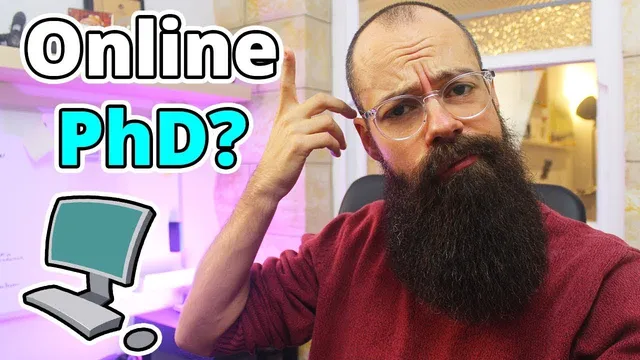
The problems with doing a PhD online - should you do one?
Based on Andy Stapleton's video on YouTube. If you like this content, support the original creators by watching, liking and subscribing to their content.
Fully online PhDs are portrayed as a poor fit for many science disciplines that require lab or institute-based research infrastructure.
Briefing
Online PhD programs can work for some people and some disciplines, but doing a PhD entirely online is widely framed as a bad deal under today’s academic norms—mainly because it can reduce access, mentorship, and credibility in a system that still rewards the full in-person “package.” The core tension is that certain research tasks require lab or institute infrastructure, while other parts—especially programming or analysis—can be handled remotely if supervision and communication stay strong.
For science PhDs that depend on hands-on experimentation, the “nuts and bolts” of research are said to need a university or research institute setting. Even so, the transcript points to a workable middle model: a supervisor who is based in the same city but not constantly in the lab, with the student doing much of the programming work from home. The emphasis is less on whether remote work is possible and more on whether the student can maintain regular contact with their supervisor and preserve the creative, iterative thinking that a PhD demands.
A key carve-out is for professional tracks where a PhD is used to unlock career progression rather than to pivot into academia. Medical doctors, educators, and people in government are presented as examples of professionals who may benefit from an online or remote PhD because they remain embedded in their day-to-day field. In that setup, the PhD functions alongside ongoing work—keeping “feet on the ground” in the information economy of the job—so the degree can support promotions and higher pay scales without requiring a full-time break from professional practice.
The transcript then turns sharply critical of universities marketing fully online PhDs. The motivation offered for the growth of online programs is market differentiation: institutions that applicants might otherwise avoid are said to use online formats to attract tuition. The warning is blunt—online PhDs can be predatory, charging students for a credential that may be “useless paper” if it isn’t accredited and recognized by employers or future institutions.
Beyond accreditation, the argument highlights three practical risks of going fully online. First is “out of sight, out of mind”: supervisors are busy, and without frequent in-person presence, students may struggle to get timely help. Second is reduced access to the university ecosystem—physical resources, services, and the informal support networks that often make research feasible. Third is credibility: academia is described as slow to accept unfamiliar credentials, so a fully online PhD can make it harder to secure grants, persuade committees, or be taken seriously—especially when the institution is less known.
The proposed future is hybrid. Some components can move online, but others still require lab exposure and campus-based immersion. Under that evolution, remote PhDs are positioned as a partial solution—particularly for working professionals—while fully online PhDs remain a risky proposition in the current system, unless the program is reputable, accredited, and recognized where the graduate intends to work.
Cornell Notes
A fully online PhD is portrayed as a poor fit for most research-heavy science fields and as a credibility risk in academia, largely because it can limit mentorship, resources, and recognition. Remote work can be viable for parts of a PhD—such as programming—if supervision stays regular and the student maintains strong communication. The transcript argues that online PhDs make more sense for working professionals (e.g., medical doctors, educators, government roles) who can keep their “feet on the ground” while using the degree for promotions and pay progression. It also warns that some online programs may be financially predatory and may not deliver a credential employers respect. The likely direction is hybrid PhDs: some work online, some essential lab or campus exposure in person.
Why are some science PhDs described as unsuitable for fully online study?
What remote model is offered as a workable compromise for certain PhD tasks?
When does an online or remote PhD become more defensible in the transcript’s view?
What credibility and career risks are highlighted for fully online PhDs?
What practical problems are said to arise from being online rather than on campus?
Why does the transcript warn about some online PhD providers?
Review Questions
- What conditions does the transcript suggest must be met for remote PhD components (like programming) to work without harming research quality?
- How does the transcript distinguish between using a PhD for career progression while working and doing a PhD as a standalone online credential?
- Which three disadvantages of fully online PhDs are presented as most damaging, and how do they affect mentorship, resources, and credibility?
Key Points
- 1
Fully online PhDs are portrayed as a poor fit for many science disciplines that require lab or institute-based research infrastructure.
- 2
Remote work can be viable for certain PhD components (especially programming) if supervision remains regular and communication stays strong.
- 3
Online PhDs are framed as more appropriate for working professionals—such as medical doctors, educators, and government employees—who can keep active immersion in their field while studying.
- 4
Some online PhD programs are criticized as potentially predatory, so accreditation and employer recognition should be verified before paying tuition.
- 5
Being online can reduce mentorship access because supervisors may deprioritize students who aren’t frequently visible.
- 6
Campus-based PhDs are described as offering broader resources and support networks that are harder to replicate remotely.
- 7
A hybrid model—online for some tasks, in-person for essential lab exposure—is presented as the most realistic future direction.