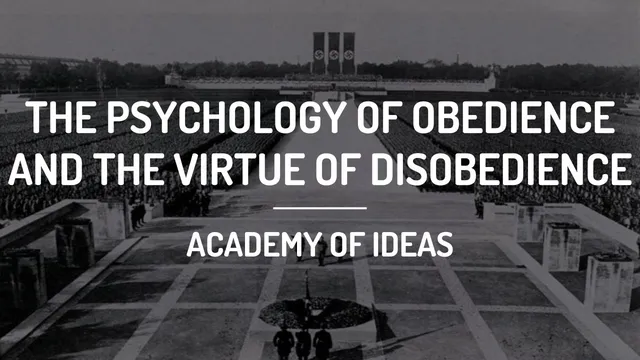
The Psychology of Obedience and The Virtue of Disobedience
Based on Academy of Ideas's video on YouTube. If you like this content, support the original creators by watching, liking and subscribing to their content.
Obedience is reinforced by evolved dominance hierarchies that train people to track rank and permitted actions.
Briefing
Obedience to government commands often persists even when those commands demand cruelty, because human beings are primed—by evolution and by psychology—to treat authority as legitimate and to reduce the mental discomfort that comes from acting against one’s self-image. The core claim is that this obedience is not mainly driven by fear or outright agreement with tyranny; it is sustained by dominance hierarchies, cognitive biases, and the way people manage internal conflict when state actions clash with personal morality.
The transcript traces obedience to dominance hierarchies that shaped survival for early humans. In such systems, people had to distinguish rank and learn which actions were permitted or forbidden for their level—mistakes could mean death or expulsion. That evolutionary pressure helps explain why obedience feels natural, but it doesn’t fully account for why ordinary people carry out atrocities on behalf of regimes they can’t justify. History, including mass killings carried out in “unselfish loyalty” to tribe, dynasty, church, or ideology, is presented as evidence that large-scale harm can be enabled by loyalty rather than personal greed.
A major mechanism is cognitive dissonance: people experience discomfort when their behavior conflicts with their beliefs or with how they see themselves. Under tyranny, citizens are repeatedly placed in situations where they must participate in acts they would condemn in other contexts. Taxes are offered as a modern trigger—money collected for war, surveillance, bailouts, or punishment of drug users can force people to reconcile “I’m a good person” with “I’m funding wrongdoing.” Instead of changing behavior, many reduce dissonance by adopting justifications for the state’s morality or by avoiding information that would make the injustice harder to ignore.
Status quo bias and conformity pressures then reinforce the tendency to accept existing institutions as inherently right. The transcript argues that indoctrination, social acceptance, and the sheer prominence of government in daily life make people treat their own society’s arrangements as obviously legitimate—even when those arrangements are oppressive. Don Mixon is cited to suggest that obedience in hierarchical structures needs little special explanation; disobedience, by contrast, requires overcoming entrenched mental habits.
The transcript then turns to what makes disobedience more likely. It argues that people won’t refuse immoral acts unless they loosen the grip of indoctrination through self-education and a renewed commitment to conscience. Disobedience also becomes more plausible when confidence in rulers collapses—either because centralized control is seen as unrealistic or because political ineptitude makes institutions look untrustworthy.
Finally, surveillance is framed as a powerful inhibitor of dissent. Mass surveillance is likened to a “prison of the mind,” encouraging citizens to police themselves the way a believer might censor thoughts under an all-seeing God. Totalitarian regimes of the 20th century are described as recognizing this, and modern technology is portrayed as enabling surveillance far beyond what earlier dictators could achieve. The transcript concludes that while obedience is common, progress depends on the “brave few” who refuse corrupt authority—acts of disobedience that protect freedom and allow new ideas to survive.
Cornell Notes
The transcript argues that obedience to authority persists even under tyranny because humans are shaped by dominance hierarchies and reinforced by psychological biases. Cognitive dissonance helps citizens keep their self-image intact when they participate in state wrongdoing—often by justifying government actions or avoiding information. Status quo bias and conformity pressures make existing institutions feel inherently legitimate, reducing the impulse to question commands. Disobedience becomes more likely when people self-educate, shed indoctrinated beliefs, lose confidence in rulers, and—critically—when surveillance is limited enough that citizens don’t feel compelled to self-censor. Ultimately, social and intellectual progress is portrayed as depending on the minority willing to say “no” to oppressive power.
Why does obedience feel “natural” to many people, even when orders are immoral?
How does cognitive dissonance keep citizens compliant with wrongdoing?
What role does status quo bias play in making oppressive governments seem legitimate?
What conditions increase the likelihood of disobedience?
Why does mass surveillance reduce disobedience?
How does disobedience contribute to social and intellectual progress?
Review Questions
- What psychological processes help citizens reconcile their self-image with participation in state harm?
- How do status quo bias and conformity differ from cognitive dissonance in sustaining obedience?
- In what ways does surveillance function as a mechanism of control beyond direct punishment?
Key Points
- 1
Obedience is reinforced by evolved dominance hierarchies that train people to track rank and permitted actions.
- 2
Cognitive dissonance helps citizens maintain a “good person” self-image by justifying state wrongdoing or avoiding information.
- 3
Status quo bias and conformity pressures make existing institutions feel inherently legitimate, reducing scrutiny of oppressive commands.
- 4
Disobedience becomes more feasible when people self-educate, discard indoctrinated beliefs, and apply conscience to judge right and wrong.
- 5
Loss of confidence in rulers—through perceived limits of centralized control or visible political ineptitude—can weaken compliance.
- 6
Mass surveillance discourages dissent by encouraging internal self-censorship, making disloyal thoughts and behaviors harder to sustain.
- 7
Social and intellectual progress is portrayed as depending on the minority willing to refuse corrupt authority.