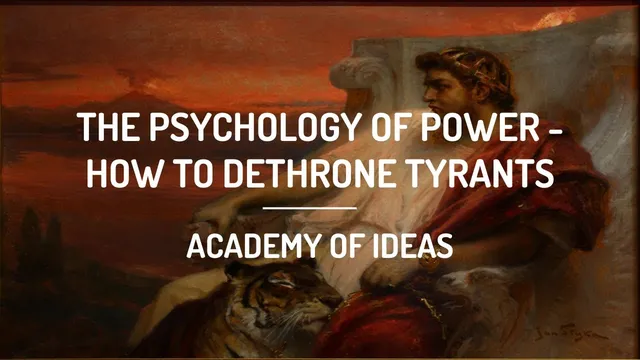
The Psychology of Power - How to Dethrone Tyrants
Based on Academy of Ideas's video on YouTube. If you like this content, support the original creators by watching, liking and subscribing to their content.
Power is defined as producing intended effects, and it is value-neutral—its moral direction depends on ends and methods.
Briefing
Power is portrayed as a value-neutral force that can build a life—or corrode it—yet the deeper problem is psychological: the “love of power” functions like a demon that never fully satisfies. Even when people receive health, shelter, and enjoyment, the craving for power keeps waiting to be fed. That craving matters because it shapes both personal well-being and the political games that determine whether societies drift toward tyranny or toward freedom.
Bertrand Russell’s definition frames power as the production of intended effects: the ability to bring deliberate change to the world so conditions better match one’s needs. But power is not purely self-generated. Achieving intended effects usually requires other people—through influence that can be immoral (force, domination, coercion, manipulation) or life-positive (appeal to truth, setting a good example, showing how interests align). The moral question, then, isn’t only the goal; it’s also the means and the human relationships power depends on.
The transcript argues that the desire for power is rooted in human nature and is not self-limiting in the way many biological needs are. Too much food or drink produces illness; too much sex produces disgust; sleep eventually forces waking. Power, by contrast, is described as potentially endless and boundless. Historical figures such as Alexander the Great and Napoleon are cited as examples of leaders who, even after gaining wealth and pleasures, kept reaching for more power. This creates a structural danger: while some power is necessary for flourishing and for survival in a threatening world, too much power—especially in social and political life—tends to corrupt.
In modern societies, the warning is that power has been centralized in statist and globalist institutions, leaving ordinary people “subjects” rather than rights-bearing citizens. The result is a division between ruling elites who seek control and the rest of the population being conditioned to believe they should not control their own lives. Tyrants, the transcript notes, do not relinquish power once they seize it; they hold it. And “truth” alone is treated as insufficient—truth must attract power or ally with it, otherwise it perishes.
The proposed antidote is not counter-tyranny but a different kind of power: life-promoting power cultivated through self-realization. Drawing on Carl Jung and Friedrich Nietzsche, the argument links self-realization to inner harmony, skill development, and adaptation to the outer world. It also insists that tyrants thrive when masses are weak; therefore, dethroning tyranny depends on enough individuals becoming stronger, more self-reliant, and capable of non-compliance.
The transcript’s practical conclusion is that tyrants can be dethroned without force if enough people desire freedom and practice civil disobedience—refusing immoral commands and resisting orders that undermine a free, prosperous society. It warns against passive waiting, pointing to 20th-century lessons about how totalitarianism is hard to remove once entrenched. Voltaire and Alexander Solzhenitsyn are invoked to stress regret for failing to act early, ending with a cautionary reminder: people who do not love freedom enough may end up “deserving everything that happened afterward.”
Cornell Notes
Power is framed as the ability to produce intended effects, and it is treated as value-neutral: it can serve life or destruction depending on ends and means. The transcript argues that the craving for power is deep, potentially endless, and not self-limiting like many biological needs, which makes political centralization especially dangerous. Tyranny is described as sustained by a population that is conditioned to be weak while elites accumulate control. The remedy offered is life-promoting power through self-realization—developing skills, inner harmony, and self-reliance—so individuals can resist immoral commands through non-compliance and civil disobedience. The warning is that waiting passively for a crisis to resolve itself is risky once totalitarianism takes hold.
Why is power described as both necessary and dangerous?
How does the transcript distinguish life-positive influence from tyrannical control?
What structural problem is blamed for modern tyranny?
Why are “love” and “truth” portrayed as insufficient on their own?
What does self-realization add to the anti-tyranny strategy?
Why does the transcript warn against waiting for “enough people” to act later?
Review Questions
- How does the transcript’s definition of power (intended effects) change the way you evaluate political actions—what role do means and other people play?
- What mechanisms does the transcript claim allow tyrants to persist, and how does self-realization counter those mechanisms?
- Why does the transcript treat passive waiting as dangerous once authoritarian control begins to take hold?
Key Points
- 1
Power is defined as producing intended effects, and it is value-neutral—its moral direction depends on ends and methods.
- 2
Influence over others is unavoidable for achieving intended effects, so power always involves human relationships that can be coercive or cooperative.
- 3
The desire for power is portrayed as deep and potentially endless, which makes unchecked political centralization especially corrosive.
- 4
Tyranny is sustained by structural weakness in the population and centralized control in ruling elites, turning citizens into subjects.
- 5
Freedom requires power aligned with freedom; truth or goodwill alone is treated as insufficient without power to back it.
- 6
Life-promoting power is cultivated through self-realization—inner harmony, skill development, and self-reliance.
- 7
Dethroning tyrants is framed as possible through non-compliance and civil disobedience, but vigilance is required because waiting can make totalitarianism hard to remove.