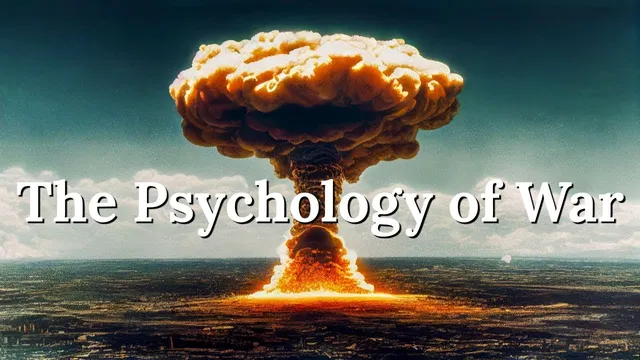
The Psychology of War - Are We Doomed to Destroy Ourselves?
Based on Academy of Ideas's video on YouTube. If you like this content, support the original creators by watching, liking and subscribing to their content.
Combat breakdown is portrayed as a predictable result of constant mortal threat, sensory overload, and prolonged exposure—not a matter of personal bravery.
Briefing
Modern war is no longer something most people can “endure” without breaking—psychological harm is widespread, and the same training systems that make soldiers effective also make large-scale catastrophe more likely. The central warning is stark: if two major powers fight again, today’s weapons and the human machinery built to use them could push civilization into an extinction-level spiral.
War’s roots run deep in culture and history, but the decisive shift is technological. The argument ties together two ideas: war is psychologically damaging for nearly everyone exposed to combat, and militaries can overcome natural reluctance to kill through conditioning. That combination matters because it means the barrier to mass violence is not human nature alone—it can be engineered, and modern arsenals make the consequences immediate and vast.
Combat stress is described as relentless and cumulative. Soldiers face constant risk of death or maiming, while their senses are saturated by the sights, sounds, and smells of dying—often including friends. War also strips away control and replaces it with hostility from an enemy intent on killing. Multiple sources are used to underline that breakdown is not a matter of cowardice. Courage does not cancel the strain; psychiatric casualties rise with the intensity and duration of exposure, and “getting used to combat” is treated as a myth. World War II veteran William Manchester is quoted to capture the mindset of battle as a “highly disturbed” and epidemic condition—one that affects everyone there.
Beyond fear, the text emphasizes a second driver of psychological injury: the job of killing itself. Richard A. Gabriel and David Grossman are used to argue that most people are not “by nature” killers and that even hostility and confrontation are difficult for ordinary people. A key claim follows from S.L.A. Marshall’s World War II research: most combatants do not fire their weapons, even when they face repeated enemy charges. Historians then find similar patterns in earlier conflicts, including Civil War battlefield evidence suggesting many muskets were loaded multiple times but never fired. The reluctance is framed as an “inner resistance” to taking a fellow human’s life.
Militaries respond by redesigning training to bypass moral resistance. After low firing rates were identified, the U.S. Army increased firing through reflexive drills, realistic human-shaped targets, and combat simulations that teach soldiers to shoot quickly “without thinking too much.” Vietnam-era estimates cited in the transcript put firing rates as high as 80%. Yet reflex training is only half the transformation; soldiers also need psychological conversion—described as almost religious in militarized societies—plus group solidarity that makes accountability to comrades outweigh personal conscience.
The conditioning toolkit also includes dehumanizing propaganda, which aims to separate killing from murder by portraying the enemy as less than human and as an existential threat. Finally, distance is treated as a psychological lever: killing becomes easier when the victim is not in view, whether through bullets fired from hundreds of meters away or bombs and missiles that remove the killer from the victim’s field of vision.
The transcript then widens the lens from individual psychology to political incentives. War is portrayed as a “racket” that enriches the military-industrial complex, centralizes state power, and enables rights-stripping under emergency justification. With advanced weapons now able to scale death rapidly, the concluding message pushes responsibility outward: citizens must resist propaganda, speak out against war, and refuse to let governments—rather than the public—manufacture the next conflict. The stakes are framed with a grim arithmetic: another great-power war could kill at a million people per minute, turning local tragedies into global catastrophe.
Cornell Notes
The transcript argues that modern war is psychologically unsustainable for most people and that militaries can still turn ordinary recruits into killers through training and conditioning. Combat stress—constant threat of death, sensory overload, and witnessing friends die—produces breakdown that is not explained by cowardice. A second barrier is moral resistance to killing; evidence from World War II and earlier wars is used to claim many soldiers do not fire unless trained to overcome reluctance. After low firing rates were discovered, armies increased effectiveness with reflex drills, combat simulations, group solidarity, dehumanizing propaganda, and tactics that increase physical distance from victims. The implication is political as well: if war can be engineered in human minds and scaled by modern weapons, preventing another major war becomes a collective responsibility, not just a military one.
Why does the transcript treat psychiatric breakdown in war as widespread and not a sign of weakness?
What evidence is used to claim that many soldiers initially refuse to fire at the enemy?
How does the transcript connect training methods to higher firing rates?
What role does group solidarity play in enabling atrocities?
Why does the transcript emphasize dehumanization and physical distance as psychological tools?
How does the transcript move from individual psychology to political responsibility?
Review Questions
- What mechanisms does the transcript claim make breakdown in combat inevitable, and why does it reject cowardice as the explanation?
- How do reflexive firing drills, group solidarity, and dehumanizing propaganda work together to reduce reluctance to kill?
- What political incentives does the transcript associate with war, and how does that shape the proposed solution for preventing another major conflict?
Key Points
- 1
Combat breakdown is portrayed as a predictable result of constant mortal threat, sensory overload, and prolonged exposure—not a matter of personal bravery.
- 2
Most people are described as naturally resistant to killing, and evidence cited from multiple wars suggests many soldiers do not fire without training and conditioning.
- 3
Modern military training increases firing rates by building reflexes through realistic drills and simulations that reduce hesitation under stress.
- 4
Group solidarity and accountability to comrades are presented as major psychological drivers that can override individual moral restraint.
- 5
Dehumanizing propaganda is treated as a justification mechanism that separates killing from murder by stripping the enemy of full human status.
- 6
Increasing physical distance between killer and victim is described as a powerful way to make killing psychologically easier.
- 7
Preventing another major war is framed as a civic responsibility: resisting propaganda and pressuring governments, since war is also linked to state power and profit incentives.