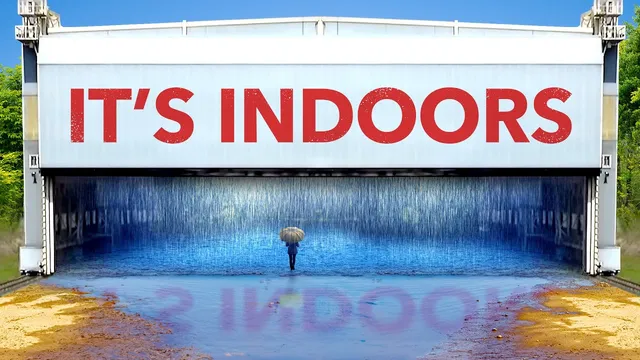
The Rainiest Place On Earth
Based on Veritasium's video on YouTube. If you like this content, support the original creators by watching, liking and subscribing to their content.
The Tsukuba rainfall simulator can generate storms up to 300 millimeters per hour using 550 controllable nozzles, enabling tests that match record one-hour rainfall intensity.
Briefing
A giant rainfall simulator in Tsukuba, Japan can reproduce the most intense rainfall ever recorded—down to the millimeter per hour—so researchers can stress-test flood and landslide risk under controlled, repeatable conditions. The facility matters because Japan’s typhoons can dump enormous volumes of rain in short windows, overwhelming drainage systems and destabilizing slopes, with consequences measured in evacuations, deaths, and massive economic losses.
Japan’s wet extremes are not just a curiosity: Yakushima Island can receive up to 10 meters of rain annually, while the Amazon averages about three meters. Most of the time, rainfall soaks in or evaporates without incident. But after typhoons, water arrives faster than soils and infrastructure can absorb it. In July 2018, Typhoon Prapiroon triggered floods across Japan; some regions saw nearly two meters of rain in 10 days, forcing more than 8 million people to evacuate and contributing to over 200 deaths and more than 1 trillion yen in damage. Tokyo faces a particular vulnerability because it sits amid more than a hundred rivers; underground pipes and tunnels feed an enormous storage tank. During Typhoon Hagibis in October 2019, the system diverted 12 million cubic meters of water after the city received over 200 millimeters in under 48 hours, preventing an estimated $1.7 billion in damage.
The simulator’s core capability is precision. A warehouse-like structure houses 550 nozzles that can dial rainfall intensity from 15 millimeters per hour up to 300 millimeters per hour—matching the worst one-hour rainfall record set in Holt, Missouri in 1947 (305 millimeters in an hour). Researchers can also vary raindrop size using nozzles with four hole diameters, since drop size affects fall speed and how water impacts surfaces. The physics matters: gravity and air resistance set terminal velocity, and large drops fall faster, while very large drops deform, flatten, and break apart.
Landslides add another layer of complexity. NIED researchers have identified over 700,000 locations where landslides threaten homes, but predicting when a slope will fail—slow slide versus rapid flow—depends on interacting factors: slope geometry, soil type and minerals, vegetation, and how water pressure builds within pores. The facility can even move on railway tracks and tilt into set angles (such as 20 and 30 degrees) to run shallow and steeper slope experiments with controlled soil layers. A key correction to common intuition is that water is not an “anti-friction” lubricant; instead, rainfall fills soil pores, increases pore water pressure, and reduces friction between grains, allowing gravity to overcome resistance.
Beyond geohazards, the same repeatable rain environment supports engineering tests for drones and self-driving cars. Rain can reduce camera and LIDAR performance by lowering visibility and sensor accuracy, so controlled storms help developers improve detection hardware and software. With climate change driving more frequent and intense downpours—Japan’s 50 millimeters per hour rain events becoming 40% more common and double-intensity events up 70%—the simulator’s role is likely to expand. The work aims at prevention and better design, while also underscoring that long-term risk reduction depends on addressing the root causes of climate change, not only its impacts.
Cornell Notes
A rainfall simulator in Tsukuba, Japan can generate extreme, repeatable storms—up to 300 millimeters per hour—by using 550 controllable nozzles. Researchers use it to study how intense rainfall triggers flooding and landslides, especially by testing how water changes soil behavior and slope stability. Landslides are hard to predict because failure mode and speed depend on many interacting variables, from soil minerals and vegetation to pore water pressure. The facility also supports non-geology engineering, including testing drones and self-driving cars in rainy, windy conditions where cameras and LIDAR lose accuracy. As climate change increases the frequency and intensity of heavy rainfall, controlled experiments become more important for prevention and safer infrastructure.
Why does extreme rainfall become dangerous even when most rain is absorbed or evaporates?
How does the simulator reproduce “record” rainfall conditions?
What determines how fast raindrops fall, and why does drop size matter?
What actually triggers a landslide during heavy rain?
Why is large-scale experimentation needed for landslides?
How does the rainfall simulator help with technology beyond geohazards?
Review Questions
- How do pore water pressure and friction interact to turn heavy rainfall into a landslide trigger?
- What aspects of rainfall—intensity and raindrop size—change the physical impact of storms on surfaces and sensors?
- Why might small-scale flume experiments fail to predict landslide behavior accurately at real-world scales?
Key Points
- 1
The Tsukuba rainfall simulator can generate storms up to 300 millimeters per hour using 550 controllable nozzles, enabling tests that match record one-hour rainfall intensity.
- 2
Japan’s typhoon-driven downpours can overwhelm both drainage infrastructure and slope stability, leading to large-scale evacuations and major economic losses.
- 3
Raindrop size affects fall speed through terminal velocity, and very large drops deform and break apart, changing how water impacts ground and structures.
- 4
Landslides are triggered when gravity overcomes friction; heavy rain increases pore water pressure in soils, reducing friction between grains.
- 5
The facility can physically reposition and tilt to test different slope angles and shallow-versus-steeper landslide scenarios with controlled soil layers.
- 6
Controlled rain conditions also improve engineering for drones and self-driving cars by testing camera and LIDAR performance when visibility drops.
- 7
Climate change is increasing the frequency of intense rainfall events, making prevention-focused research and infrastructure design more urgent.