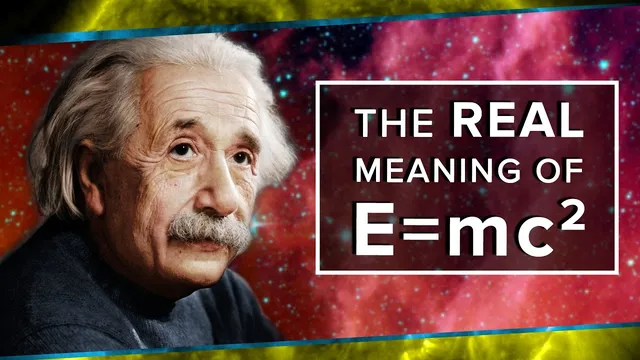
The Real Meaning of E=mc²
Based on PBS Space Time's video on YouTube. If you like this content, support the original creators by watching, liking and subscribing to their content.
E=mc² links mass to total energy content, including kinetic, potential, thermal energy, and the energy of confined light.
Briefing
E=mc² is best understood not as a claim that “mass turns into energy,” but as a statement that energy—kinetic, potential, thermal, and even confined light—always carries mass. That reframes what a scale measures: it doesn’t just count “stuff,” it measures the total energy content of what’s inside the object, which is why mass can change even when the amount of material doesn’t.
A key starting point is a counterintuitive fact: two objects built from identical constituents don’t necessarily have equal total mass. The mass of a composite system depends on how its parts are arranged and how they move. The transcript uses a pair of windup watches as a concrete example. One watch is fully wound and running; the other is stopped. The running watch contains kinetic energy from moving gears and hands, potential energy stored in springs, and a small amount of thermal energy from friction heating the components. Under E=mc², all that energy contributes to the watch’s mass. The effect is tiny—about a billionth of a billionth of a percent for a typical watch—so everyday scales can’t detect it, but with sufficiently sensitive instruments the difference would show up.
Modern physics also treats “mass” in E=mc² as rest mass: the quantity observers agree on for an object at rest. Rest mass is tied to how hard it is to accelerate something and how strongly it responds to gravity. That’s why a ticking watch has more rest mass than an otherwise identical stopped watch: the internal energies of its parts are part of what the system weighs.
The same energy-as-mass idea explains why turning on a flashlight makes its mass drop. The battery’s electrochemical energy becomes light and other forms of energy that leave the system, so the flashlight loses the corresponding mass by E=mc². The sun behaves like an enormous flashlight: it loses mass each second as it radiates energy, though the fractional change is minuscule on human timescales. Crucially, this is not “alchemy.” The radiated energy comes from changes in the sun’s internal kinetic and potential energies; the mass loss tracks those energy shifts.
A mirrored-box thought experiment sharpens the point. If a flashlight shines inside a closed, perfectly reflecting box on a scale, the scale reading doesn’t change. The flashlight loses mass, but the box gains an equal amount because the confined light’s energy still contributes to total mass—even though light itself is massless in the usual sense. Energy can carry mass through E=mc² whether it’s moving freely or trapped.
Finally, the transcript addresses the hydrogen atom puzzle: a hydrogen atom can weigh less than the sum of the proton and electron masses that make it up. The reason is that binding involves negative potential energy. When the electron and proton form an atom, their electric potential energy drops below zero relative to the “infinitely far apart” reference. Even though the electron has positive kinetic energy, the negative potential energy is large enough that the total (kinetic + potential) energy—and thus the mass via E=mc²—comes out negative relative to the separated parts. The same logic extends to atoms and molecules: chemical bonds and nuclear structure generally reduce total mass because negative potential energy is part of the bound system.
The episode ends by challenging viewers to apply the idea to a planetary scale: if everyone on Earth simultaneously picks up a hammer, does Earth’s total mass increase, and by how much? The answer hinges on how gravitational potential energy and energy content change when objects are lifted.
Cornell Notes
E=mc² is a rule for how energy contributes to mass: kinetic, potential, thermal energy, and even the energy of confined light all add to an object’s total mass via m = E/c². That’s why a running watch weighs more than a stopped one—its internal moving parts, stored spring energy, and frictional heating are all energy contributions. A flashlight’s mass drops when light escapes, but a flashlight inside a mirrored box doesn’t change the scale reading because the box gains the light’s energy. Hydrogen (and most bound atoms and molecules) can weigh less than the sum of their separated parts because binding involves negative potential energy that outweighs positive kinetic energy. Overall, scales measure cumulative energy content, not just “amount of stuff.”
Why can a composite object weigh more than the sum of its parts, even when the parts are made of the same material?
How does the “rest mass” idea change the interpretation of E=mc²?
If light is massless, why does a flashlight lose mass when it shines?
Why doesn’t a scale reading change when a flashlight is turned on inside a mirrored box?
How can a hydrogen atom weigh less than the sum of a proton and electron?
Does the sun “convert mass to energy” in the sense of alchemy?
Review Questions
- In the running-vs-stopped watch example, which specific forms of internal energy increase the system’s mass, and how does E=mc² account for the difference?
- Explain why a flashlight inside a closed mirrored box does not change the scale reading when turned on, even though the flashlight alone loses mass.
- What role does negative potential energy play in making a hydrogen atom’s mass smaller than the sum of its proton and electron masses?
Key Points
- 1
E=mc² links mass to total energy content, including kinetic, potential, thermal energy, and the energy of confined light.
- 2
Composite systems can weigh more or less than the sum of their constituents because internal energy depends on arrangement and motion.
- 3
“Mass” in m = E/c² is treated as rest mass in modern discussions, tied to acceleration and gravitational response.
- 4
A flashlight loses mass when light escapes because escaping energy carries away mass-equivalent energy; a mirrored box prevents that loss from changing the total system mass.
- 5
The sun’s radiated energy corresponds to reductions in internal kinetic and potential energies, not “mass-to-energy” alchemy.
- 6
Bound systems like hydrogen can have less mass than separated parts because binding involves negative potential energy that can outweigh positive kinetic energy.