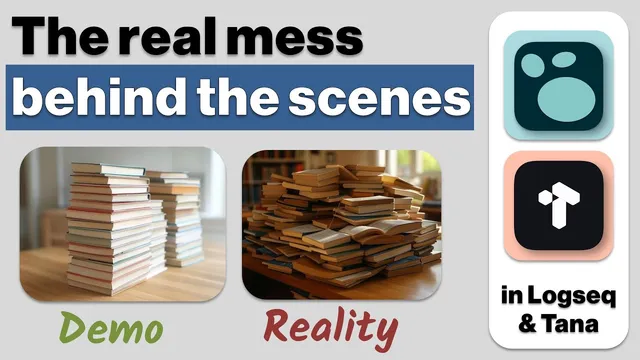
The real mess behind the scenes of my Logseq & Tana tutorials
Based on CombiningMinds's video on YouTube. If you like this content, support the original creators by watching, liking and subscribing to their content.
The aim is “alignment”: actions should reflect values and intentions, not just exist as neatly organized notes.
Briefing
A messy, real-world workflow beats a perfectly mapped “second brain” fantasy—especially when the goal is alignment between values and daily action. CombiningMinds frames personal knowledge management (PKM) and productivity systems as tools for shaping experience, not as rigid structures that pretend life is orderly. The core tension: Logseq and Tana can capture intentions and support follow-through, but the hoped-for clean mapping from values → goals → projects → tasks rarely survives contact with actual behavior.
The creator’s motivation for sharing behind-the-scenes clutter is partly creative and partly ethical. Publishing tutorials used to feel impossible without “battle-tested” certainty that everything would work long term. A friend’s question—what are you trying to achieve?—lands on “alignment”: making actions match intentions. Yet the creator admits their own implementation doesn’t hold up to that ideal. Instead of a coherent hierarchy that cleanly connects every layer, the system has duplicates, scattered notes, and pages that exist more as seeds than as actively revisited references. Some written values and practices are dated and stored, but they often aren’t read again; the value shows up later as memory and reinforcement rather than immediate use.
To make the mess concrete, the creator walks through a “five Ps” framework inspired by digital gardening (planting, plowing, growing, probing) and then applies it to planning. The hierarchy begins with values/intentions, which translate into goals, then strategy, then scheduling—positioned as a life-organization lens rather than a project-management template. From there, the walkthrough shows how Logseq becomes confusing through overlap: values appear in multiple places, intentions are duplicated, and a homepage becomes a “higgledy piggledy” board of ideas rather than a single navigable map. Goals in Logseq also show limitations: annual goals exist, but they’re rarely revisited, and earlier goal structures lack clarity (e.g., “publish 12 essays” without a deadline).
Tana, by contrast, is described as more effective for day-to-day action management. Goals in Tana are closer to SMART-style thinking—specific, measurable, achievable, relevant, and time-bound—so “publish 12 essays” becomes less actionable than goals like “have a vocabulary of over 100 words by July 31st.” The creator also distinguishes intentions from goals, noting that some “success” metrics imported from elsewhere (like a board or chair role) need reframing. Beyond goals, Tana is used for tracking “back of mind” items, affiliate link maintenance, accounting statements, and project completion—where the system’s usefulness shows up as confidence and quick retrieval.
The takeaway is not anti-system; it’s pro-coherence-in-progress. Drawing on Nietzsche’s skepticism of systematizers and the reality of entropy, the creator argues for a middle way: build order where it improves outcomes, accept mess as normal, and separate practices from tools. The next step is cleaning up duplicates, sharpening the structure, and reporting back as the channel and workflows evolve—inviting viewer feedback on whether this messier, behind-the-scenes approach is more helpful than polished tutorials.
Cornell Notes
The creator shares a candid look at how Logseq and Tana support “alignment”—matching actions to values—while admitting the hoped-for clean structure rarely holds. A values→goals→strategy→schedule hierarchy is used as a guiding framework, but Logseq ends up with duplicates, scattered intentions, and goals that often aren’t revisited. Tana is portrayed as more effective for action management because goals are made more specific and time-bound, and tracking is organized around practical workflows like projects, affiliates, and accounting. The broader message is pro-practice, not pro-perfection: systems should be flexible, continuously cleaned up, and judged by whether they shape experience over time.
What does “alignment” mean in the creator’s PKM approach, and why does it matter?
How does the “five Ps” framework connect to planning in daily life?
Why does Logseq become “messy” in this workflow, even when the underlying ideas are sound?
What changes in Tana make it more useful for execution?
How does the creator reconcile skepticism about productivity systems with continued use of them?
What does the creator consider the real value of writing down intentions and values?
Review Questions
- Where does the creator place values/intentions in the planning hierarchy, and what are the next steps in the chain?
- What specific problems appear in Logseq (duplication, overlap, goals not revisited), and how does Tana address them?
- How does the creator’s view of entropy and Nietzsche’s critique influence their stance on productivity systems?
Key Points
- 1
The aim is “alignment”: actions should reflect values and intentions, not just exist as neatly organized notes.
- 2
A values→goals→strategy→scheduling hierarchy can guide planning, but real life often breaks the clean mapping.
- 3
Logseq can become cluttered through duplicated values/intentions and overlapping pages that aren’t revisited.
- 4
Tana works better for execution when goals are specific and time-bound, and when tracking categories match real workflows.
- 5
Some written practices may not be read immediately, but they can still shape behavior later as “planted seeds.”
- 6
The creator argues for a flexible middle way: systematize enough to improve outcomes, while accepting entropy and mess as normal.
- 7
The next phase focuses on cleaning duplicates, sharpening structure, and sharing progress with viewer feedback.