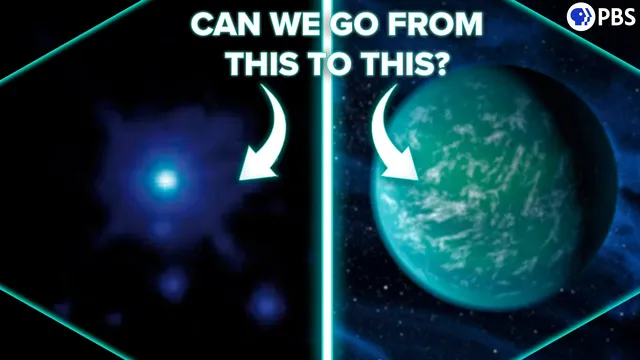
The REAL Possibility of Mapping Alien Planets!
Based on PBS Space Time's video on YouTube. If you like this content, support the original creators by watching, liking and subscribing to their content.
Using the Sun as a gravitational lens could amplify an exoplanet’s brightness by ~10^12 and magnify surface detail by ~10^11 near the focal region.
Briefing
A solar-system-sized “telescope” could, in principle, map the surfaces of distant exoplanets by exploiting the Sun as a gravitational lens—turning a faraway planet’s light into a highly magnified, reconstructable image. The key idea is to place a spacecraft at the Sun’s gravitational lens focal region, roughly 550 astronomical units (AUs) from the Sun, where the planet’s light rays bend inward and converge. At that location, the exoplanet’s brightness could be amplified by about a trillion, while surface detail could be magnified by roughly 100 billion—enough to move from “single dot” imaging to patch-by-patch surface mapping.
The challenge is not physics so much as engineering and navigation. Resolving power is limited by diffraction: even the largest feasible telescopes blur distant planets into dots. Traditional interferometry can mimic a huge aperture for radio waves, but visible-light interferometry at the needed precision is far harder. Sending a telescope to the Sun’s gravitational lens focal region sidesteps that limit by using gravity itself to concentrate the light.
Gravitational lensing is already well understood through Einstein’s general relativity: massive objects curve spacetime and bend light, producing distorted images such as Einstein rings when alignment is close. The Sun’s field would act as a much cleaner lens than the messy lensing seen in galaxy clusters. That matters because reconstructing an original image from a distorted lens is feasible in simulations; with the Sun’s predictable gravitational geometry, scientists argue the same reconstruction approach becomes straightforward.
The proposed mission architecture targets a destination far beyond the outer planets. The focal region begins near 550 AUs and extends as a focal line, meaning the Einstein ring remains observable for years as a spacecraft travels away from the Sun. Reaching it within the working lifetime of the mission team implies 25–30 years of travel time and average speeds above 100 km/s—several times faster than Voyager 1, which is currently around 150 AUs after 45 years.
Two mission concepts are outlined for NASA: a “flagship” craft with a 1–2 meter telescope, or a preferred “string of pearls” approach using many small spacecraft. The small-sat train would ride solar sails—catching photon momentum rather than carrying fuel—because long-duration acceleration is easier without onboard propellant. The destination requires enormous sail area (larger than a football stadium) and precise deployment and control. The plan calls for an advanced solar sail design dubbed SunVane, using multiple controllable sail panels made from reflective, high-melting-point, low-density metal alloy sheets only a few hundred atoms thick.
Once in the focal column, the spacecraft would deploy a telescope and use a coronagraph to block the Sun’s glare. From a single location, the telescope would see only a tiny patch of the planet (about 10 km across for an Earth-sized world at 100 light-years). Mapping the whole surface would require moving along the focal line and imaging patch by patch. Because the exoplanet and the Sun both move, the Einstein ring would shift; ion thrusters would handle the “shifting pirouette,” all without real-time guidance from Earth due to several-day light travel time.
If the concept works, the expected surface resolution is around 25 km for an exoplanet 100 light-years away. That could enable mapping coastlines, islands, mountain ranges, lakes, ice caps, and even vegetation signatures via color. Bright lights on a night side could also serve as evidence of technological activity. The approach would require a new fleet for each target exoplanet, but the small-sat design aims to keep costs down. No funded mission exists yet; the researchers involved have reportedly advanced to NASA’s phase 3 stage through the NAIA program, with the next step depending on NASA uptake.
Cornell Notes
A solar gravitational lens could turn the Sun into a giant telescope, enabling direct imaging of exoplanet surfaces. Placing spacecraft near the Sun’s gravitational lens focal region (~550 AU) would amplify an exoplanet’s brightness by ~10^12 and magnify surface detail by ~10^11. The mission concept relies on reconstructing distorted gravitationally lensed images using the Sun’s clean, well-understood gravitational field, plus coronagraph optics to block the Sun’s glare. Because the focal region is a long focal line, the Einstein ring stays visible for years as the spacecraft moves, allowing patch-by-patch mapping. With a “string of pearls” solar-sail fleet, scientists estimate ~25 km surface resolution for an Earth-sized exoplanet at 100 light-years, potentially revealing geography and even signs of technology.
Why can’t Earth-based or near-Earth telescopes resolve exoplanet surfaces, even with better optics?
How does the Sun’s gravity act like a telescope?
What makes image reconstruction plausible at the Sun’s gravitational lens focal region?
Why is the mission’s distance so extreme, and how does that affect the spacecraft design?
What is the “string of pearls” solar-sail approach, and why is it preferred?
How would the spacecraft actually map an exoplanet surface once it arrives?
Review Questions
- What diffraction-limited resolution problem motivates using a gravitational lens rather than a larger conventional telescope?
- Why does the Sun’s gravitational lens focal region behave like a focal line instead of a single focal point, and how does that change observing strategy?
- What observational role does a coronagraph play in imaging an Einstein ring near the Sun?
Key Points
- 1
Using the Sun as a gravitational lens could amplify an exoplanet’s brightness by ~10^12 and magnify surface detail by ~10^11 near the focal region.
- 2
Direct surface imaging is otherwise blocked by diffraction limits: distant planets remain unresolved as dots with feasible telescope sizes.
- 3
The mission relies on reconstructing distorted gravitationally lensed images, arguing the Sun’s gravitational field is predictable enough to recover surface structure.
- 4
The focal region begins near ~550 astronomical units, requiring 25–30 years of travel and average speeds above 100 km/s for a mission to be feasible.
- 5
A “string of pearls” fleet of small spacecraft using solar sails is favored over a single flagship craft, aiming to reduce cost and enable iterative improvement.
- 6
Enormous, heat-resistant, precisely controlled solar sails (SunVane) are central to reaching the required speeds and destination.
- 7
Surface mapping would be done patch-by-patch using a coronagraph to block the Sun’s glare, with ion thrusters handling ring motion without real-time Earth control.