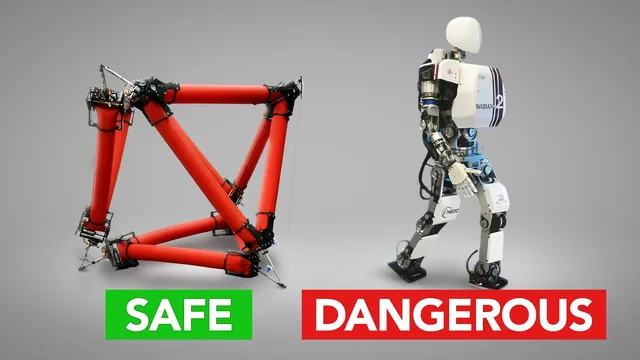
The Real Reason Robots Shouldn’t Look Like Humans | Supercut
Based on Veritasium's video on YouTube. If you like this content, support the original creators by watching, liking and subscribing to their content.
Soft, non-humanoid robot designs can be safer for human interaction while still delivering task-specific advantages like tip-based navigation through tight spaces.
Briefing
The next generation of robots may look nothing like humanoids—because the safest and most capable machines often come from abandoning human-shaped bodies in favor of specialized forms built around specific physics. Soft, flexible designs can reduce injury risk during everyday interaction while also enabling abilities that rigid robots struggle to match, from squeezing through rubble to applying large forces without hard contact.
A plant-inspired “vine robot” illustrates the point. Powered by compressed air, it grows from the tip through airtight tubing, allowing it to pass through tight spaces and navigate sticky or cluttered environments where wheels and rigid frames would get trapped. Even punctures don’t necessarily stop it: as long as air pressure is maintained, the robot can keep extending. The core idea is simple—fold airtight tubing so it inflates outward from the tip—but the engineering challenge is steering, retracting, and attaching useful payloads like cameras. Researchers add pneumatic “muscles” that steer by inflating different side chambers, shortening and lengthening sections to bend the growing body. For sensing, the camera can be held on the front using an end cap or an interlocking frame that stays connected as the robot extends.
That combination of softness, tip growth, and steering makes the vine robot useful in high-stakes settings. In search and rescue, it can be grown into cluttered or collapsed structures and equipped with cameras to locate people; it’s also described as hard to stop and potentially cheap enough to deploy in large numbers. In archaeology, it was taken to Peru to explore narrow underground tunnels too small for humans, capturing video for the research team. A medical offshoot aims at faster, safer intubation: a miniature vine-like device can be guided passively into the correct airway by its flexible branching geometry, with tests in a cadaver lab showing successful intubation without the same level of operator skill required by traditional tools. Other experiments include burrowing through sand by fluidizing it with an air jet, and the design is framed as a potential improvement over Mars burrowing attempts that failed due to insufficient friction.
The same “don’t copy humans” philosophy shows up in a different robot specialty: record-breaking jumping. A tiny carbon-fiber-and-rubber jumper—about 30 grams—uses a spring-like structure and a motor-driven winding process to store energy over time, then releases it via a latch. The result is a jump that reaches 31 meters, far beyond the previous 3.7-meter record, with extremely fast takeoff and acceleration. The breakthrough is not just lightweight construction; it’s “work multiplication,” where energy is accumulated gradually through many motor revolutions before release, allowing a small motor to produce a massive burst. The team also explores steerable and self-righting variants for navigation and planetary exploration, arguing that jumpers could hop over cliffs and craters where rovers struggle.
Finally, the transcript broadens from specific robots to a design philosophy: compliant mechanisms and soft robotics can be safer, more predictable, and easier to package for space or human-adjacent environments. The throughline is specialization—robots entering daily life more like a toolbox of precise tools than a single multipurpose humanoid.
Cornell Notes
Robots built for the real world may not need humanoid bodies. Soft, flexible machines like a compressed-air “vine robot” can grow through tight spaces, avoid getting stuck on sharp objects, and keep moving even if punctured—while still carrying sensors such as cameras. That same passive mechanical intelligence supports applications ranging from search-and-rescue and archaeology to faster, potentially safer intubation and burrowing through sand. In parallel, a carbon-fiber-and-rubber jumping robot achieves extreme heights by storing energy in a spring structure and using “work multiplication” to accumulate energy over time before release. Together, these examples argue that matching robot shape and materials to the task can outperform human-like designs and open new capabilities.
Why does abandoning humanoid shapes improve both safety and performance?
How does the vine robot move, and what makes it robust in messy environments?
What engineering problem arises when adding a camera to a robot that keeps growing, and how is it solved?
What is “passive intelligence” in the intubation concept, and what evidence is cited?
How does the jumping robot reach 31 meters, and what is “work multiplication”?
What does the micromouse section add to the overall theme of specialization?
Review Questions
- Which specific vine-robot features (movement method, steering method, and payload attachment) enable its search-and-rescue and archaeology use cases?
- Explain how “work multiplication” lets a small motor contribute to a very high jump, and why that matters for robot design.
- In micromouse competitions, how do algorithmic strategies like flood-fill differ from depth-first or breadth-first search, and why does that matter for speed?
Key Points
- 1
Soft, non-humanoid robot designs can be safer for human interaction while still delivering task-specific advantages like tip-based navigation through tight spaces.
- 2
The vine robot’s compressed-air tip extension enables movement over sticky surfaces and continued operation even after punctures, as long as pressure is maintained.
- 3
Steering and sensing are engineered as separate problems: pneumatic side “muscles” bend the growing body, while camera attachment uses end caps or interlocking frames to survive extension.
- 4
A miniature vine-robot approach to intubation relies on flexible mechanical geometry for passive path-finding, aiming to reduce operator skill requirements; cadaver-lab results are cited as successful.
- 5
The jumping robot’s extreme height comes from energy storage in a carbon-fiber/rubber spring structure plus “work multiplication,” where energy is accumulated gradually and released in a single burst.
- 6
Soft robotics and compliant mechanisms are framed as a broader design toolkit—trading rigid frames for predictable, flexible components that can improve reliability and packaging for environments like space.
- 7
Micromouse reinforces the specialization theme: decades of competition-driven improvements show how hardware, sensors, and algorithms co-evolve to optimize one narrow objective—fast maze solving.