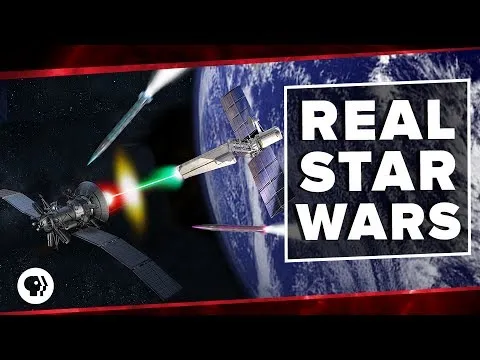
The Real Star Wars
Based on PBS Space Time's video on YouTube. If you like this content, support the original creators by watching, liking and subscribing to their content.
Sputnik’s launch and early ICBM testing accelerated the shift from space as a scientific frontier to space as a strategic military domain.
Briefing
Outer space became a strategic battleground soon after Sputnik—first as a way to watch rivals, then as a place to threaten them. The core thread runs from early Cold War optimism to a steady militarization of orbit: reconnaissance satellites enabled intelligence gathering across the Iron Curtain, while ballistic missiles and purpose-built “space weapons” turned low-Earth orbit into a contested zone. That shift mattered because it changed space from a scientific frontier into an arena where escalation could be fast, global, and hard to reverse.
The arms race began with delivery systems that were technically “suborbital.” ICBMs followed parabolic trajectories shaped by gravity, peaking around 1,200 kilometers—high enough to reach the altitudes of many low-Earth orbit satellites without achieving orbital velocity. As missile technology advanced, a single launch could carry multiple nuclear warheads across thousands of kilometers in roughly half an hour. One Soviet concept, the Fractional Orbital Bombardment System, went further by entering true orbit, allowing multiple warheads to be delivered from different directions anywhere in the world.
Both superpowers then leaned on space for defense and monitoring. Reconnaissance satellites—often film-based before digital imaging—ejected canisters that were retrieved on the ground or via parachute. The Soviets also fielded Almaz, a program that used crewed space stations to develop film onboard for rapid response. Salyut 3, the first Almaz station, was also the first weaponized satellite: it carried a 23-millimeter autocannon intended to counter anti-satellite measures, though it fired only once as a test.
The most famous “Star Wars” moment came with Ronald Reagan’s Strategic Defense Initiative in 1983. It aimed to break the logic of mutually assured destruction by expanding U.S. missile defense, including surface ABM networks and an audacious x-ray laser concept called Excalibur. Excalibur’s plan relied on a nuclear bomb–powered x-ray laser satellite: a nuclear detonation would generate x-rays behind an array of laser tubes, and the resulting lasers could vaporize metal targets in space over hundreds or thousands of kilometers. The dream was that a small number of platforms could knock out an entire missile fleet even during simultaneous launches.
Funding—hundreds of millions from 1983 to 1990—could not overcome two problems. First, it remained unclear whether underground tests produced the promised laser amplification. Second, there was no credible way to protect the satellites themselves; they would need highly elliptical Molniya orbits that kept them over key regions but also made them vulnerable to attack. The Outer Space Treaty also blocked the nuclear-powered approach by prohibiting nuclear weapons or other weapons of mass destruction in orbit or on celestial bodies.
After Excalibur, the focus shifted toward “conventional” loopholes: Brilliant Pebbles proposed non-explosive kinetic interceptors, and Project Thor imagined dropping tungsten cylinders (“Rods from God”) from orbit to strike at extreme speed. Meanwhile, anti-satellite research started earlier than these headline programs. The U.S. achieved a notable first success in 1985 by destroying the Solwind satellite with an F-15–launched missile. The USSR pursued orbital “satellite fighter” concepts like Istrebitel Sputnik, and also experimented with ground-based lasers and particle-beam ideas.
The modern danger is that real-world ASAT tests create debris that can multiply. China’s 2007 destruction of its own weather satellite generated a large fraction of tracked low-Earth-orbit debris and triggered a new competition; the U.S. followed in 2008 by destroying a spy satellite with a repurposed missile. With multiple countries now holding or developing ASAT capabilities, even a few destroyed satellites could start a chain reaction in increasingly crowded orbit—turning space into a growing shell of wreckage. For now, restraint has prevailed, but the risk of escalation remains.
Cornell Notes
Space militarization accelerated after Sputnik, moving from intelligence gathering to attempts at weaponizing orbit. Early ICBMs were “suborbital,” reaching altitudes comparable to low-Earth orbit without orbital velocity, and they rapidly evolved toward multi-warhead delivery. The U.S. and USSR used satellites for reconnaissance—often with film canisters—and the Soviets even tested weaponized platforms like Salyut 3’s autocannon. Reagan’s Strategic Defense Initiative (“Star Wars”) pursued missile defense, including Excalibur’s nuclear-powered x-ray laser satellite, but it was defunded over uncertain performance, satellite vulnerability, and Outer Space Treaty violations. Later concepts leaned on treaty-allowed conventional weapons, yet real ASAT tests (notably China in 2007 and the U.S. in 2008) showed how debris can threaten the long-term usability of low-Earth orbit.
Why were early ICBMs considered “space weapons” even though they didn’t orbit?
How did reconnaissance satellites work before digital imaging became standard?
What made Excalibur’s x-ray laser concept both powerful and problematic?
How did Brilliant Pebbles try to avoid the treaty and the Excalibur vulnerability?
What changed after China’s 2007 ASAT test?
What does the Outer Space Treaty allow, and why did that matter for space weapons designs?
Review Questions
- Which technical feature of ICBMs made them capable of threatening low-Earth orbit satellites without entering orbit?
- What were the two main practical reasons Excalibur was defunded, and how did the Outer Space Treaty factor into the decision?
- How do ASAT tests create long-term risks for low-Earth orbit even when the destroyed satellite is small or retired?
Key Points
- 1
Sputnik’s launch and early ICBM testing accelerated the shift from space as a scientific frontier to space as a strategic military domain.
- 2
ICBMs threatened satellites through suborbital trajectories that reached altitudes comparable to low-Earth orbit without achieving orbital velocity.
- 3
Film-based reconnaissance satellites relied on ejected canisters recovered on the ground or by parachute, enabling intelligence collection before digital imaging.
- 4
Salyut 3 marked an early weaponized satellite approach by carrying a 23-millimeter autocannon, though it was only fired once for testing.
- 5
Reagan’s Strategic Defense Initiative (“Star Wars”) pursued missile defense, including Excalibur’s nuclear-powered x-ray laser concept, but it collapsed under uncertain test performance, satellite vulnerability, and Outer Space Treaty constraints.
- 6
Later “conventional” concepts like Brilliant Pebbles and kinetic impact ideas sought treaty compliance, yet real ASAT tests demonstrated that debris can threaten the sustainability of low-Earth orbit.
- 7
China’s 2007 ASAT destruction and the U.S. response in 2008 highlighted how debris-driven escalation could turn orbit into an increasingly unusable environment.