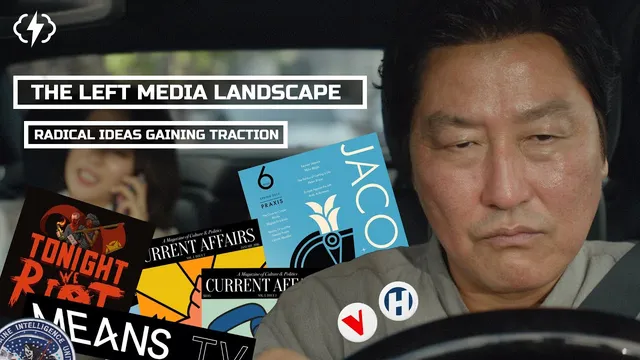
The Resurgence of Popular Left Media
Based on Second Thought's video on YouTube. If you like this content, support the original creators by watching, liking and subscribing to their content.
Left media’s resurgence is attributed to mainstream-friendly formats—games, podcasts, magazines, streaming, and big-budget film—that make anti-capitalist ideas easier to encounter.
Briefing
A wave of popular left media is breaking out of niche politics by adopting mainstream-friendly formats—games, podcasts, magazines, streaming, and big-budget films—making anti-capitalist ideas easier to encounter, share, and discuss. The core shift is not just more left content, but more accessible left content: messages delivered through entertainment and design choices that feel welcoming rather than academic or hostile.
Dissatisfaction in wealthy capitalist countries has been building for decades, with major flashpoints including the Iraq War backlash, the 2008 financial crash and Occupy Wall Street, Black Lives Matter, rising scrutiny of police brutality, and criticism of for-profit healthcare during the pandemic. By the late 2010s, that broader mood helped set the stage for a new wave of left media in the 2020s—print magazines, podcasts, and even Academy Award–winning movies—aimed at reaching people who do not already live inside leftist discourse.
One prominent example is the anti-capitalist game Tonight We Riot, positioned as a blunt condemnation of capitalism and notable for being available not only on PC but also on the Nintendo Switch. The strategy is straightforward: many people won’t read dense political theory, but they will play a fun game and absorb a political message along the way. That accessibility gap is framed as a long-standing problem for left media online, where right-wing outlets have benefited from simpler, highly digestible branding and broad recognition.
Podcasts are another growth engine, with a post-2015 surge in left programming on Patreon and beyond. Chapo Trap House is cited as a major success story, averaging roughly 150,000–200,000 downloads per episode, while still remaining smaller in cultural reach than Joe Rogan, whose cross-spectrum appeal and “everyman” style help ideas travel farther. The left’s newer podcast wave is described as more niche—such as Chapo’s “dirtbag left” humor, Know Your Enemy’s focus on understanding American conservatism, and The Trillbilly’s Appalachian perspective—yet still a meaningful step toward broader visibility.
Print publishing shows similar momentum. Jacobin, founded in 2010, is credited with combining left commentary with polished design and a coffee-table-friendly presentation, reaching a print circulation of about 50,000 and a monthly web audience above 2 million. Current Affairs, launched in 2015, is described as succeeding by avoiding ads and filler, steering clear of obscure jargon, and balancing seriousness with “joyful whimsy.” Radical book publishers also play a role: Haymarket Books (listed by Publishers Weekly as a fast-growing independent publisher) and Verso Books are highlighted for building accessible catalogs and sustaining left literature through subscription and sales.
In film and streaming, the argument is that left ideas are gaining legitimacy through mainstream distribution and awards. Means TV, launched in February 2020 as a worker-owned anti-capitalist service, is presented as an alternative to corporate-backed entertainment shaped by advertising and venture capital. Meanwhile, Bong Joon-ho’s Parasite is treated as a landmark: a universal story about living under capitalism’s inequality that won four Oscars, including Best Picture, demonstrating that anti-capitalist themes can resonate globally without relying on dense political lectures.
The closing takeaway is strategic: right-wing media has long succeeded through unity, visibility, and simple pillars. The left’s challenge is to build household-name platforms and back existing institutions rather than multiplying fragmented projects—while using the current momentum in popular media to expand reach and support.
Cornell Notes
Left media is gaining popularity by becoming more accessible and mainstream-friendly, using entertainment formats and design choices rather than relying on dense political theory. The resurgence is tied to long-running dissatisfaction in wealthy capitalist countries and a post-2015 expansion of left podcasts, magazines, games, streaming services, and explicitly anti-capitalist films. Examples include Tonight We Riot on Nintendo Switch, the podcast growth around Chapo Trap House and other shows, and print successes like Jacobin and Current Affairs that avoid jargon and emphasize appealing presentation. In streaming and film, Means TV and award-winning cinema such as Parasite show that anti-capitalist messages can travel widely and still feel universal. The remaining hurdle is building unified, high-visibility platforms that can compete with entrenched right-wing media ecosystems.
Why is Tonight We Riot treated as a meaningful milestone for left media?
What does the comparison between Chapo Trap House and Joe Rogan reveal about podcast reach?
How do Jacobin and Current Affairs illustrate a strategy for print success?
What role do worker-owned or non-corporate media models play in the streaming discussion?
Why is Parasite highlighted as more than just another political film?
Review Questions
- Which specific media formats are credited with expanding left ideas beyond niche audiences, and what accessibility features make them effective?
- How does the transcript connect the left’s visibility problem to fragmentation and the right’s success to unity and simple messaging?
- What concrete examples are used to show that anti-capitalist messages can succeed in mainstream markets (games, podcasts, print, streaming, film)?
Key Points
- 1
Left media’s resurgence is attributed to mainstream-friendly formats—games, podcasts, magazines, streaming, and big-budget film—that make anti-capitalist ideas easier to encounter.
- 2
Tonight We Riot is singled out because it delivers a direct anti-capitalist message in a widely accessible gaming platform, including the Nintendo Switch.
- 3
Podcast growth on the left is real, but broader cultural reach still lags behind cross-spectrum formats like Joe Rogan’s, which rely on an everyman style and low jargon.
- 4
Print publishing has succeeded by pairing left politics with appealing design and approachable language, as seen in Jacobin’s circulation and Current Affairs’ ad-free, jargon-avoiding model.
- 5
Worker-owned streaming like Means TV is framed as a way to avoid corporate incentives that shape entertainment toward the status quo.
- 6
Parasite is presented as a landmark demonstration that class and inequality narratives can achieve universal appeal and major awards.
- 7
The left’s strategic challenge is to build unified, household-name platforms and support existing institutions rather than multiplying fragmented projects.