The Ridiculous Engineering of Jet Engines
Based on Veritasium's video on YouTube. If you like this content, support the original creators by watching, liking and subscribing to their content.
Jet thrust in passenger aircraft relies heavily on bypass air: roughly 90% of incoming air bypasses the core, producing over 80% of thrust.
Briefing
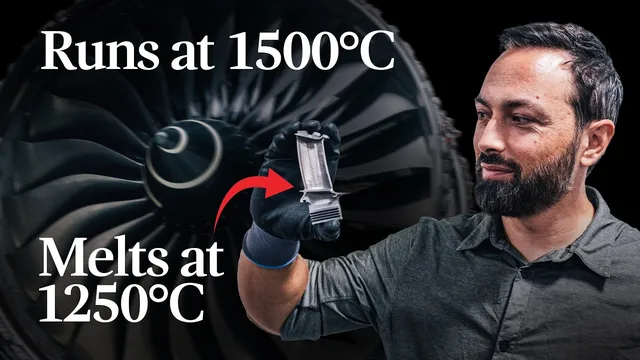
Jet engines run on a brutal mismatch: the hot gas inside can reach roughly 1,500°C—around 250°C hotter than the melting point of the materials that make up key components—yet the engines keep operating for tens of thousands of flight hours. The core reason is that thrust comes from a carefully managed expansion of high-pressure gas through turbines and, crucially, from a massive front fan that bypasses most air around the hot section. That architecture reduces how much energy must be extracted from the hottest region, buying room for materials to survive.
Inside a modern turbojet/turbofan, air enters a giant fan and a compressor system that squeezes only about 10% of the flow into narrower passages. That compression drives pressure up to around 50 atmospheres and raises temperature to about 600°C. Fuel is then injected and ignited in a combustion chamber, pushing gas temperatures to roughly 1,500°C. The hot, high-pressure gas then expands through turbine blades: pressure drops from about 50 atmospheres down toward one, and the gas expands nearly 20×, spinning turbines up to around 12,500 revolutions per minute. Those turbines power the fan and compressors, while the exhaust provides additional thrust.
But the biggest thrust lever is the bypass stream. More than 80% of thrust in a passenger jet comes from the large fan pushing the remaining ~90% of air around the engine core—effectively a huge ducted propeller. This bypass strategy is not just about power; it’s about efficiency. For the same momentum change (impulse), pushing more air with a smaller velocity increase wastes less kinetic energy because exhaust energy scales with velocity squared. Bigger engines and higher bypass ratios also help reduce noise by surrounding the hot exhaust with cooler air.
Efficiency is also bounded by thermodynamics. The maximum fraction of heat that can become work follows Carnot efficiency, which depends on the hot gas temperature and the cold ambient temperature. Higher cruise altitudes mean colder outside air, improving the temperature gap—but raising combustion temperatures further makes the turbine environment even harsher. Turbine blades face a compound assault: extreme heat, rapid rotation, and enormous centrifugal loads. A representative high-pressure blade experiences inward forces equivalent to the weight of about 20 metric tons, while its tips slice through air at nearly 1,900 km/h. Meanwhile, oxygen can react with blade materials, and dust and sand can erode surfaces.
Material science and manufacturing are the long game that makes “run hotter than the melting point” survivable. Early jet engines used steel turbine blades, but steel lost strength at lower temperatures and limited flight duration. Nickel-based superalloys became the breakthrough, with microstructures engineered around two phases: a disordered gamma phase and an ordered gamma prime phase (nickel-aluminum). Gamma prime blocks dislocation motion by forcing dislocations into high-energy paired “super dislocations,” boosting strength and even creating a strength peak as temperature rises. Yet that strength must be balanced against brittleness.
Even stronger gains came from controlling crystal structure. Grain boundaries act as weak points and diffusion highways, accelerating creep and deformation. Casting methods now produce directionally solidified blades and—most importantly—single-crystal turbine blades, reducing grain boundaries from tens of thousands to one. After casting, blades undergo heat treatments to tune the final gamma/gamma prime microstructure. These single-crystal blades can last up to nine times longer against creep and thermal fatigue and resist corrosion far better than multi-grain designs, enabling modern engines to run about 25,000 hours between major overhauls.
Survival still depends on cooling and coatings. Internal cooling passages and film cooling holes route compressor air (around 600°C) to form a protective film over the blade surface. A thin metallic bond coat and a ceramic top coat keep the metal 100–170°C cooler than it otherwise would be. The final threat is ingested dust: in tests, sand-like particles can melt onto turbine surfaces, rip off thermal barrier coatings, and raise underlying alloy temperatures until blades deteriorate. Ongoing refinements to ceramic coatings aim to extend turbine life further—pushing engines to the edge of what physics and metallurgy will allow, without crossing the line into failure.
Cornell Notes
Jet engines survive extreme temperatures by combining engine design with materials engineering. Only a small fraction of incoming air is compressed and heated to about 1,500°C; most thrust comes from the bypass air pushed by the front fan, which also improves efficiency and noise. Turbine blades must endure heat, oxidation, centrifugal forces, and erosion, so engineers use nickel-based superalloys with a gamma/gamma prime microstructure that resists dislocation motion. Casting has shifted toward directionally solidified and then single-crystal blades to eliminate grain boundaries that drive creep and corrosion. Cooling passages, film-cooling holes, and ceramic coatings provide additional barriers, while ongoing coating upgrades target damage from ingested dust.
Why doesn’t a jet engine melt even when the hot gas is far hotter than typical metal melting points?
How does bypass air improve jet engine efficiency?
What makes nickel superalloys stronger at high turbine temperatures than steel or titanium?
Why did turbine blade manufacturing move toward single-crystal blades?
How do cooling and coatings work together to prevent blade failure?
What role does dust play in turbine blade degradation?
Review Questions
- How do bypass ratio and exhaust velocity trade-offs affect jet engine efficiency for the same thrust (impulse)?
- Explain how gamma prime microstructure changes dislocation motion compared with the gamma phase.
- Why do grain boundaries accelerate creep, and how does single-crystal casting mitigate that risk?
Key Points
- 1
Jet thrust in passenger aircraft relies heavily on bypass air: roughly 90% of incoming air bypasses the core, producing over 80% of thrust.
- 2
Compression heats only a portion of the airflow to about 600°C before combustion raises core gas temperatures to around 1,500°C.
- 3
Turbine blades convert the hot gas’s expansion energy into shaft power, spinning at about 12,500 RPM under extreme centrifugal loads.
- 4
Nickel superalloys gain high-temperature strength from gamma prime ordering, which forces dislocations to move as high-energy paired “super dislocations.”
- 5
Single-crystal turbine blades reduce creep and corrosion by eliminating grain boundaries, which act as weak points and diffusion pathways.
- 6
Blade survival depends on layered defenses: internal cooling passages, film-cooling holes, and ceramic top coats that keep the metal 100–170°C cooler.
- 7
Ingested dust can melt onto blades, damage thermal barrier coatings, and raise underlying alloy temperatures—driving ongoing improvements in ceramic coating durability.