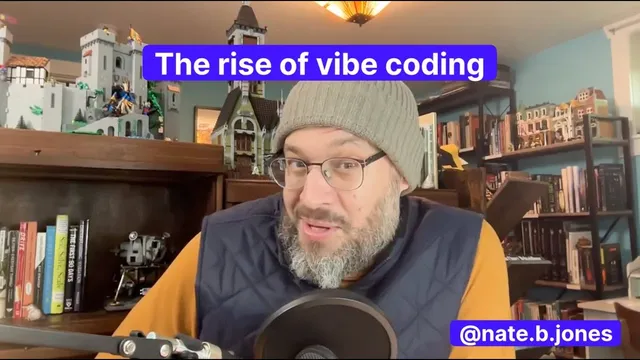
The rise of vibe coding: copycats and winners
Based on AI News & Strategy Daily | Nate B Jones's video on YouTube. If you like this content, support the original creators by watching, liking and subscribing to their content.
Late entrants such as Canva are positioning vibe coding primarily for prototyping, but that narrow value wedge may not satisfy users seeking finished apps.
Briefing
The vibe coding market is shifting from “quick prototypes” toward fully featured, end-to-end app building—because early leaders are getting users to trust AI enough to finish real products. That change matters for anyone betting on this space: companies that position themselves as only partially capable (or only good for early drafts) risk being boxed out as users increasingly demand working workflows, not just demos.
Canva’s reported entry into the “lovable bolt world” highlights the tension. Canva is emphasizing a narrow use case—prototyping—framing the tool as a design-first experience. Rumors suggest Figma may be moving in a similar direction. The underlying claim from these late entrants is that the best value is limited to early-stage experimentation, not building complete applications. But the market signal coming from the head of the pack points elsewhere: users are flocking to products that promise more than sketches, and they’re pushing for completion.
Lovable and Replit are presented as examples of that early-leader momentum. Lovable’s roadmap is described as expanding beyond prototyping—adding capabilities like database integration and announcing “Lovable 2,” with features such as bringing in teams and security scanning. The direction implies a broader goal: making it feasible to build web apps inside the product, not merely mock them. Replit’s improvement is tied to a specific workflow upgrade—its building agent now handles planning more effectively. Instead of rushing, the agent reportedly takes time to think through the whole workflow and then sets expectations with a notification that the build may take around 10 minutes, encouraging users to wait.
That planning-and-timing detail is treated as a practical turning point. The transcript describes a firsthand moment where a child saw the “10 minutes” warning and adjusted expectations, suggesting the system is becoming better at managing the user experience around longer build cycles. It also contrasts today’s progress with earlier failure modes: previously, builds could produce non-working functionality and fall into error-fixing loops. While endless error loops still happen—messages from users complaining about them appear frequently—the overall competency curve is said to be rising quickly.
The market’s deeper dynamic is framed through an analogy: imagine a city that previously only had restaurants, then suddenly invents affordable kitchens. Not everyone will cook at home, and restaurants still matter—but the existence of kitchens creates an entirely new industry. In the same way, vibe coding is not replacing professional engineering or traditional development; it’s creating a new path for building “light web apps” for little money, quickly enough to attract sustained demand.
Against that backdrop, the transcript argues that companies emphasizing “half-featured” outcomes will struggle long term. Users aren’t just curious—they’re frustrated when builds don’t work, and that frustration is interpreted as evidence of real appetite for a home-kitchen experience: fully featured apps that can actually ship, not just start as prototypes.
Cornell Notes
Vibe coding is moving from prototype-only tools toward systems that can produce working, fully featured apps. Late entrants like Canva (and rumored Figma movement) are positioning their offerings as best for prototyping, but early leaders such as Lovable and Replit are expanding capabilities and improving build workflows. Lovable’s roadmap includes database support and “Lovable 2” features like team support and security scanning, signaling a push beyond drafts. Replit’s building agent reportedly improved planning by taking time to map the workflow and warning users to expect a longer build (around 10 minutes). Even though error loops still occur, the overall capability curve is rising fast enough to create real demand for finished products rather than half-done demos.
Why does the transcript treat “planning time” (e.g., a 10-minute warning) as a meaningful product improvement rather than a minor UX tweak?
What’s the strategic difference between Canva’s positioning and the positioning attributed to early leaders like Lovable and Replit?
How does the transcript justify the claim that vibe coding is creating a real market rather than a temporary novelty?
What evidence is offered that early leaders are improving quickly enough to change user behavior?
What does “distinct value wedge” mean in this context, and why is it presented as necessary for survival?
Review Questions
- Which specific product changes (planning, databases, security scanning, teams) are described as pushing vibe coding beyond prototyping?
- How does the “kitchens vs. restaurants” analogy map onto the relationship between vibe coding and professional engineering?
- Why does the transcript suggest that user frustration is a signal of market demand rather than a sign that the tools are failing?
Key Points
- 1
Late entrants such as Canva are positioning vibe coding primarily for prototyping, but that narrow value wedge may not satisfy users seeking finished apps.
- 2
Lovable’s roadmap is described as expanding from prototyping toward full web-app building, including database integration and features like teams and security scanning in “Lovable 2.”
- 3
Replit’s building agent is portrayed as improving reliability through better workflow planning and explicit time expectations (about 10 minutes).
- 4
Even with ongoing issues like endless error loops, the overall capability curve for leading vibe coding tools is rising quickly enough to sustain demand.
- 5
Vibe coding is framed as creating a new “home kitchen” industry for building light web apps, not replacing restaurants (professional engineering).
- 6
Companies that publicly accept half-featured outcomes risk losing long-term share to tools committed to delivering end-to-end app functionality.
- 7
User frustration when builds fail is treated as evidence of real intent to ship products, not just curiosity about demos.