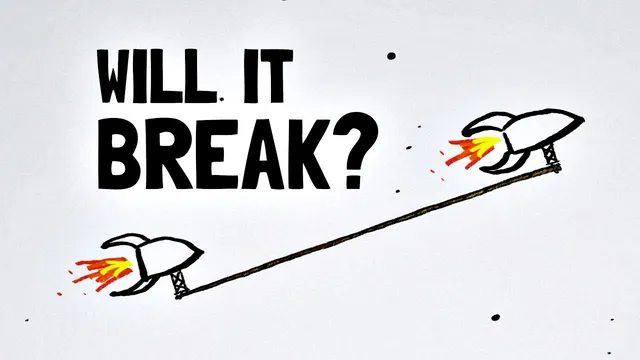
The Rocket & String Paradox
Based on minutephysics's video on YouTube. If you like this content, support the original creators by watching, liking and subscribing to their content.
A weak string connecting two spacecraft can fail under equal simultaneous acceleration because relativistic constraints on separation and contraction don’t all fit together.
Briefing
Two spacecraft tied together by a very long, thin string and given the same sudden acceleration at the same time create a paradox: special relativity predicts length contraction for moving objects, so the string and the ships should each shorten in the direction of motion. If both ships and the string contract together, the ships end up closer than they were, implying the string must snap. Yet if the ships contract individually while keeping the same separation, the string must shorten relative to the ships—also suggesting it should snap. The key question becomes what “length contraction” physically does to a connected system.
The resolution hinges on how relativistic effects redistribute simultaneity and forces across the system. From one viewpoint, the electromagnetic forces that hold the string together also undergo length contraction. That means the atomic and intermolecular separations inside the string literally contract, effectively pulling the string shorter; if the string is weak and cannot accommodate the required shortening, it tears. In this picture, the string breaks because its internal binding forces contract in the direction of motion.
From another viewpoint, the break comes from relativity of simultaneity rather than from internal contraction alone. In the frame moving with the ships’ final speed, events that were simultaneous in the original setup are no longer simultaneous. The “front” spacecraft begins accelerating first in that moving frame, so for a period it moves away from the “back” spacecraft. By the time the back spacecraft catches up and both have accelerated, the separation between them is larger than it was initially. That mismatch forces the string to fail—now the ships themselves are the agents that effectively “snap” the connection.
Why don’t ordinary objects tear apart whenever they accelerate? The transcript’s answer is that most objects are not driven by multiple independent acceleration sources. Instead, one part is pushed or pulled, and intermolecular forces transmit the acceleration throughout the material. When those internal forces experience relativistic contraction, the object responds as a whole by contracting rather than splitting. Tearing becomes plausible only when different parts of an object are accelerated independently—like two separate rockets tied together—because then the internal structure can’t reconcile the different relativistic constraints without breaking.
The deeper takeaway is that “what breaks what” depends on the frame: length contraction and simultaneity shifts can both be used to describe the same physical outcome, but they assign the failure to different parts of the system. Spacetime diagrams are presented as the practical tool for tracking the full causal structure, keeping the paradox from collapsing into frame-dependent confusion. The overall message is that in special relativity, connected systems can fail in ways that look contradictory until simultaneity and force transmission are handled consistently.
Cornell Notes
Two spacecraft connected by a weak string and accelerated simultaneously raise a paradox because special relativity predicts length contraction for moving objects. If the ships and string all contract together, the ships end up closer than before; if the ships contract individually while keeping their separation, the string must shorten relative to them. One resolution says the string tears because the electromagnetic forces holding it together contract too, pulling the string shorter. Another resolution says simultaneity changes in a moving frame: the front ship accelerates first there, increasing separation until the back catches up, so the string fails. Ordinary objects don’t explode because internal forces transmit acceleration so the body contracts as a whole unless different parts are driven independently.
Why does simultaneous acceleration of two connected spacecraft still lead to a “string snapping” conclusion?
How can length contraction itself cause the string to tear?
How does relativity of simultaneity shift the cause of the break to the spacecraft?
Why don’t normal objects tear apart when they accelerate?
What role do spacetime diagrams play in resolving the paradox?
Review Questions
- In what sense can the same string-breaking event be attributed to the string in one viewpoint and to the spacecraft in another?
- What condition about acceleration sources inside an object makes tearing by relativistic effects plausible?
- How does relativity of simultaneity change the order of acceleration events in a moving frame?
Key Points
- 1
A weak string connecting two spacecraft can fail under equal simultaneous acceleration because relativistic constraints on separation and contraction don’t all fit together.
- 2
Length contraction affects not only the macroscopic bodies but also the electromagnetic forces and internal separations that hold the string together.
- 3
Relativity of simultaneity means acceleration events that are simultaneous in one frame are not simultaneous in another, changing which ship effectively “moves away first.”
- 4
In a moving frame with the final speed, the front ship accelerates first, temporarily increasing separation until the back catches up—forcing the string to snap.
- 5
Ordinary objects usually don’t tear because internal intermolecular forces transmit acceleration so the body contracts as a whole.
- 6
Tearing becomes more plausible when different parts of an object are accelerated independently, as with two separate rockets tied together.
- 7
Spacetime diagrams provide a consistent way to track simultaneity and causal ordering across frames.