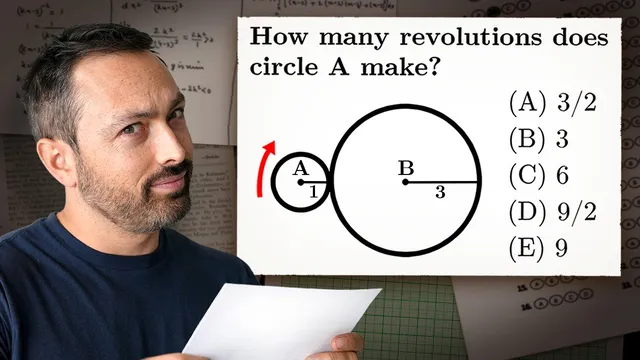
The SAT Question Everyone Got Wrong
Based on Veritasium's video on YouTube. If you like this content, support the original creators by watching, liking and subscribing to their content.
The circumference-ratio intuition (radius ratio → circumference ratio → rotation count) misses an extra rotation caused by the closed, curved path.
Briefing
A single SAT math question from 1982 became infamous because every student who took it was marked wrong—yet the correct answer wasn’t even among the choices. The problem asked how many revolutions circle A makes as it rolls around circle B, given that circle A’s radius is one-third of circle B’s. The intuitive “circumference ratio” logic points to three rotations, and that’s exactly what test writers and students alike initially chose. But the official answer key didn’t match the actual mechanics of rolling.
The core issue is a classic “coin rotation paradox”: when a smaller circle rolls around an identical-sized circle, it can end up appearing to rotate twice even though the path length suggests only one rotation. In this SAT problem, the same mismatch shows up more strongly. A careful, scale-based count shows circle A rotates four times before its center returns to the starting point. The extra rotation comes from the fact that rolling around a curved path adds a geometric contribution beyond simply matching arc length to circumference.
One way to see the “four” result is to convert the circular motion into a straight-line roll using a ribbon whose length equals the circumference of the larger circle. Rolling along that straightened path produces one fewer rotation than the circular case; when the straight path is bent back into a circle, circle A gains an additional rotation to complete the loop. More generally, the number of rotations equals the distance traveled by the rolling circle’s center divided by its circumference—plus or minus one circumference depending on whether the rolling occurs on the outside or inside of the larger shape.
Still, the transcript highlights why multiple answers can be defended. If “revolution” is interpreted in an astronomical sense—meaning a complete orbit around another body—then circle A “revolves” around circle B only once, even if it rotates several times. That ambiguity in wording helps explain how people could justify different numeric answers (three, four, or even one orbit), even though the SAT’s multiple-choice framing treated the question as having a single unambiguous numeric solution.
The consequences were real. Only three students out of roughly 300,000 wrote to the College Board about the error: Shivan Kartha, Bruce Taub, and Doug Jungreis. After reviewing their letters, the College Board publicly admitted the mistake and nullified question 17 for all test takers. Scores were rescored, shifting final results by about 10 points on the 800-point scale—enough to matter for scholarships and strict admissions cutoffs. The episode also fed a broader lesson about standardized testing: even small wording or keying errors can ripple into outcomes, and the SAT’s long history of “one exam that determines futures” didn’t protect it from a preventable math mistake.
Beyond the rescoring, the rolling-circle principle gets extended to timekeeping. The same rotation-vs-orbit distinction that explains the coin paradox also underlies why sidereal time differs from solar time: Earth’s rotation count changes depending on whether you track the Sun’s position overhead or a distant star’s return to the same point in the sky. In short, the SAT blunder became a gateway to a deeper, everyday truth about motion, reference frames, and what “one rotation” really means.
Cornell Notes
The 1982 SAT question about a small circle rolling around a larger one was wrong in its answer choices: the correct rotation count was not listed. The common “circumference ratio” intuition gives three rotations, but the rolling geometry adds an extra rotation, and careful counting yields four rotations for circle A when its center returns to the start. The discrepancy is tied to the coin rotation paradox and to how rolling distance relates to rotation when the path is curved. The transcript also notes that the word “revolutions” is ambiguous: an astronomical definition could justify an “orbit” count of one, even if the circle rotates multiple times. After students complained, the College Board rescored and nullified the question for everyone.
Why does the simple circumference-ratio intuition fail here?
How does the “coin rotation paradox” connect to SAT question 17?
What does the transcript mean by a general rule for circles rolling without slipping?
Why can “three different solutions” be justified despite one correct multiple-choice answer?
What happened after students reported the error?
Review Questions
- In the rolling-circle problem, what geometric factor adds the “extra” rotation beyond the circumference ratio?
- How does the definition of “revolution” (orbit vs axial rotation) change what answer could be defended?
- Using the general rule, how would you predict the rotation count difference between rolling on the outside versus inside of a shape?
Key Points
- 1
The circumference-ratio intuition (radius ratio → circumference ratio → rotation count) misses an extra rotation caused by the closed, curved path.
- 2
For the SAT setup with circle A radius = 1/3 of circle B, careful counting gives circle A four rotations when its center first returns to the starting point.
- 3
The coin rotation paradox illustrates the same principle: rolling on a closed path can produce more rotations than simple arc-length reasoning predicts.
- 4
The word “revolutions” is ambiguous enough that an astronomical “orbit” interpretation can yield a different numeric answer than a mechanical “rotation” interpretation.
- 5
Three students (Shivan Kartha, Bruce Taub, Doug Jungreis) reported the error; the College Board later nullified the question and rescored scores.
- 6
Nullifying a single question shifted scores by about 10 points on an 800-point scale, which can matter for scholarships and strict admissions thresholds.
- 7
The same rotation-vs-orbit distinction helps explain why sidereal time and solar time differ in astronomy and satellite operations.