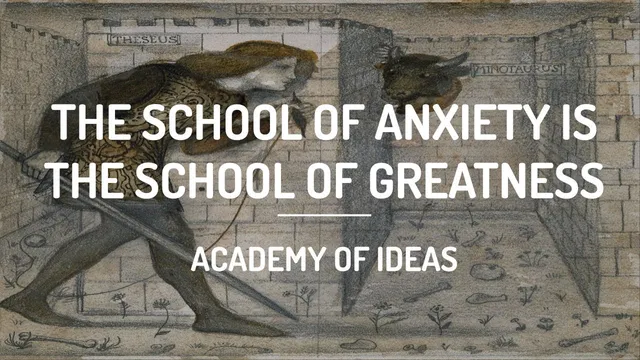
The School of Anxiety is The School of Greatness
Based on Academy of Ideas's video on YouTube. If you like this content, support the original creators by watching, liking and subscribing to their content.
Anxiety is framed as a necessary bridge between possibility and action; avoiding it can mean betraying one’s potential.
Briefing
A life of passivity ends when anxiety stops being a signal to retreat and starts functioning as a prompt to act. Kierkegaard’s “school of anxiety” frames anxiety as a Janus-faced force: it can wreck a person through fear and avoidance, or it can guide self-development when someone meets the anxious moment with bold work instead of excuses. The central claim is blunt—serenity comes not from endless reflection, but from doing the duty that anxiety reveals as necessary, then stepping back to see what kind of self that action creates.
The transcript argues that humans differ from other creatures because freedom—not instinct—defines their predicament. People can imagine alternative futures, weigh possibilities, and then choose which paths to actualize. That process of self-creation depends on an “intermediate determinant” between possibility and reality: anxiety. Possibility may “pass over into actuality,” but not automatically; anxiety is the friction that accompanies moving into an unpredictable, open-ended future. When someone moves forward without that anxiety, it isn’t proof of mental health—it can indicate betrayal of one’s potential, a life lived too safely to test what one is capable of.
Rollo May is invoked to stress that anxiety is not merely a problem to eliminate; it is the price of moving ahead despite shocks and threats. Self-realization happens only at the cost of pushing through uncertainty. Yet most people respond by fleeing—deluding themselves that they don’t want more, or trading long-term growth for short-term comfort. The transcript calls this a Faustian bargain: avoiding anxiety reduces the chance of failure, but it also removes the chance for genuine self-expression, leaving a person with a “living death” that slowly erodes meaning.
Several thinkers sharpen the warning. Alexander Lowen links survival without self-expression to danger “from within,” while Carl Jung describes refusal to launch into life as a kind of partial suicide—killing off the parts of the self that envision and desire a greater life until the comfort zone becomes a tomb. The escape from this trap depends on three practical shifts. First, action must be taken in the presence of anxiety; waiting to feel anxiety-free breeds weakness and can foster dependence on substances. Second, responsibility can’t be outsourced—no one can move through another person’s anxiety or actualize their potential. Nathaniel Branden’s “no one is coming” moment captures the psychological pivot from rescuer fantasies to agency.
Finally, the transcript adds a more unsettling ingredient: the “shadow.” Jung’s shadow is not just negativity; it is the denied, instinctual side of the self that can drive risk when reasoning stalls. The argument is that life needs disorder to generate new forms of self-organization, and that destruction can clear space for the new. Nietzsche’s line about living dangerously closes the loop: the greatest fruitfulness comes from taking bold risks rather than worshiping safety. In this framework, anxiety becomes the gateway—dangerous if avoided, constructive if answered with action.
Cornell Notes
Anxiety is presented as a necessary middle step between possibility and reality. Kierkegaard’s “school of anxiety” treats anxiety as Janus-faced: it can destroy a life through avoidance, or it can develop the self when a person meets anxious moments with duty and hard work. Self-realization requires choosing possibilities that unfold one’s potentials, and it often comes with shocks that can’t be eliminated—only faced. The transcript argues that escaping passivity depends on acting despite anxiety, accepting personal responsibility (“no one is coming”), and even drawing on the shadow side of the self that craves risk and disorder. The payoff is a life with self-expression rather than a slow, constricting death in a comfort shell.
Why does the transcript treat anxiety as an “intermediate determinant” rather than a problem to remove?
What does “action can be taken in the face of anxiety” look like in practice, according to the transcript?
How does the transcript argue that responsibility can’t be outsourced?
Why does the transcript bring in Jung’s shadow and the idea of disorder?
What is the “living death” described, and how is it linked to self-expression?
What role does Nietzsche play in the transcript’s overall message?
Review Questions
- How does the transcript distinguish anxiety that helps self-development from anxiety that ruins a life?
- What three factors are presented as crucial for escaping passivity, and how does each one change a person’s behavior?
- Why does the transcript claim that moving forward without anxiety can indicate a problem rather than good mental health?
Key Points
- 1
Anxiety is framed as a necessary bridge between possibility and action; avoiding it can mean betraying one’s potential.
- 2
Self-creation requires choosing possibilities that unfold capacities, then taking steps despite uncertainty rather than waiting for comfort.
- 3
Procrastination driven by the belief that anxiety must disappear first is treated as a form of weakness that can foster harmful coping.
- 4
Personal responsibility is non-transferable: no rescuer can move through another person’s anxiety or make life right for them.
- 5
Refusing self-expression is described as a slow internal death that eventually turns a comfort zone into a tomb.
- 6
Escaping stagnation may require engaging the shadow side—instinctual energy that can push action when reasoning stalls.
- 7
Risk and even disorder are portrayed as conditions for new forms of self-organization, not just threats to be avoided.