The Science Behind Dogs' Incredible Sense Of Smell
Based on Veritasium's video on YouTube. If you like this content, support the original creators by watching, liking and subscribing to their content.
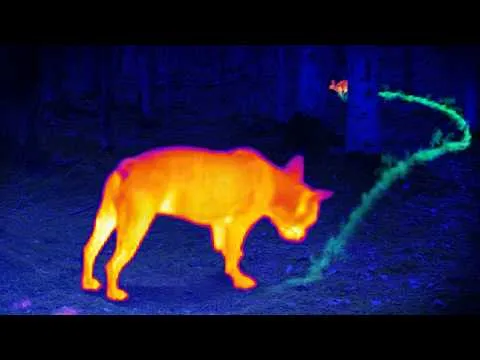
Dogs’ sniffing effectiveness comes from rapid inhale–exhale cycles at about five times per second plus turbulent exhalation that pulls fresh air from ahead.
Briefing
A U.S. government lab is using high-speed airflow and particle-imaging tools to understand how trace substances move through air and surfaces—work that ranges from solving crimes to improving mask design. The central finding is that dogs’ extraordinary sniffing power comes from a built-in sampling mechanism: rapid, turbulent exhalations combined with a five-times-per-second inhale–exhale rhythm that repeatedly refreshes the chemical “sample” reaching the olfactory system. That same principle has inspired engineered sniffing devices that can boost detection performance by roughly an order of magnitude compared with standard vapor detectors that simply inhale air.
In the lab, researchers study air flow with techniques like Schlieren imaging and shadowgraphy, which visualize tiny changes in air temperature and density. A Schlieren setup uses focused light reflected off a mirror and a razor-edge cutoff to reveal refractive-index shifts caused by turbulence; a shadowgraph variant is less sensitive but easier to build, using a light source and a wall to cast visible “shadows” of hot gas plumes. These tools aren’t just for optics—they help interpret real-world events. After gunshots, the expanding hot gases and shockwaves create pressure and density changes that appear as darker features in shadowgraph footage, letting investigators estimate bullet speed and even infer relative loudness from the strength of the shock. Laser light-sheet imaging adds another layer: a thin sheet of laser light illuminates fine particles, making otherwise invisible gunshot residue plumes visible with high-speed cameras.
The lab’s forensic focus extends beyond bullets. Researchers emphasize Locard’s Exchange Principle—every contact leaves traces—so contamination from people and environments becomes a measurable risk. Human thermal plumes shed skin cells and other particles continuously, and chemical sensors can detect extremely small residues, including single particles of explosive material. That sensitivity drives practical questions: where should screening devices sample a package, and how can “burping” a sealed container reveal vapors escaping through gaps and corners? Experiments simulating illicit drug manufacturing show that contamination spreads widely and can be visualized only with specialized illumination, even when the naked eye sees nothing.
To connect airflow science to public safety, the lab also explores how to sample hazardous environments efficiently. One concept uses a drone: its prop wash would stir particles off suspected surfaces, while onboard collection and later chemical analysis determine whether Hazmat crews are necessary. Another branch of work, accelerated during COVID-19, uses breathing-mimicking rigs and Schlieren-based visualization to quantify how well masks seal versus filter. By tracking how warm, exhaled air changes the optical signal, researchers can compare performance across mask types and even visualize leakage paths.
Across these projects—dog-inspired sniffing, gunshot-residue imaging, trace detection, drone sampling, and mask evaluation—the through-line is flow visualization as a decision tool. Quantitative measurements matter, but seeing where particles originate, how they travel, and where they concentrate can turn ambiguous contamination into actionable evidence for security and health.
Cornell Notes
Dogs’ sniffing ability is tied to a specific airflow sampling strategy: rapid inhale–exhale cycles at about five times per second, paired with turbulent exhalation that pulls fresh air from ahead of the dog. That mechanism increases effective detection reach by roughly an order of magnitude compared with simple inhalation. The same sampling logic has been translated into engineered “nostrils” that make commercial vapor detectors sniff more like dogs, improving detection by about 16–18× in controlled tests. Parallel lab work uses Schlieren imaging, shadowgraphy, and laser light sheets to visualize how temperature, density, and particles move after gunshots, during contamination spread, and through mask leakage. These methods support forensic interpretation and public-safety decisions by revealing where trace substances travel and accumulate.
Why do dogs detect faint scents from far away, and what role does their breathing pattern play?
How does the “sniffing” mechanism translate into better detection hardware?
What do Schlieren imaging and shadowgraphy reveal about air and gunshots?
How does laser light-sheet imaging make gunshot residue visible?
How do the lab’s trace-detection and mask-visualization projects connect to public safety?
Review Questions
- What specific airflow behaviors (timing and turbulence) make a dog’s sniffing more effective than continuous inhalation?
- How do Schlieren imaging and shadowgraphy differ in sensitivity and what physical changes each method makes visible?
- What sampling strategy does “burping” a sealed package test, and why do gaps and corners matter for trace detection?
Key Points
- 1
Dogs’ sniffing effectiveness comes from rapid inhale–exhale cycles at about five times per second plus turbulent exhalation that pulls fresh air from ahead.
- 2
Engineered nostril attachments that force vapor detectors to “sniff” like dogs can improve detection performance by roughly 16–18× in distance-based tests.
- 3
Schlieren imaging and shadowgraphy visualize turbulence and density/temperature changes by turning tiny refractive-index shifts into visible patterns.
- 4
Shadowgraph footage of gunshots can be used to infer shock strength and estimate bullet speed from the geometry of the conical shockwave.
- 5
Laser light-sheet imaging reveals gunshot residue plumes by illuminating fine particles with a thin laser plane.
- 6
Trace detection depends on Locard’s Exchange Principle and the fact that people and environments shed particles that sensitive chemical sensors can detect.
- 7
Mask research benefits from flow visualization: breathing-mimic systems and Schlieren-style measurements can show sealing versus filtering and where leakage occurs.