The Science of Thinking
Based on Veritasium's video on YouTube. If you like this content, support the original creators by watching, liking and subscribing to their content.
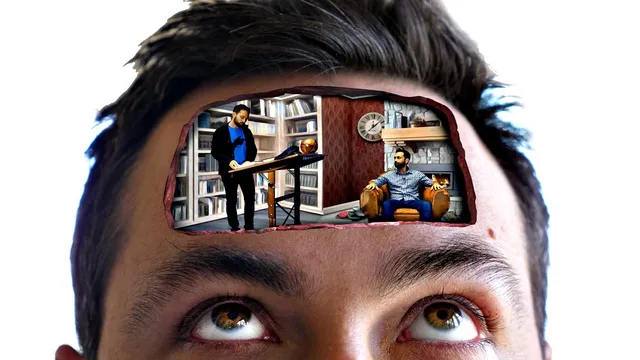
Gun performs fast, automatic processing using long-term memory, while Drew performs slow, effortful reasoning using limited working memory.
Briefing
Thinking often feels unpleasant because most of the brain’s work happens automatically—fast, effortless, and largely outside conscious awareness—while deliberate reasoning is slower, effortful, and limited. That mismatch helps explain why people confidently answer simple logic questions incorrectly, why everyday habits can become stubborn errors, and why learning methods that demand active effort tend to work better.
The core framework comes from a two-mode model of cognition: “Gun” handles rapid, automatic processing, while “Drew” performs conscious, step-by-step thought. Gun constantly filters incoming sensory information, fills in gaps, and relies on long-term memory—an accumulated library of past experiences—to generate quick interpretations. Drew, by contrast, lives in working memory and can hold only a few novel items at once (roughly four or five). When tasks are familiar, Gun takes over and Drew barely needs to engage. When tasks are unfamiliar, confusing, or require manipulation of information, Drew must work—and that’s when effort shows up.
This division clarifies the “bat and ball” puzzle. The bat and ball total $1.10, and the bat costs a dollar more than the ball. Many people jump to “ten cents” for the ball because Gun quickly spots the relevant pieces and produces a plausible snap answer. Drew then endorses it without checking, since Drew is lazy and avoids the mental labor of verifying consistency. The correct reasoning—if the ball were ten cents, the bat would be $1.10 and the total would be $1.20—requires Drew to slow down and test the logic. The point isn’t that people lack intelligence; it’s that they avoid the discomfort of thinking unless something forces them to.
Evidence for Drew’s strain appears in physiology. In an “Add One” and “Add Three” task, participants must read digits aloud and then, on a beat, add one or three to each digit while keeping the sequence in mind. During these demanding manipulations, pupils dilate and other stress markers rise (including increased heart rate and sweat). When participants chat instead of doing the task, pupil dilation largely disappears—suggesting the arithmetic manipulation specifically taxes Drew.
Learning and expertise follow the same logic. Skills become automatic when repeated practice builds larger “chunks” in long-term memory, allowing Gun to handle the routine. Early learning—like tying shoelaces—requires Drew to rehearse steps, but repetition transfers control to Gun, producing “muscle memory.” That automation can also create persistent mistakes: moving from Canada to Australia flips the meaning of “up” and “down” for light switches, leading to years of reversed behavior until Drew relearns the mapping. Similar issues arise when learning to ride a bicycle with reversed steering.
Finally, the framework explains why some educational and persuasive strategies work. Confusing or hard-to-read materials can reduce snap responding by making Gun’s quick pattern-matching harder, forcing Drew to reason. Advertising often aims for easy comprehension so Drew can stay idle, but modern campaigns sometimes use ambiguity to slip past automatic filtering. Lectures can also become easy to tune out when they overload working memory; workshops, peer instruction, and frequent questions push students to engage Drew more often. The takeaway is blunt: real learning requires choosing discomfort—working through confusion—because thinking is effortful by design.
Cornell Notes
Thinking relies on two interacting modes. Gun is fast and automatic, drawing on long-term memory to interpret the world with little conscious effort. Drew is slow and effortful, limited to a small amount of working memory, and becomes necessary when tasks require manipulation, checking, or reasoning. When Gun can generate a plausible answer quickly, Drew often endorses it without verification—leading to classic errors like the bat-and-ball puzzle. Learning improves when practice builds larger “chunks” so more work shifts from Drew to Gun, but that transfer only happens after Drew repeatedly engages with the material.
Why do people often answer the bat-and-ball puzzle incorrectly even when the correct logic is simple?
What limits Drew’s capacity, and how does chunking overcome that limit?
How do researchers measure when Drew is working hard?
Why do automatic habits persist even after learning new rules (like light switches in Australia)?
How can making text harder to read improve performance on reasoning questions?
Why do workshops and peer instruction often outperform lectures for learning?
Review Questions
- How do Gun and Drew differ in what they rely on (long-term memory vs working memory), and how does that difference affect error-checking?
- In what way does chunking change the number of items Drew can effectively manage, and what role does deliberate practice play in building chunks?
- Why might confusing or poorly formatted materials increase correct answers on logic problems? Describe the cognitive mechanism behind that effect.
Key Points
- 1
Gun performs fast, automatic processing using long-term memory, while Drew performs slow, effortful reasoning using limited working memory.
- 2
Drew’s working memory capacity is small (about four or five novel items), which makes unstructured or unfamiliar information hard to manipulate.
- 3
People often accept snap answers because Gun generates plausible responses and Drew endorses them without checking when the cost of verification feels too high.
- 4
Physiological markers like pupil dilation rise during tasks that require Drew to hold and transform information (e.g., adding one or three to digits on a beat).
- 5
Repeated practice builds larger “chunks” in long-term memory, shifting routine performance from Drew to Gun and enabling expertise.
- 6
Automatic habits can become persistent errors when new environments change mappings (such as light-switch directions after moving countries).
- 7
Learning methods that force active answering and reasoning (workshops, peer instruction) better engage Drew than passive listening, even though they feel more uncomfortable.