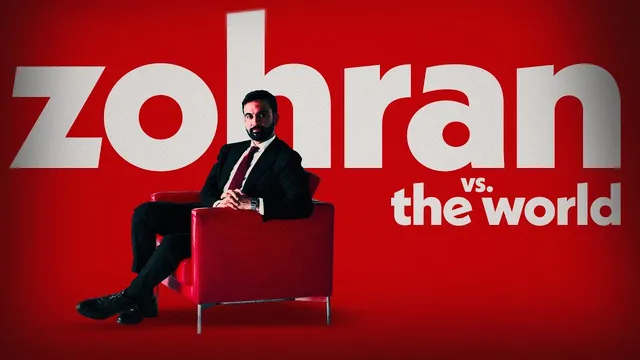
The Secret Plan To Tank Zohran
Based on Second Thought's video on YouTube. If you like this content, support the original creators by watching, liking and subscribing to their content.
The transcript frames Zoran Mdani’s socialist momentum as a threat to the political order, not just a single election outcome.
Briefing
A socialist candidate’s momentum in New York is triggering an all-out, money-heavy counteroffensive from the state’s political and financial establishment—an effort that mirrors the playbook used to stop India Walton in Buffalo, only on a larger scale. The central claim is that Zoran Mdani’s rise is being treated as a threat not just to a single election, but to the broader political order, because even a “whisper” of socialist success could signal a repeatable path to power for working-class voters.
The transcript first revisits Buffalo as a cautionary case study. After a DSA-backed socialist candidate won the Democratic primary, the city’s establishment allegedly mobilized quickly—uniting wealthy donors, real estate interests, and Republican money—to propel centrist Democrat Byron Brown to victory in the general election. The party’s support for Walton is portrayed as lukewarm and delayed, with endorsements and mobilization arriving late or not at all. Meanwhile, Brown’s campaign is described as overwhelming Walton with advertising and ground operations, while Walton faced intense media scrutiny focused on minor past legal and personal issues rather than policy. Despite Brown’s corruption allegations and worsening inequality indicators during his tenure, the establishment’s financial advantage is presented as the decisive factor.
That Buffalo pattern is then mapped onto Mdani’s campaign for New York City. The transcript argues that the wealthy can’t simply “out-message” a candidate like Mdani; they must “obliterate” him because the stakes are larger in the financial and cultural capital. Polling is cited as showing Mdani leading in hypothetical scenarios where other candidates drop out, and campaign performance metrics are used to reinforce the idea that working-class politics can win: tens of thousands of volunteers, millions of doors knocked, and a message centered on affordability—rent, groceries, child care—alongside immigrant and LGBT rights and a stance on Gaza.
But the transcript’s real emphasis is money. It claims that while Mdani has substantial fundraising, the anti-Mdani effort is fueled by super PACs—independent groups that can spend unlimited sums, including from dark-money nonprofits, without direct coordination with campaigns. The scale is illustrated with examples such as Cuomo’s super PAC spending tens of millions, and a broader ecosystem of multiple anti-Mdani super PACs targeting him from different angles. The argument is that the rich are scrambling to prevent a repeat of Walton’s upset, and that their spending could trigger even more extreme tactics if Mdani threatens to win.
Finally, the transcript warns that if the establishment loses electorally, it may escalate beyond campaign messaging. It points to immigration enforcement rhetoric—especially around ICE—along with signals that Donald Trump could intervene more aggressively if Mdani appears likely to prevail. The takeaway is urgent: winning a primary is treated as symbolic, not sufficient. The call is for early and decisive voting, framed as necessary to stop a potential “fascist takeover” and to push socialist policies from electoral possibility into governing reality.
Cornell Notes
Zoran Mdani’s rise in New York is portrayed as a working-class electoral breakthrough that alarms wealthy donors and party insiders. The transcript compares his situation to Buffalo, where a DSA-backed socialist lost the general after the establishment allegedly delayed support for the primary winner and flooded the race with money and targeted media attacks. In New York City, the counterpressure is described as coming less from traditional campaign donations and more from super PAC spending—potentially tens of millions—financed by large donors and dark-money nonprofits. The core worry is that if the rich can’t stop Mdani through spending, they may escalate politically, including through immigration enforcement threats. The message ends with a push for early voting, treating the primary win as only the first step.
Why is Buffalo used as a warning example for Mdani’s campaign?
What does the transcript claim is the key difference between Walton’s loss and Mdani’s challenge?
What evidence is offered that Mdani’s campaign has a genuine path to victory?
How does the transcript explain the role of money in the anti-Mdani effort?
What escalation risk does the transcript warn about if Mdani threatens to win?
Review Questions
- What specific mechanisms does the transcript claim helped Byron Brown win despite losing the primary, and how are those mechanisms mapped onto Mdani’s race?
- How do super PACs change the fundraising and spending landscape compared with direct campaign donations, according to the transcript?
- What does the transcript suggest could happen if the anti-Mdani strategy fails at the ballot box?
Key Points
- 1
The transcript frames Zoran Mdani’s socialist momentum as a threat to the political order, not just a single election outcome.
- 2
Buffalo is used as a model where delayed party support and establishment money allegedly overcame a socialist primary win.
- 3
Mdani’s campaign is portrayed as winning through working-class-focused messaging and large-scale volunteer organizing.
- 4
The anti-Mdani effort is described as relying heavily on super PAC spending, including funds from dark-money nonprofits (501c4s and 501c6s).
- 5
Examples of large super PAC expenditures—such as Cuomo’s—are used to illustrate how wealthy donors can scale spending dramatically.
- 6
The transcript warns that if electoral defeat looms, immigration enforcement threats and broader political escalation could follow.
- 7
The closing message urges early voting, treating a primary win as insufficient for achieving socialist policy change.